Category: B2B data

B2B data providers — contact and company databases, intent, technographics and enrichment.

  • B2B Data Enrichment Guide 2026

    B2B Data Enrichment Guide 2026

    Your list knows a name and a company. Enrichment fills in everything else.

    This B2B data enrichment guide explains what enrichment adds to the records you already have, which data types matter most for cold email, how waterfall enrichment finds the contacts a single source misses, what accuracy claims really mean, and what seven leading providers charge, checked on 16 November 2026.

    Visit Apollo →Explore Saleshandy →See Lemlist →

    Prices checked 16 November 2026 on the official sites of all seven providers. Features and pricing can change, so please check the provider’s site before you buy. We do not guess at features, prices or trials.

    Quick Answer

    It is the process of adding missing fields to the contact and company records you already have, such as a verified work email, a direct dial, a job title, company size, tech stack and buying-intent signals, so every record is complete enough to target, personalise and send to. A single data source typically finds 40 to 70% of the emails you ask for, while a waterfall that queries several providers in sequence lifts coverage to 75 to 95%.

    Apollo is the best all-round starting point, with a free plan and 240M+ contacts from $49 a month. Saleshandy is the best value waterfall, with 1 credit per verified email and $0 for unverified results. In short, enrich every list before you verify it, pay only for results you can use, and refresh the data every quarter.

    Why this B2B data enrichment guide starts with the record, not the email

    Firstly, most cold email advice starts with writing, and that order is backwards. A brilliant email means nothing when it goes to the wrong person, at a company that would never buy, with a first line that guesses at a job title the person left two years ago. Enrichment is the step that stops all three mistakes before the email is written. This B2B data enrichment guide therefore starts with the record itself, the humble row in a spreadsheet, and shows how a good record turns into a reply.

    Secondly, the good news is that enrichment is cheap, fast and largely automatic. A list of one thousand contacts can be enriched for the price of a single month on an entry plan, often under $50. The work takes minutes rather than the days of manual research it replaces. Compared with the cost of mailing the wrong people, burning a domain on bounces, or paying a sales rep to research every prospect by hand, enrichment is the cheapest leverage in cold email. Every provider in this B2B data enrichment guide exists to make that leverage easy to buy.

    Finally, every price and feature in this B2B data enrichment guide was checked on the official sites on 16 November 2026. Where a vendor publishes no price, or where a figure comes from a reported third-party breakdown, the guide says so in plain language. Jump to the pricing section when the budget is the constraint, and start at the top when the goal is understanding how enrichment actually works.

    What B2B data enrichment is, and why it matters for cold email

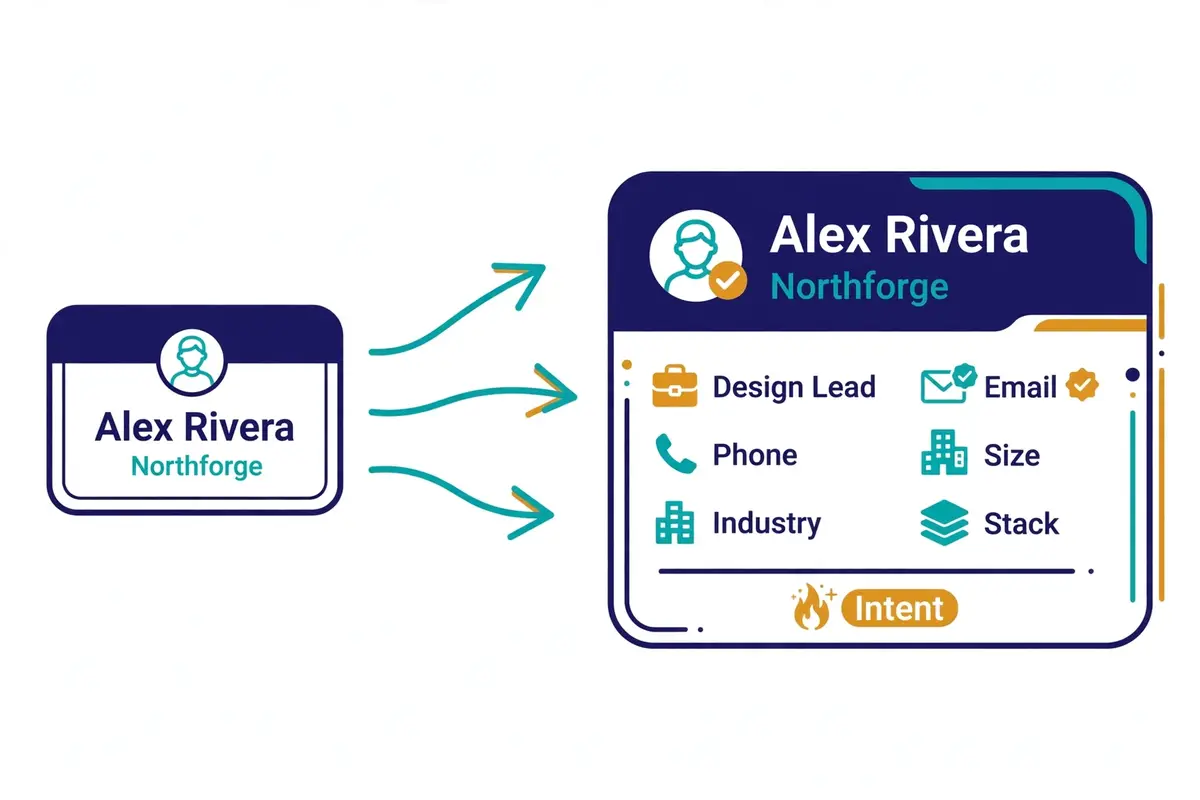
    In fact, B2B data enrichment is the process of taking a contact or company record you already own and adding the fields that are missing. A list usually starts thin: a name, a company, perhaps a LinkedIn URL. Enrichment fills in the rest. It adds a verified work email, a direct dial or mobile number, a job title and seniority, the company size and industry, the technologies the company uses, and signals that the company is ready to buy. The record that comes back is the same person, described properly.

    Moreover, enrichment matters for cold email because every part of a campaign depends on the record behind it. Targeting depends on firmographics: the sender needs to know the company is the right size, in the right industry, in the right place. Personalisation depends on contact and technographic data: the sender needs a real job title, a real tech stack, a real recent event to mention. Deliverability depends on verification: the sender needs an email that exists, not a guess. Enrichment feeds all three, which is why it sits at the start of the workflow rather than the end.

    B2B data enrichment guide: enrichment is not the same as finding

    Firstly, two words get mixed up, and the mix-up causes real confusion. Finding is the job of discovering new contacts, usually by searching a database for people who match a description. Enrichment is the job of completing records you already have, usually by matching a name and company against several databases and adding whatever they know. A tool can do one, the other, or both, and most of the providers in this B2B data enrichment guide do both. The distinction matters when a tool claims a huge database yet only enriches the contacts you bring it. A database of 850 million contacts is a finding asset. A waterfall that completes your own list is an enrichment asset. Buy the one you need.

    Secondly, enrichment is also different from verification, which is a narrower job. Verification checks whether an email address is real and able to receive mail. Enrichment adds the address in the first place, along with everything else about the person and the company. A record should be enriched first and verified second, because verifying a thin record wastes credits on addresses that were never the right person. Our Email Verification Guide 2026 covers the verification step in full, and our Email Finders Guide covers the finding step.

    B2B data enrichment guide: the three things enrichment changes

    For example, enrichment changes three things about a campaign, and all three show up in the numbers. Replies rise, because the email reaches the right person with a first line that is actually about them. Bounces fall, because the email address came from a verified source rather than a pattern guess. Time collapses, because a rep who used to spend twenty minutes researching each prospect now spends two. A team that enriches properly mails fewer people, writes better emails, and hears back more often, which is the opposite of the spray-and-pray approach that gives cold email a bad name.

    In sum, enrichment is not a nice extra, and it is not a task for later. Do it first with any new list, and do it again whenever a list gets old. B2B data decays by roughly a fifth each year, as people change jobs, companies close, and inboxes get abandoned. A list enriched in January is a different list by June. The rest of this B2B data enrichment guide shows which data types matter, how waterfall enrichment works, and which provider to buy.

    Data types explained: firmographic, technographic, contact, intent and job-change signals

    B2B data enrichment guide: four stacked layers forming one complete contact record, a company building, a laptop, a person with an envelope, and a flame with a bell
    The four layers of enrichment in this B2B data enrichment guide: firmographic data about the company, technographic data about its tools, contact data about the person, and intent and job-change signals about timing.

    Secondly, enrichment adds five kinds of data, and each kind answers a different question. Firmographic data describes the company: its size, industry, location, revenue and growth. Technographic data describes the tools the company uses: its CRM, its email provider, its marketing stack. Contact data describes the person: their name, title, seniority, email and phone. Intent data describes timing: signals that the company is researching a purchase right now. Job-change signals describe movement: people who just started a new role, and the roles they left behind. A complete record has all five, and the table below shows what each one adds.

    The five data types at a glance

    Data typeWhat it addsExample fieldsWhat it changes for cold email
    FirmographicCompany factsSize, industry, location, revenue, headcount growthTargeting: only the right companies enter the list
    TechnographicTools the company usesCRM, email provider, marketing stack, hiring toolsPersonalisation: the email can name the stack they run
    ContactPerson detailsVerified email, direct dial, title, seniority, LinkedInDelivery: the email reaches a real person who can reply
    IntentBuying signalsTopic surges, funding news, hiring spikes, tech changesTiming: mail the companies researching a purchase now
    Job-changePeople on the moveNew role, start date, previous company, vacated roleWarmth: a new hire is the easiest door to open

    Last checked: 16 November 2026. Features and pricing can change, so please check the provider’s site before you buy. We do not guess at features, prices or trials.

    Firmographic data: who the company is

    Moreover, firmographic data is the foundation, because it decides whether a company belongs on the list at all. Selling to companies with 50 to 500 staff calls for a headcount filter. Manufacturers call for an industry filter. European sales call for a location filter. Apollo covers 30M+ company accounts, ZoomInfo covers 100M+ companies, and Saleshandy covers 42M+ company profiles, so the coverage is there. The practical rule is simple: filter on firmographics first, and only enrich the companies that survive the filter, because enriching companies you would never mail wastes credits.

    For example, a firmographic filter can cut a list of ten thousand companies to two thousand in seconds. The two thousand that remain are the ones worth enriching. A sender who enriches first and filters second pays to enrich eight thousand records that were never going to be mailed. Order matters, and the order is filter, then enrich, then verify.

    Technographic data: what the company runs

    Finally, technographic data is the personalisation goldmine, because it tells the sender what the company already uses. HubSpot users will care about a HubSpot integration. Salesforce shops will care about a Salesforce sync. Companies that just adopted a rival’s tool have a budget and a live problem. Apollo, ZoomInfo and Cognism all sell technographic filters, and Lemlist surfaces the stack inside its enrichment. The first line of an email that names the prospect’s actual tool is a first line that could only have been written for them.

    In sum, technographics also sharpen targeting in a way firmographics cannot. Two companies can be the same size, in the same industry, in the same city, yet one runs a modern cloud stack and the other runs software from 2009. The first is a buyer for a modern tool. The second is a project. Technographic data is what tells them apart. It is the field most beginners skip, which is exactly why it works so well when it is used.

    B2B data enrichment guide: contact data, the field that gets mailed

    Secondly, contact data is the field that actually gets mailed, so it deserves the most scrutiny. A verified work email is worth more than a guessed one, a direct dial is worth more than a switchboard number. A correct job title is worth more than a seniority guess. Apollo charges 1 credit for an email and 8 for a phone number. Saleshandy charges 1 credit for a verified email and 6 for a phone, and charges nothing when the email cannot be verified. La Growth Machine charges 5 credits for an email and 20 for a phone. The credit cost is the price of the field, and the guide compares it properly in the pricing section.

    Moreover, contact data decays fastest of all, because people change jobs. Roughly a fifth of the contacts on a list go stale every year. A phone number goes stale faster than an email. That is why the refresh step matters, and why a provider that re-verifies on a schedule, such as Cognism with its 30-day decision-maker refresh, is worth more than a provider that enriches once and forgets.

    Intent data: the timing signal

    For example, intent data answers the question every sender asks: why now? A company researching a topic, hiring for a role, raising funding, or switching tools is a company with a live need. An email that arrives in that week lands differently from an email that arrives in a random one. ZoomInfo tracks 4,500+ intent topics, Cognism bundles Bombora Surge intent with 12 topics from a pool of 11,000+ on its Pro plan. Lemlist sells buying intent signals as a $29 a month add-on, or $21 on annual billing. Intent is the most expensive data type, and the most powerful, which is why it is usually plan-gated rather than included everywhere.

    Finally, intent data works best as a priority signal, not a filter. A sender who mails only the companies showing intent will run out of list quickly, because most companies are not showing intent on any given week. A sender who mails the whole list, and mails the intent companies first, with the sharpest first lines, gets the best of both worlds: volume and timing. Treat intent as a sorting key, and it pays for itself.

    Job-change signals: the warmest door in B2B

    In fact, job-change signals are the warmest door in B2B outreach, and the cheapest to act on. A person who started a new role in the last ninety days is settling in, choosing tools, and open to conversations that would have bounced off their predecessor. A role that was just vacated is a gap someone needs to fill. Apollo, ZoomInfo and Amplemarket all track job changes, and Amplemarket lets a Startup plan follow 500 contacts for job-change alerts. A campaign built around new hires will reply at a higher rate than any other segment on the list, and it costs nothing extra to run.

    In sum, the five data types stack. Firmographics choose the companies, technographics choose the angle, contact data chooses the person, intent chooses the week, and job changes choose the warmest names. A record with all five is a record that writes its own first line. The next section explains how waterfall enrichment assembles that record when no single source has all of it.

    Waterfall enrichment: why several sources beat one
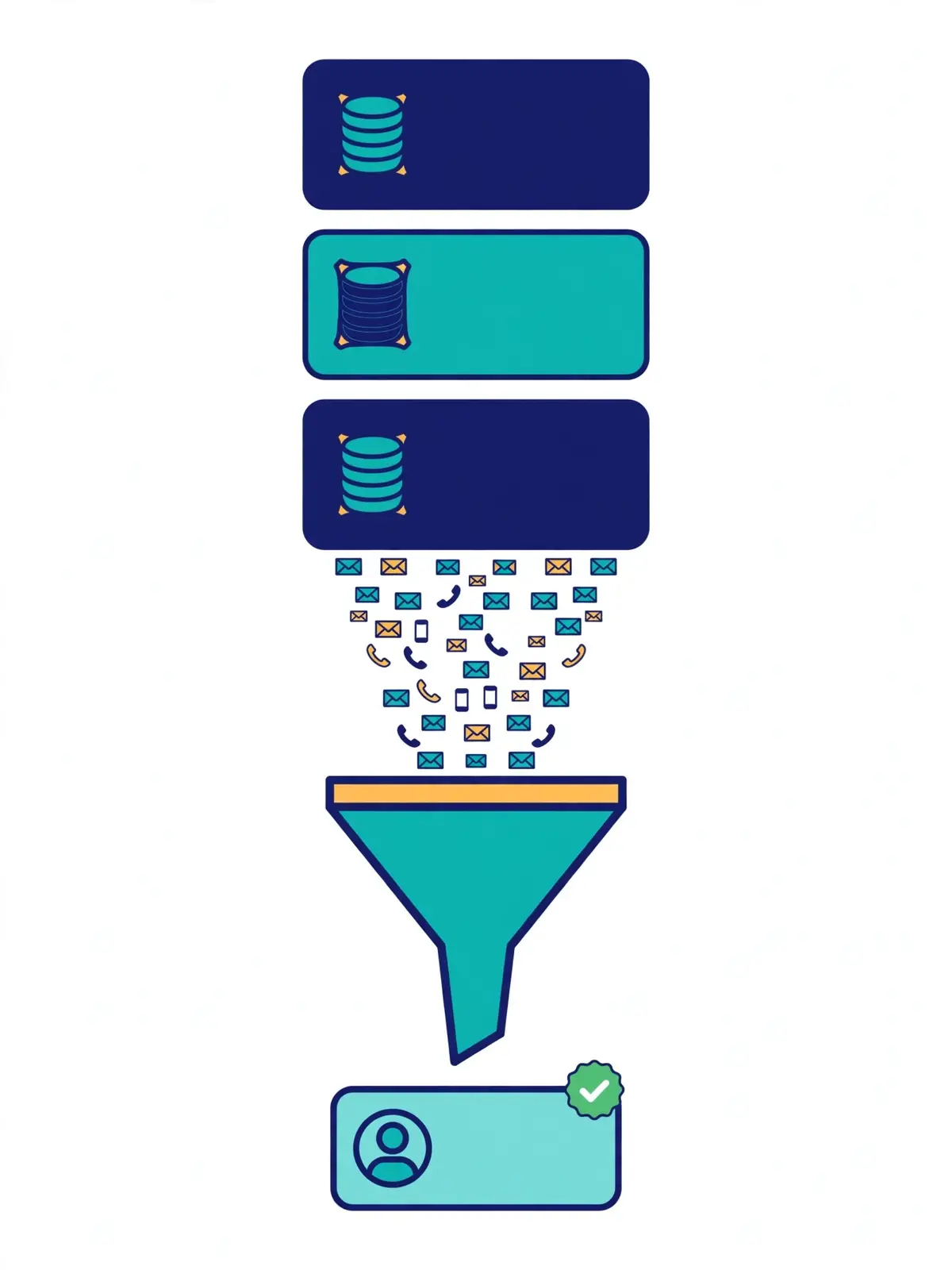
    B2B data enrichment guide: three data provider boxes pouring envelopes and phone icons down through a funnel into one verified contact card with a green checkmark
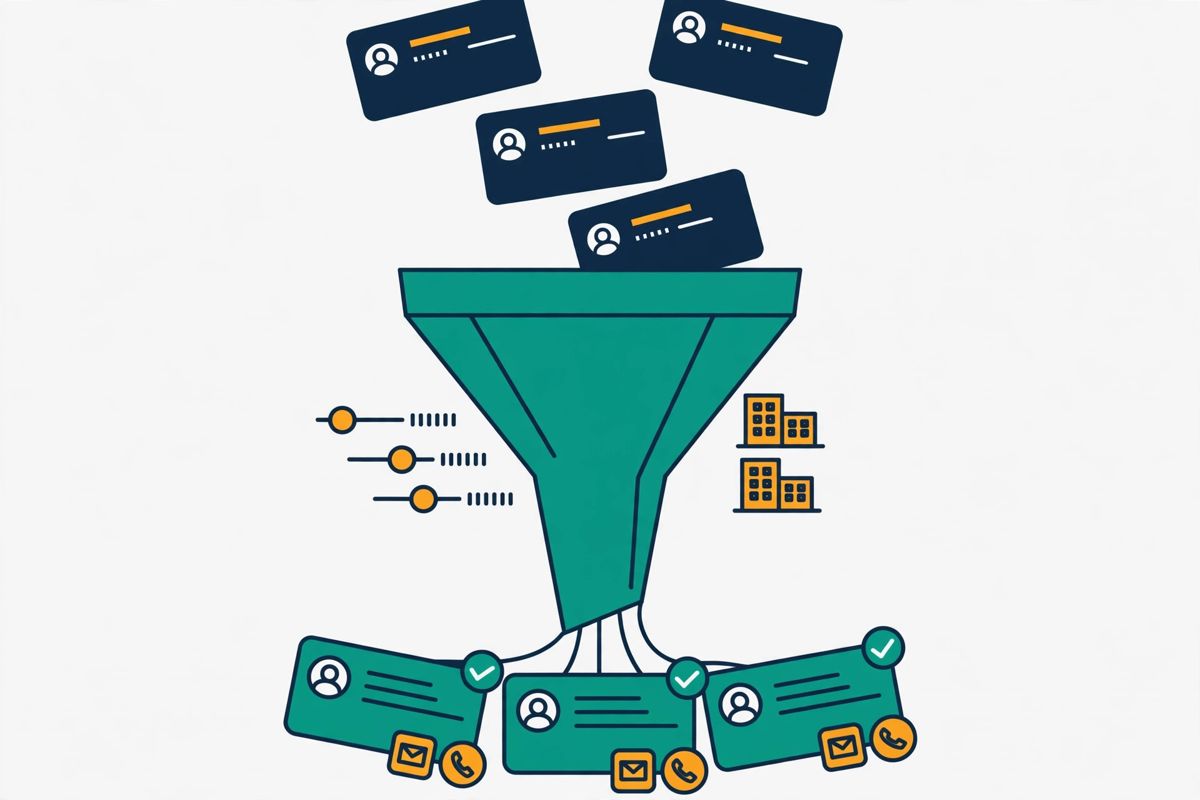
    Waterfall enrichment in this B2B data enrichment guide: three providers queried in sequence, their results funnelled into one verified contact card, with the cascade stopping as soon as a provider finds a match.

    Secondly, waterfall enrichment is a simple idea with a big payoff. Instead of asking one data provider for a missing field, the tool asks several providers in sequence, one after another, until one of them returns a verified result. The first provider is asked first. If it finds the email, the cascade stops. If it finds nothing, the record falls to the second provider, then the third, and so on until every provider has been tried. A single provider typically finds 40 to 70% of the emails it is asked for. A waterfall lifts that to 75 to 95%, according to the industry guides that track these figures. The gap between those two ranges is the reason waterfall enrichment exists.

    In fact, the waterfall matters because no single database covers everyone. Apollo holds 240M+ contacts, ZoomInfo holds 500M+. Saleshandy searches 852M+, yet each of them is thin somewhere: one is strong in the United States, another in Europe, a third in small companies. A provider that is strong in one place is weak in another. The weakness only shows when the list reaches that place. A waterfall covers the gaps by asking the next provider, and the next, until the record is filled.

    How a waterfall runs, step by step

    Firstly, a waterfall run starts with the records you already have, usually a name and a company, or a LinkedIn URL, or a domain. The tool normalises the inputs first, because a waterfall is only as good as its inputs: a misspelled company name will fail at every provider, not just the first. Then it queries the providers in a fixed order, usually the cheapest or most accurate first. It stops the moment one returns a verified result. The result is written back with its source, so the sender knows which provider found it, and the record moves on to verification.

    Secondly, the order of the providers matters more than the number of them. A waterfall that asks a weak provider first will return weak results early and stop, because the cascade stops at the first result, not the best result. A waterfall that asks the strongest provider first will return the best result it can, and only fall through to the weaker ones when the strong one has nothing. The best tools let the sender set the order, or set it intelligently themselves. Saleshandy, for instance, runs an 8-provider waterfall that includes verification inside the same credit, so the result that comes back is already verified. Lemlist runs a 14+ provider waterfall, and La Growth Machine runs one across 9 providers.

    B2B data enrichment guide: how credit costs stack in a waterfall

    Moreover, the credit cost of a waterfall depends on how the tool charges, and the models differ sharply. Some tools charge one credit per result, however many providers were queried, which is the fairest model. Saleshandy charges exactly that: one credit covers the whole job, all 8 providers checked, the email verified, and nothing charged when the result is unverified. Other tools charge per provider queried, so a record that falls through four providers costs four credits, which punishes the sender for the tool’s own gaps. A third model charges per field, so an email costs one credit and a phone costs more, whatever the waterfall did. Apollo charges 1 credit for an email and 8 for a phone. La Growth Machine charges 5 credits for an email and 20 for a phone, with top-ups at €0.01 a credit.

    For example, a list of one thousand contacts enriched through a fair one-credit-per-result waterfall costs one thousand credits. The sender knows the price before starting. The same list through a per-provider waterfall can cost two or three thousand credits, and the sender only finds out afterwards. Before buying, ask one question: do I pay per result, or per provider queried? The answer decides whether the waterfall is a bargain or a trap.

    When a waterfall does not help

    Finally, a waterfall has one honest limit, and it is worth stating plainly. It cannot find what no provider holds. Very small businesses, tradespeople, and companies without a polished LinkedIn presence or a corporate email domain are thin in every database. A waterfall will shrug and walk away just as a single provider would. The Scrap.io guide that accompanies the video below makes this point well: over 80% of the businesses on Google Maps fall into that bucket. A waterfall is a multiplier on good coverage, not a cure for no coverage. A sender whose list is mostly local businesses should enrich from a different source, such as a maps-based scraper, rather than a corporate waterfall.

    Video: How to Automate Data Enrichment? by Scrap-io on YouTube. This video is the creator’s property, embedded via YouTube for education. OutreachCompare is not affiliated with Scrap-io and does not claim ownership of this video.

    In sum, the video above walks through two ways to automate enrichment, a pure enrichment tool and a scraper that enriches at the same time. It shows the waterfall idea in action on a real file. The lesson to take from it is the same as the lesson of this section: ask several sources, stop at the first verified result, pay per result rather than per provider, and know when the list needs a different kind of source entirely.

    How to read accuracy claims: vendor numbers against independent benchmarks

    Secondly, every enrichment vendor claims high accuracy, and the claims are hard to compare, because each vendor measures accuracy differently. ZoomInfo claims 96% email deliverability and 87% mobile accuracy. Amplemarket claims a bounce rate below 3% and 96.5% phone accuracy, figures that come from its own vendor blog and are flagged as untested here. Cognism talks about Diamond Data and phone-verified contacts rather than a single percentage. Saleshandy publishes customer quotes, including a claim of 23% higher email accuracy than Apollo, which is a vendor claim from a customer testimonial, not a measurement. These are vendor claims, measured by the vendors themselves, and no neutral audit exists that tests them all the same way. Saying so matters, because it changes how much weight any claim deserves.

    The independent benchmarks that exist paint a more complicated picture, and they do not agree with each other. An Anymail Finder benchmark measured how many found addresses were actually verified, and found Hunter at 37.6% and Snov.io at 20.1%. A Tomba benchmark from February 2026 found Skrapp at 42.8% verified, against its own claim of 92% search success. Both benchmarks are genuine third-party work, and neither one is a neutral audit. The difference is what counts as a success: a finder that returns an address pattern for 92% of the names it tries has a 92% search rate, yet only 42.8% of those addresses may pass verification. Both figures can be true at once. The gap between them is the addresses that look right yet do not exist.

    B2B data enrichment guide: what a database size really means

    Firstly, database size is the most quoted number in enrichment, and the most misunderstood. Apollo claims 240M+ contacts, ZoomInfo claims 500M+, Lemlist claims 650M+, and Saleshandy claims 852M+. A bigger database is not automatically a better one, because the number counts records, not live people. A database with 852 million records and a fifth of them stale is a database with 680 million live records, while a database with 240 million records refreshed monthly can be more useful. The number to ask for is not the size, but the refresh cadence: how often the records are re-checked, and how the vendor knows when a person changes jobs. Cognism refreshes decision-maker data every 30 days, which is a concrete promise. A vendor that publishes no refresh cadence is asking to be trusted on faith.

    Secondly, database size also hides a geography question. Cognism holds 200M+ European contacts and 70M+ US mobiles, which tells a sender exactly where it is strong. A vendor that claims a single global total tells the sender nothing about the region that matters. A sender mailing German companies should ask about European coverage, not global totals. A sender mailing American companies should ask about US mobiles. The headline number is marketing. The regional number is the buying decision.

    The accuracy checklist before you buy

    Moreover, four questions separate a good enrichment provider from a good sales page. Does it charge only for results, or for every provider queried? Will it verify the email it returns, or hand back an unverified guess? Are its records refreshed on a published schedule, or left to decay? Does it screen against do-not-call lists and honour opt-outs, as Cognism does with its DNC screening across 15 to 16 countries? A provider that answers all four well is worth its price. A provider that dodges them is not, whatever the headline claims.

    The practical accuracy test is simple: run a list you already know through the provider. Take one hundred contacts you know well, with emails and phones you have confirmed yourself, and run them through the provider. Count how many come back right, how many come back wrong, and how many come back empty. A provider that returns wrong data is dangerous, because a wrong email bounces and a wrong phone wastes a call. A provider that returns nothing is honest yet unhelpful. Many empty results are fine when the provider charges nothing for them, as Saleshandy does, and expensive when it charges anyway. That test costs a few dollars in credits, and it reveals more than any vendor claim ever will.

    Compliance: enrichment must respect the law

    Finally, enrichment must respect data law, and the sender carries the responsibility. Enrichment uses personal data, so the provider must source it lawfully. The sender must have a lawful basis to mail the people it enriches. In Europe, that means GDPR: use providers that publish how they source and process data, honour opt-outs and do-not-call lists, and keep records current. Cognism’s DNC screening and its Diamond Data verification exist for exactly this reason. A provider that cannot explain where its data comes from is a provider to avoid, whatever its price, because the fine for mailing unlawfully sourced data dwarfs any saving on credits.

    The full enrichment workflow, step by step
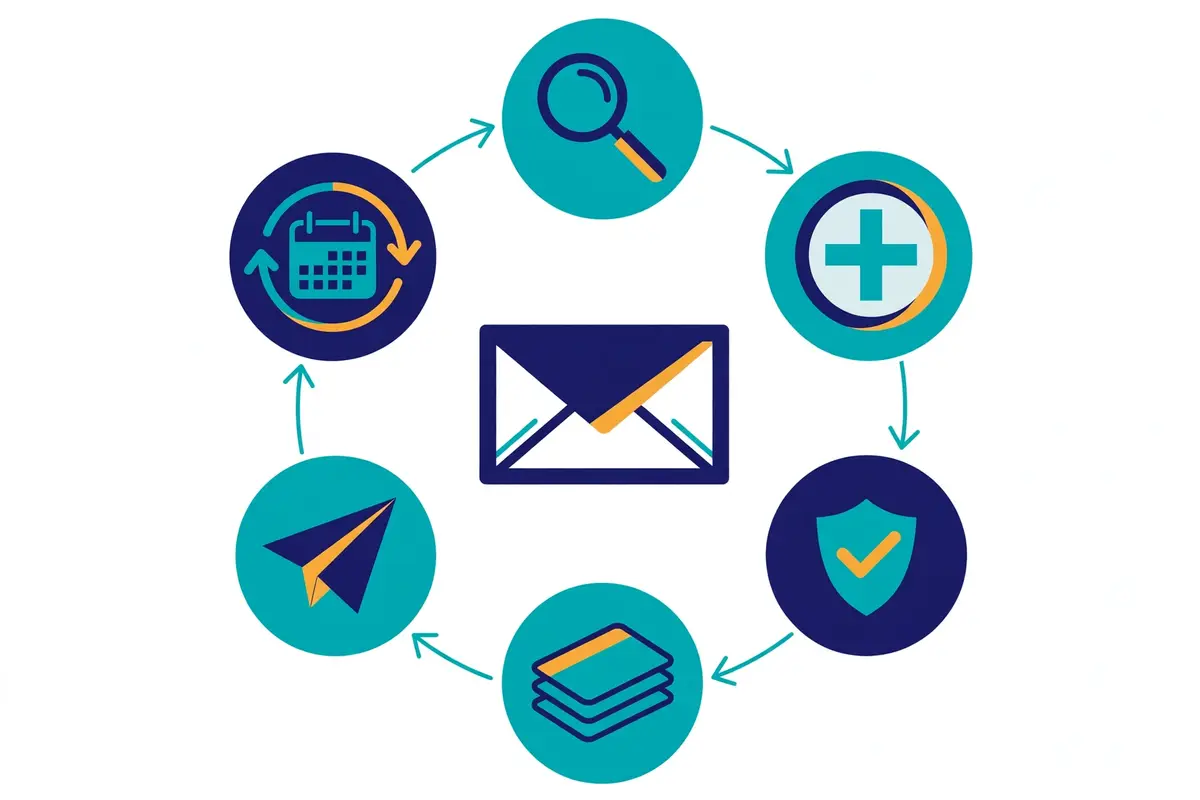
    B2B data enrichment guide: a circular six-step workflow loop around a central envelope, with a magnifying glass, a plus sign, a shield, stacked cards, a paper plane and a calendar refresh step
    The enrichment workflow in this B2B data enrichment guide: find, enrich, verify, segment, send, and refresh on a calendar, in a loop that repeats every quarter.

    Secondly, enrichment works best as a workflow, not a one-off chore. The workflow has six steps, and each step takes minutes. A sender who follows it will keep bounce rates below 2% without thinking about it, and will mail people who actually match the offer. Skip a step, and the sender is left guessing why the replies dried up. The six steps are: find, enrich, verify, segment, send, and refresh. The rest of this section walks through each one.

    In fact, the workflow matters more than the provider. The best enrichment tool in the world cannot save a list that was never filtered. The cheapest tool in the world is enough for a sender who follows the steps. Buy the provider that fits the budget, then follow the workflow every time, and the results will take care of themselves.

    B2B data enrichment guide: step 1, find the companies

    Firstly, find the companies from a source that describes them properly. A database such as Apollo, ZoomInfo or Saleshandy lets the sender filter by size, industry, location, tech stack and hiring signals, and the filter is the whole point. A sender who filters well starts with two thousand companies that match, rather than ten thousand that mostly do not. Our Lead Generation and List Building Guide 2026 and our guide to building a cold email list cover the finding step in full.

    Secondly, keep the source with the record. A column that records where each contact came from, and when, turns a list into a traceable asset. When a campaign bounces, the sender can see which source produced the bad records and stop using it. When a source produces 90% verified emails month after month, the sender can trust it more. A list without sources is a list without a memory.

    Step 2, enrich every record before anything else

    Moreover, enrich every record before verifying, segmenting or sending. Upload the list, or connect the CRM, and let the waterfall fill in the missing fields: verified email, phone, title, seniority, company size, industry, tech stack and intent signals. Do not enrich a sample and mail the rest, because the sample is not the list. The untested half is where the wrong people live. Do not enrich after the first campaign, because the first campaign is where the damage happens.

    For example, a sender with a list of one thousand contacts should expect enrichment to cost between $34 and $71 for a month on an entry plan, depending on the provider, and to take minutes. The cost table later in this B2B data enrichment guide shows the exact figures for each provider at each volume. The time saved is the real return: a rep who used to research twenty minutes per prospect now spends two. The list is ready the same day.

    B2B data enrichment guide: step 3, verify what enrichment found

    Finally, verify every email that enrichment returns, before the first send. Enrichment finds addresses. Verification confirms they can receive mail. The two steps are different jobs, and skipping the second is how a list enriched at 90% coverage still bounces at 8%. Upload the enriched list to a verifier, delete the Invalid addresses, and keep the Valid ones. Our Email Verification Guide 2026 explains the checks and the results in full, and our Best Email Verification Tools Compared article compares the verifiers.
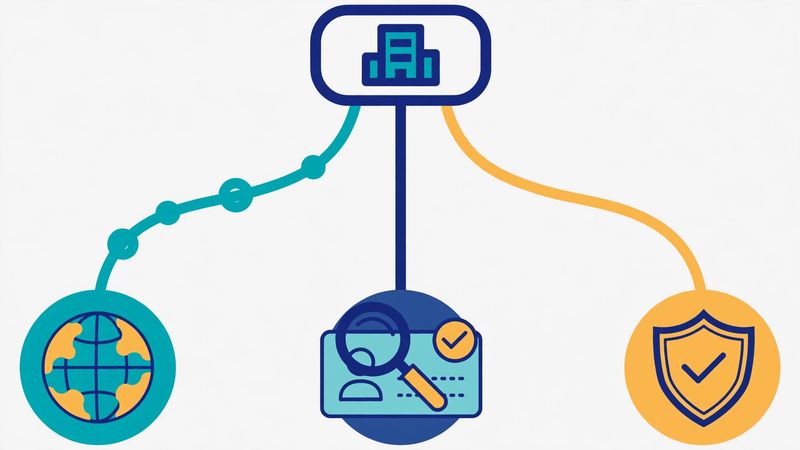
    In sum, verification also catches the enrichment mistakes. A waterfall that returns a guessed email will pass the enrichment step and fail the verification step, which is exactly what verification is for. A sender who verifies after enriching pays a few dollars to catch the guesses, and saves a domain from the bounces they would have caused.

    Step 4, segment on the enriched fields

    Secondly, segment the enriched list before sending, using the fields enrichment just added. Companies showing intent go first, with the sharpest first lines. New hires go next, with a congratulations opener. Companies on a named tech stack go into their own segment, with an email that names the stack. Small companies go into a segment with a different offer from the enterprise one. Segmentation is what turns five data types into five sensible campaigns, instead of one blunt one.
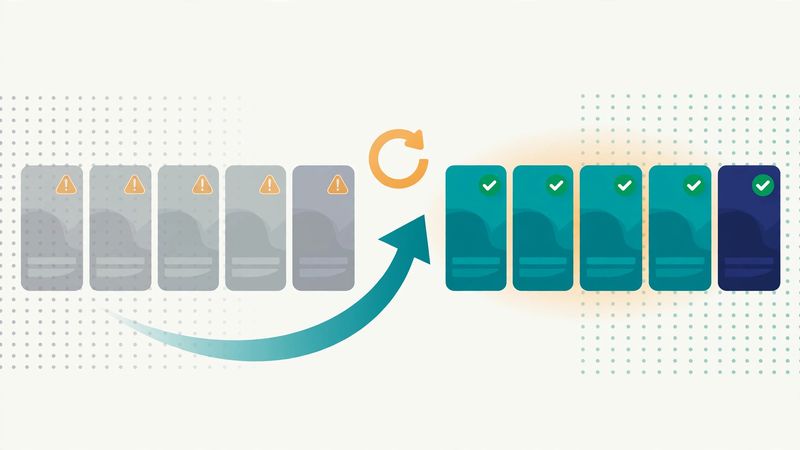
    Segmentation doubles as protection: when one segment goes wrong, the rest of the campaign keeps running. If the intent segment bounces above 2%, the sender pauses that segment only, while the main campaign keeps running. Mailed as one campaign, the same bounces would have hurt the whole domain at once. Think of segments as bulkheads: a leak in one compartment does not sink the ship.

    B2B data enrichment guide: step 5, send slowly and watch the numbers

    For example, send the enriched, verified list slowly, at thirty to fifty emails a day per mailbox, and watch the bounce rate after the first hundred sends. An enriched and verified list should bounce under 2%, and under 1% is better. A bounce rate above 2% on a verified list means something went wrong: the list was enriched too long ago, the waterfall returned guesses, or the sending domain has a problem of its own. Pause, investigate, and do not push through. The Deliverability Guide 2026 covers the whole system those numbers belong to.

    Finally, watch the reply rate beside the bounce rate. Replies are the number enrichment is really judged on, because a list that bounces little yet replies never was enriched for the wrong people. A reply rate above 5% on a cold campaign is strong. A reply rate below 1% means the targeting was wrong, whatever the bounce rate says. Enrichment fixes targeting, and the reply rate is where that fix shows.

    Step 6, refresh on a calendar

    In fact, refresh every enriched list every three months, and enrich again 24 to 48 hours before any big campaign. B2B data decays by roughly a fifth each year, as people change jobs and companies close, so a list enriched in January is a different list by June. A refresh costs the same per record as the first enrichment. It is cheaper than the bounces and wrong-person emails it prevents. Put the refresh on the calendar, next to the campaign dates, so it happens before the send rather than after the damage.
    Video: B2B Data Enrichment with Snov.io: A Step-by-Step Guide by Snovio on YouTube. This video is the creator’s property, embedded via YouTube for education. OutreachCompare is not affiliated with Snovio and does not claim ownership of this video.

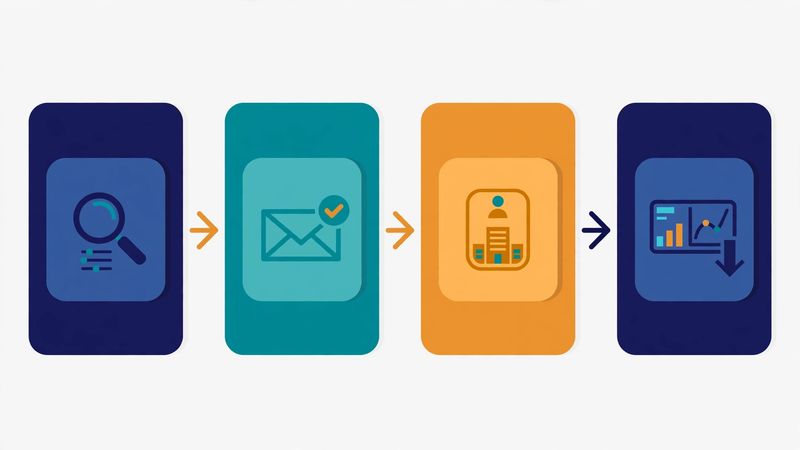
    In sum, the video above walks through the same workflow this section describes, from building a prospect list to enriching it with AI and turning the results into personalised cold email openers. The workflow is a loop, not a line. Find, enrich, verify, segment, send, and refresh, then find more companies and start again. Every pass round the loop leaves the list cleaner and the sender safer.

    Pricing compared: seven providers, honest numbers

    Secondly, pricing is where the seven providers differ most, and the difference is larger than most senders expect. Apollo starts free and reaches $119 a seat a month. Saleshandy starts at $34 a month. Lemlist starts at $69 a month with enrichment as a $20 add-on. La Growth Machine starts at €60 a month per identity. Amplemarket starts at $600 a month. ZoomInfo and Cognism publish no prices at all. Below, the figures appear exactly as the official sites show them, checked on 16 November 2026, catches flagged beside each one.

    In fact, every provider in this B2B data enrichment guide charges in a different currency of its own. Apollo and Saleshandy charge in credits per seat or per account. Lemlist charges per user plus a monthly enrichment add-on. La Growth Machine charges per identity plus credits per field. ZoomInfo and Cognism charge per licence plus credits per profile. Amplemarket charges a flat monthly fee with an annual contact allowance. The differences are the minimum purchase, the credit cost per field, and what happens to credits that go unused. Read the footnotes, not just the headline.

    B2B data enrichment guide: the self-serve providers, priced

    ProviderFree planEntry planTop plan shownEnrichment cost
    Apollo$0, 75 credits a monthBasic $49/mo; $65 monthly
    2,500 credits a month
    Organization $119/mo annual-only
    6,000 credits a month, min 3 seats
    1 credit per email
    8 credits per phone
    Lemlist14-day trial
    200 free credits
    Email $69/mo; $55 annual
    Enrichment add-on $20; $16 annual
    Multichannel $109/mo; $87 annual
    Intent add-on $29; $21 annual
    Add-on $16/mo annual
    14+ provider waterfall
    SaleshandyNo free plan shownStarter $34/mo; $41 monthly
    1,500 credits a month
    Scale $149/mo; $189 monthly
    8,000 credits a month
    1 credit per verified email
    6 per phone; $0 if unverified
    La Growth Machine14-day trial
    No card required
    Basic €60/mo; €50 annual
    1,250 credits per identity a month
    Ultimate €180/mo; €150 annual
    5,000 credits per identity a month
    5 credits per email
    20 per phone; top-up €0.01

    Apollo Professional is $79 a month, or $99 on monthly billing, for 4,000 credits a month. Saleshandy Pro is $76 a month, or $99 monthly, for 4,000 credits a month. La Growth Machine Pro is €120 a month, or €100 annual, for 2,000 credits per identity a month. Last checked: 16 November 2026. Features and pricing can change, so please check the provider’s site before you buy. We do not guess at features, prices or trials.

    What the self-serve prices really buy

    Moreover, the four self-serve providers sell different things beside enrichment, and the bundle matters. Apollo sells a whole sales platform: sequences, a dialer, LinkedIn tasks and a CRM sync share the same credits as enrichment, so the $49 a month buys far more than data. Lemlist sells outreach first and enrichment second: the $55 a month Email plan buys sending, warmup and a 650M+ database. The enrichment add-on is $16 on top. Saleshandy sells the same shape at a lower price: $34 a month buys sending, warmup and an 852M+ database with the waterfall included, not added on. La Growth Machine sells multichannel outreach per identity: €50 a month buys LinkedIn and email sending with enrichment credits bundled in.

    For example, the free starting point also differs in a way that matters to a beginner. Apollo gives a real free plan, 75 credits a month forever, which is enough to enrich a small list every month. Lemlist and La Growth Machine give 14-day trials, which are enough to test the tool once, and then the card is charged. Saleshandy shows no free plan on its pricing page. A beginner who wants to try before buying should start with Apollo’s free plan, then test the two trials, then compare the paid plans on the credit maths in the next section.

    B2B data enrichment guide: the quote-only providers, priced by report

    ProviderPublished priceFree planDatabaseHow enrichment is charged
    ZoomInfoQuote only
    No prices on the pricing page
    Lite, 10 credits a month
    25 with Community Edition
    500M+ contacts
    100M+ companies
    1 credit per exported profile
    Licences plus credits
    CognismQuote only
    Reported Standard ~$22,500 a year*
    None shown200M+ European contacts
    70M+ US mobiles
    1 credit per reveal
    Reuse free until job change
    AmplemarketStartup $600/mo annual term
    Growth and Elite custom
    Free trial on all plans200M+ verified contacts†13,500 email credits a year
    Per user, Startup plan

    * Cognism figures are reported, not published: Standard around $22,500 a year for 5 seats and Pro around $37,500 a year, with a Vendr median of $32,750 across 94 contracts, reported 22 October 2026. † Amplemarket’s 200M+ database figure comes from its vendor blog, not the pricing page, and is flagged as untested. ZoomInfo’s pricing page publishes no prices. Last checked: 16 November 2026. Features and pricing can change, so please check the provider’s site before you buy. We do not guess at features, prices or trials.

    Reading the quote-only prices: ask for the credit maths

    Secondly, the quote-only providers are the hardest to compare, because the price depends on the deal. ZoomInfo prices by licences plus credits, with one credit per exported profile, and its free Lite plan gives 10 credits a month, or 25 with Community Edition, which is enough to test the data before talking to sales. Cognism prices by seats, with one credit per reveal. The reveal can be reused for free until the person changes jobs, which makes its credits stretch further than a per-export model. Amplemarket prices by plan, with 27,000 contacts and 13,500 email credits per user a year on Startup, which works out at $0.27 per email credit over the year across its 2 included users (27,000 credits for $7,200 a year).

    In sum, a buyer talking to any of the three should ask four questions before signing. How many credits does the deal include, and what does one credit buy? Do unused credits roll over, or expire at the end of the term? What does the renewal cost, and is it capped? And what happens to the enriched data if the contract ends? A quote-only deal hides its true cost in those answers. The sender who asks them will pay less than the sender who does not. Our Apollo vs ZoomInfo vs Cognism comparison covers the three in depth, and our Best B2B Data Providers 2026 article compares the databases side by side.

    B2B data enrichment guide: the feature matrix at a glance

    ProviderContactsWaterfallIntent signalsCRM enrichmentFree start
    Apollo240M+YesYes, 6 to 12 topicsYesFree plan
    ZoomInfo500M+YesYes, 4,500+ topicsYesLite plan
    Cognism200M+ EUYesYes, Bombora Surge, Pro onlyYes—
    Lemlist650M+Yes, 14+ providersYes, $29 add-onYes14-day trial
    Saleshandy852M+Yes, 8 providersHiring signalsYes—
    Amplemarket200M+†YesYes, AI intentYesFree trial
    La Growth Machine27M+ companiesYes, 9 providers—Yes, Ultimate14-day trial

    † Amplemarket’s database figure comes from its vendor blog and is flagged as untested. “Yes” means the feature is stated on the provider’s site; “—” means not confirmed. Last checked: 16 November 2026. Features and pricing can change, so please check the provider’s site before you buy. We do not guess at features, prices or trials.

    Cost per enriched contact at 1,000, 5,000 and 10,000 contacts

    Secondly, the headline price is rarely the price a sender pays, because the credit cost per field changes the maths completely. A $49 plan that gives 2,500 credits enriches 2,500 emails at 1 credit each, while a €50 plan that gives 1,250 credits enriches only 250 emails at 5 credits each. The table below shows the cheapest way to enrich each volume from the three providers whose credit maths can be worked out from their published pages, using the figures checked on 16 November 2026. Each figure carries its working beside it, so the reader can check the maths.

    The cost table: three providers, three volumes

    Volume (emails only)Apollo Basic $49/mo annualSaleshandy Starter $34/mo annualLa Growth Machine Basic €50/mo annual
    1,000 enriched emails$49
    1 month, within 2,500 credits; $0.049 each
    $34
    1 month, within 1,500 credits; $0.034 each
    €200
    4 months at 5 credits each; €0.20 each
    5,000 enriched emails$98
    2 months at 2,500 credits; $0.0196 each
    $136
    4 months at 1,500 credits; $0.0272 each
    €1,000
    20 months at 5 credits each; €0.20 each
    10,000 enriched emails$196
    4 months at 2,500 credits; $0.0196 each
    $238
    7 months at 1,500 credits; $0.0238 each
    €2,000
    40 months at 5 credits each; €0.20 each

    Arithmetic: Apollo Basic gives 2,500 credits a month and charges 1 credit per email, so 1,000 emails fit in one month and 10,000 take four months. Saleshandy Starter gives 1,500 credits a month and charges 1 credit per verified email, so 5,000 emails take four months and 10,000 take seven. La Growth Machine Basic gives 1,250 credits a month per identity and charges 5 credits per email, so 1,000 emails need 5,000 credits, or four months. At its €0.01 top-up rate, the marginal cost is €0.05 per email: €50 for 1,000, €250 for 5,000 and €500 for 10,000. Last checked: 16 November 2026. All figures are arithmetic from the published plans and credit costs; check the provider’s site before you buy.

    Three lessons from the cost table

    The table teaches three lessons. The first is that the credit cost per field matters more than the plan price. La Growth Machine looks cheap at €50 a month, yet at 5 credits per email it is the most expensive way to enrich emails in this B2B data enrichment guide, at €0.20 each from its allowance. The second is that Apollo and Saleshandy are close at every volume, with Saleshandy cheaper at 1,000 contacts and Apollo cheaper at 10,000, because Apollo’s allowance is larger. The third is that a sender who enriches phones as well as emails should re-run the maths, because Apollo charges 8 credits per phone and Saleshandy charges 6, while La Growth Machine charges 20, which changes the ranking fast.

    For example, a sender who enriches 1,000 contacts with emails only should buy Saleshandy Starter for $34, because it fits in one month’s allowance. A sender who enriches 10,000 contacts should buy Apollo Basic for $196 over four months, because the larger allowance wins at volume. A sender who enriches through La Growth Machine should buy top-up credits at €0.01 each rather than waiting for the monthly allowance, because the top-up halves the cost per email. The right price depends on the field, not just the volume.

    Why Lemlist, ZoomInfo, Cognism and Amplemarket are not in the cost table

    Finally, four providers are missing from the cost table. The reason is honest: their cost per enriched contact cannot be worked out from their published pages. Lemlist sells enrichment as a $16 a month add-on on annual billing, yet its pricing page does not state how many credits the add-on includes, so no per-contact figure can be calculated.

    ZoomInfo and Cognism publish no prices at all, so their cost per contact is whatever the sales call produces. Amplemarket publishes its allowance, 13,500 email credits per user a year on Startup, which works out at $0.27 per email credit over the year across its 2 included users (27,000 credits for $7,200 a year), yet that figure bundles sending, sequencing and intent tools as well, so it is not a pure enrichment cost. A guide that invented figures for these four would be guessing, and this B2B data enrichment guide does not guess.

    Pros and cons: the honest case for each provider

    Secondly, every provider in this B2B data enrichment guide has a genuine strength and a genuine weakness. The honest case for each one is worth stating. A guide that lists only strengths is a sales page. A guide that lists only weaknesses is a hit piece. The version below gives each provider its due, in plain language, so the reader can weigh the trade-off rather than taking a recommendation on trust.

    B2B data enrichment guide: Apollo, the all-rounder

    Firstly, Apollo is the best all-round enrichment provider, and its strength is breadth at a low price. It holds 240M+ contacts and 30M+ accounts, it enriches with a waterfall, it verifies, it sequences, it dials. It starts free with 75 credits a month, which is enough to test the data properly before paying. Its weakness is depth: its accuracy claims are thinner than ZoomInfo’s or Cognism’s, its credits do not roll over. A rival’s customer testimonial claims 23% higher email accuracy against it, which is a vendor claim yet worth noting. When one platform should cover the whole job, Apollo is the pick. A sender who needs the deepest enterprise data should look at ZoomInfo.

    ZoomInfo, the enterprise database

    Secondly, ZoomInfo is the best enterprise enrichment database, and its strength is scale and depth. It holds 500M+ contacts, 100M+ companies, 300M+ verified emails and 135M+ direct dials, it tracks 4,500+ intent topics. It claims 96% email deliverability and 87% mobile accuracy. Its weakness is price and access: the pricing page publishes no prices, the deal is licences plus credits. The platform is built for teams with a sales budget, not for a solo sender. A team with an enterprise budget and a large sales org should buy it. A beginner should start with Apollo instead.

    B2B data enrichment guide: Cognism, the European specialist

    Moreover, Cognism is the best enrichment provider for European outreach, and its strength is compliance and depth in Europe. It holds 200M+ European contacts and 70M+ US mobiles, it refreshes decision-maker data every 30 days, it verifies mobiles on demand. It screens against do-not-call lists across 15 to 16 countries. Its weakness is price and transparency: the plans are quote-only, reported figures put Standard near $22,500 a year for 5 seats. Bombora intent is limited to 12 topics on Pro. A team mailing Europe under GDPR should buy it. A team on a small budget should not.

    Lemlist, the enrichment inside outreach

    For example, Lemlist is the best enrichment inside an outreach platform, and its strength is that the data never leaves the sending tool. It holds a 650M+ database, it runs a 14+ provider waterfall, it adds AI enrichment and intent signals. The enrichment add-on costs $20 a month, or $16 on annual billing, on top of an Email plan from $69 a month. Its weakness is that the credit allowance is not published on the pricing page, so the cost per enriched contact cannot be calculated before buying. The enrichment is an add-on rather than the core product. A sender who already sends with Lemlist should buy it. A sender who needs enrichment alone should buy Apollo or Saleshandy.

    B2B data enrichment guide: Saleshandy, the value pick

    Finally, Saleshandy is the best value enrichment provider, and its strength is fairness. It searches 852M+ contacts and 42M+ companies, it runs an 8-provider waterfall with verification inside the same credit, it charges 1 credit per verified email and nothing for unverified results, and it starts at $34 a month. Its weakness is scope: it shows no free plan, its intent signals are hiring-based rather than topic-based. It is a smaller vendor than Apollo or ZoomInfo, with a narrower brand footprint. A sender who enriches in volume and wants to pay only for results should buy it. A sender who wants a free plan should look at Apollo instead.

    Amplemarket, the all-in-one platform

    In sum, Amplemarket is the best enrichment inside an all-in-one sales platform, and its strength is consolidation. It bundles a 200M+ verified contact database, AI intent signals, multichannel sequences, a dialer and a copilot into one platform, with 13,500 email credits per user a year on its Startup plan. Its weakness is price: $600 a month on an annual term is the highest entry price in this B2B data enrichment guide, and its database and accuracy figures come from its vendor blog rather than the pricing page, so they are flagged as untested. A funded team that wants one platform for everything should buy it. A small team should start cheaper.

    La Growth Machine, the multichannel enricher

    Secondly, La Growth Machine is the best enrichment for multichannel outreach, and its strength is the identity model. It enriches from 9 providers against a database of 27M+ companies, it works across LinkedIn and email in one sequence, and teammates who only prepare campaigns join free. Its weakness is the credit cost per field: 5 credits per email and 20 per phone make it the most expensive way to enrich emails in this B2B data enrichment guide when the monthly allowance is used, though top-ups at €0.01 a credit halve that cost. A sender whose outreach is LinkedIn-first should buy it. A sender who enriches emails in bulk should not.

    Who should pick which: a decision framework

    The choice is simpler than the comparison suggests, because most senders fall into one of four groups, and each group has an obvious pick. Answer which group describes the sender, and the choice narrows from seven providers to one or two. Skip the question, and the choice stays seven wide, which is no choice at all. The framework below covers the beginner, the volume enricher, the enterprise team. The sender whose outreach lives in one platform.

    Pick Apollo when you are starting out, or want one platform

    Firstly, pick Apollo when the budget is small, or when one platform should do everything. Its free plan gives 75 credits a month forever, its Basic plan costs $49 a month on annual billing. The same subscription enriches, verifies, sequences and dials. A freelancer building a first list, a startup enriching its first thousand leads, or a team that wants to stop paying for three tools should all start with Apollo. The only reason to look elsewhere is a need for deeper enterprise data, or for European compliance depth.

    Pick Saleshandy when you enrich in volume and hate waste

    Secondly, pick Saleshandy when enrichment runs in volume and every wasted credit hurts. Its 1-credit-per-verified-email model with $0 for unverified results is the fairest in this B2B data enrichment guide, and its $34 a month entry price is the lowest paid plan here. A team enriching ten thousand contacts a month, an agency enriching client lists, or a sender who has been burned by paying for empty results should all pick Saleshandy. The only reason to look elsewhere is a need for a free plan, or for topic-based intent signals.

    Pick ZoomInfo or Cognism when the data must be deepest

    Moreover, pick ZoomInfo when the team is large, the budget is enterprise. The data must cover the whole market, with 500M+ contacts and 4,500+ intent topics. Pick Cognism when the market is Europe, the law is GDPR. The data must be phone-verified and refreshed every 30 days, with do-not-call screening across 15 to 16 countries. A sales org with dozens of reps should pick one of the two. A solo sender should not, because the price will not make sense at that scale.

    Pick Lemlist, Amplemarket or La Growth Machine when outreach lives in one place

    For example, pick Lemlist when the sending already happens there, because its $16 a month enrichment add-on keeps the data inside the outreach tool. Pick Amplemarket when the team wants one platform for data, intent, sequences and calling, and can afford $600 a month. Pick La Growth Machine when the outreach is LinkedIn-first and multichannel, because its identity model and 9-provider waterfall fit that shape. A sender who buys enrichment separately from sending should not pick any of the three, because a standalone enricher is cheaper per contact.

    In sum, the framework is a ladder, not a leap. Start with the cheapest provider that fits the pattern, enrich the first list, and watch the bounce rate and the reply rate. If bounces stay below 2% and replies stay above 5%, the provider is doing its job, and the sender should stay with it. If the volume grows, or the needs change, the sender can switch, because enrichment credits are not a marriage. Choosing by pattern rather than by brand keeps spending down, keeps bounces down, and means fewer switches later.

    Frequently asked questions

    B2B data enrichment guide: what is B2B data enrichment, in one sentence?

    It is the process of adding missing fields to the contact and company records you already have, such as a verified work email, a direct dial, a job title, company size, tech stack and buying-intent signals, so every record is complete enough to target, personalise and send to.

    B2B data enrichment guide: how much does data enrichment cost?

    Data enrichment costs from $0 on Apollo’s free plan, to $34 a month on Saleshandy Starter and $49 a month on Apollo Basic, up to $600 a month on Amplemarket Startup, with ZoomInfo and Cognism quote-only. At 1,000 enriched emails, Saleshandy costs $34 and Apollo costs $49 from their monthly allowances, while La Growth Machine costs €200 from its allowance, or €50 on top-up credits.

    B2B data enrichment guide: what is waterfall enrichment?

    Waterfall enrichment queries several data providers in sequence, one after another, until one returns a verified result. A single provider typically finds 40 to 70% of the emails it is asked for, while a waterfall lifts coverage to 75 to 95%. Saleshandy runs an 8-provider waterfall, Lemlist runs 14+ providers, and La Growth Machine runs 9 providers.

    B2B data enrichment guide: how accurate is enriched data?

    Vendor claims run from 87% mobile accuracy to 96% email deliverability at ZoomInfo, and below 3% bounce at Amplemarket, yet no neutral audit exists, and independent benchmarks disagree. Third-party tests found only 37.6% of Hunter’s found addresses and 42.8% of Skrapp’s verified, against much higher search-success claims. Test any provider on a list you know before trusting its headline.

    B2B data enrichment guide: how often should I refresh enriched data?

    Refresh every enriched list every three months, and enrich again 24 to 48 hours before any big campaign. B2B data decays by roughly a fifth each year, as people change jobs and companies close, so a list enriched in January is a different list by June. Refreshing costs the same per record as the first enrichment, and it is cheaper than the bounces it prevents.

    B2B data enrichment guide: is data enrichment legal under GDPR?

    Enrichment uses personal data, so the provider must source it lawfully and the sender must have a lawful basis to mail the people it enriches. Use providers that publish how they source and process data, honour opt-outs and do-not-call lists, and keep records current. Cognism’s do-not-call screening across 15 to 16 countries and its 30-day decision-maker refresh exist for exactly this reason.

    The verdict

    Secondly, the verdict in this B2B data enrichment guide is a set of best-for labels, not a numeric score, because no hands-on testing has been done yet. A score without testing would be a guess. The labels below come from the features and prices checked on the official sites on 16 November 2026, and from the way each provider fits a beginner, a volume enricher, an enterprise team. A sender whose outreach lives in one platform.

    For example, Apollo is the best all-round enrichment provider, with a free plan and 240M+ contacts from $49 a month. Saleshandy is the best value enrichment provider, with 1 credit per verified email and $0 for unverified results from $34 a month. Lemlist is the best enrichment inside an outreach platform, with a 14+ provider waterfall from $16 a month on top of its Email plan.

    B2B data enrichment guide: the enterprise verdict

    Moreover, ZoomInfo is the best enterprise enrichment database, with 500M+ contacts and 4,500+ intent topics, priced by quote. Cognism is the best enrichment provider for European outreach, with 200M+ European contacts, phone verification and do-not-call screening. Amplemarket is the best all-in-one enrichment platform, with a 200M+ database and AI intent from $600 a month. La Growth Machine is the best enrichment for multichannel outreach, with a 9-provider waterfall from €50 a month per identity.

    Finally, enrichment is the cheapest leverage in cold email. The senders who invest in it are the ones still landing in the inbox year after year. Start with Apollo when the budget is tight, move to Saleshandy when volume grows, and move to ZoomInfo or Cognism when the data must be deepest. An enriched list, a verified email, a separate sending domain, a patient warmup and a careful pace will take a sender further than any single tool ever will.

    Our verdict on this B2B data enrichment guide

    For the best all-round enrichment, choose Apollo, free to start and from $49 a month, with 240M+ contacts. Saleshandy is the best value, from $34 a month, with 1 credit per verified email and $0 for unverified results. Lemlist is the best enrichment inside outreach, with a 14+ provider waterfall from $16 a month. ZoomInfo is the best enterprise database, with 500M+ contacts, priced by quote. No number is attached to these labels, because the tools have not been tested hands-on yet.

    Start here: pick the provider that fits how often you enrich, filter first, enrich second, verify third, and refresh every three months.

    Keep reading

    B2B data enrichment guideApollo free to start · Saleshandy from $34/mo · Lemlist enrichment from $16/mo Visit Apollo →
  • Apollo vs Snov.io 2026

    Apollo vs Snov.io 2026

    A 240M+ contact database with a dialer against a flat-rate finder, verifier and sequencer — and a clear winner for each job

    Apollo vs Snov.io is the classic data-versus-bundle contest in cold outreach. Apollo brings a 240M+ contact database, buying-intent and job-change signals, waterfall enrichment and automated email sequences. It adds a built-in cloud dialer and AI writing, priced per seat from $49 a month. Snov.io brings an email finder, a 7-tier verifier, drip campaigns and LinkedIn automation. Warm-up and a built-in CRM come in one flat monthly fee from $39 a month, with unlimited team seats on every plan. This Apollo vs Snov.io comparison checks pricing, database depth, finding, verification, enrichment, sequencing, deliverability and support on both official sites, so you can pick with confidence.

    Visit Apollo →Check Snov.io →

    Prices checked 16 November 2026 on Apollo’s and Snov.io’s official pricing pages. Features and pricing can change, so please check the provider’s site before you buy.

    Quick Answer

    Choose Apollo when finding the right people matters more than the sending itself. Its 240M+ contact database, firmographic, technographic and buying-intent filters, waterfall enrichment and signal-based prospecting find buyers other tools miss. Basic starts at $49 a seat a month on annual billing, and the free plan stays free. Choose Snov.io when you want one flat bill for the whole outreach loop. Its email finder, 7-tier verifier, drip campaigns, LinkedIn automation, warm-up and CRM come in a single subscription from $39 a month. Unlimited team seats mean a growing team never pays per rep.

    Apollo leads on database depth, with 240M+ contacts and intent signals against Snov.io’s unlisted database size. Snov.io leads on entry price and team pricing, at $39 a month flat against Apollo’s $49 a seat, and it stays flat as the team grows. Apollo leads on calling, with a built-in cloud dialer in every seat, while Snov.io has no dialer. Snov.io leads on LinkedIn, because its LinkedIn automation runs inside sequences, while Apollo’s LinkedIn steps are manual tasks a person completes by hand.

    Contents

    Why this Apollo vs Snov.io comparison settles the choice

    Picking between two capable tools is harder than picking between a strong tool and a weak one. In fact, Apollo and Snov.io both find contacts, verify them, send sequences and track replies. Both have earned large, loyal customer bases. Apollo holds a 4.7 out of 5 rating from more than 9,690 reviews on G2, according to its own pricing page. It serves more than 600,000 companies. Snov.io holds a 4.5 out of 5 rating from around 499 reviews on G2, according to an October 2026 review. Trustpilot rates it higher, at 4.7 out of 5 from about 1,482 reviews. That shared quality is exactly why the decision feels stuck.

    The picture gets sharper once you lay the two price lists and feature lists side by side. Apollo bills per seat, counts everything in credits, and spends its strength on the database, the signals and the dialer. Snov.io bills one flat monthly fee and counts finding and verification in the same credit pool. It spends its strength on the bundle: finder, verifier, drip campaigns, LinkedIn automation, warm-up and CRM in one login. Each of those differences points at a different kind of buyer.

    This Apollo vs Snov.io comparison takes those differences in turn. Pricing leads, because Apollo’s per-seat billing and Snov.io’s flat fee give the same team two very different monthly totals. Cost per find comes next, because both tools charge credits for every email they reveal, yet the credit rules are not the same. Database depth, finding, verification, enrichment, sequencing, warmup, a feature matrix and the honest pros and cons follow. By the end, the right tool, and the right plan inside it, should be clear.

    Apollo and Snov.io in plain English: a database with a sequencer against an all-in-one bundle

    Apollo is a B2B contact intelligence database with a multichannel sales engagement platform built on top. You search 240M+ contacts and 30M+ accounts with firmographic, technographic and buying-intent filters. You enrich the records through a waterfall, then run automated email sequences. Call from the built-in cloud dialer, and track deals in the same account. It suits SDR teams and founders who prospect in broad markets and want the data to do the heavy lifting. The free plan costs $0, and Basic starts at $49 a seat a month on annual billing.

    Snov.io is an all-in-one sales engagement platform that rolls prospecting, email finding, verification, cold email sequences, LinkedIn automation and a lightweight CRM into one tool. You find emails with the Email Finder extension and verify them with the 7-tier verifier. After that, enrol the contacts in drip campaigns and warm your mailboxes. Finally, manage deals in the built-in CRM, all from one login. It fits small teams and founders who want one flat bill for the whole outreach loop. The free trial gives 50 credits and never expires, and Starter starts at $39 a month.

    Both tools cover the same outbound loop at heart. You begin by finding prospects in the built-in data or importing a list of your own. You then verify and enrich those contacts. Next you enrol them in a sequence and watch the replies land in one shared inbox. To finish, you sync the activity back to your CRM. Because the loop matches on both tools, the decision rests on where each one is strongest inside it.

    What Apollo adds on top of email in this Apollo vs Snov.io comparison

    Above all, Apollo turns from a sequencer into a prospecting engine through its database and its signals. Buying-intent topics, job changes, funding rounds and hiring triggers flag the accounts that are ready to buy right now. A rep calls the warmest list first instead of working down an alphabetical one. Waterfall enrichment checks providers in turn until it finds a working address. The Chrome extension reveals emails and phone numbers while you browse LinkedIn, Gmail or a company website.

    Moreover, Apollo adds calling that Snov.io does not match. A built-in cloud dialer sits in every seat, with call recording and AI insights on Professional, so a rep can call, email and track from one screen. Automated email warmup, inbox rotation, built-in verification, AI writing, A/B testing, deal tracking and two-way HubSpot and Salesforce sync complete the platform. Our Apollo review covers the platform in full depth.

    What Snov.io adds on top of email in this Apollo vs Snov.io comparison

    Snov.io, meanwhile, turns from a sequencer into a flat-rate bundle through its breadth. The Email Finder and LinkedIn Prospect Finder extensions pull verified emails from websites and LinkedIn profiles. The 7-tier verifier cleans the list, drip campaigns run email and LinkedIn steps together, and warm-up runs on up to three mailboxes on Starter and unlimited mailboxes on Pro. The built-in CRM tracks deals without a second subscription. New extras on the pricing page include Jevu AI notetaker minutes, an AI Assistant, MCP access for Claude and ChatGPT, and a Clay integration.

    Moreover, Snov.io adds team pricing that Apollo does not match. Unlimited team seats sit on every plan, including Starter. A team of ten pays the same $39 a month as a solo founder, and credits and recipients are shared across the team. A team that grows from one rep to eight never sees the bill multiply. Our Snov.io review covers the platform in full depth.

    The one-sentence difference in this Apollo vs Snov.io comparison

    Apollo is the prospecting engine: a 240M+ database with intent signals, waterfall enrichment and a built-in dialer, priced per seat, with LinkedIn steps left as manual tasks. Snov.io is the flat-rate bundle: finder, verifier, drip campaigns, LinkedIn automation, warm-up and CRM in one subscription, priced flat, with unlimited seats. A rep who lives in the database will notice the difference in week one. A founder who watches the monthly bill will notice it on the first invoice.

    Neither tool is made for permission-based newsletters, so a team that mostly emails its own subscribers should look at the marketing platforms in our best cold email software guide instead. For B2B prospecting and outbound, though, this pair stays one of the most useful match-ups around.

    Pricing head-to-head in this Apollo vs Snov.io comparison

    Pricing is where this Apollo vs Snov.io comparison first gets interesting, because the two price lists work in opposite ways. Apollo bills per seat, so the bill climbs with every new rep. Every email reveal, phone number and enrichment costs credits from a pooled allowance. Snov.io bills one flat monthly fee, so the bill holds steady whether one person or ten people send from the account. Finding and verification draw from the same credit pool. A lone founder and a five-person team will read the same two price lists and reach opposite conclusions.

    Every figure below is taken from the official pricing pages, checked today, 16 November 2026. For example, Apollo figures are in US dollars per seat, with annual billing first and monthly billing second, because the annual figure is the headline on its pricing page. Snov.io figures are in US dollars per month, with monthly billing first and annual billing second. Where a price is not shown on the official page, this Apollo vs Snov.io comparison says so plainly instead of guessing.

    Apollo vs Snov.io comparison: two coin stacks of different heights beside a calculator and a small bar chart, one tall stack for per-seat pricing and one short flat stack for a flat monthly fee
    Pricing in this Apollo vs Snov.io comparison: Apollo charges per seat, so the bill grows with the team, while Snov.io charges one flat monthly fee with unlimited seats.

    Apollo plans: Free, Basic, Professional and Organization, from $49 a seat a month

    PlanPrice*What you getBest forVisit
    Apollo — FreeBest for trying Apollo$0
    Free plan, stays free
    75 credits a seat a month
    900 a year, sequences included, Gmail only
    Founders testing the databaseVisit Site →
    Apollo — BasicBest for solo sellers$49 a seat a month
    $65 billed monthly
    2,500 credits a seat a month
    30,000 a year upfront, 1 mailbox a seat
    Individual sellers doing regular outboundSee Plans →
    Apollo — ProfessionalBest for full-time reps$79 a seat a month
    $99 billed monthly
    4,000 credits a seat a month
    48,000 a year upfront, unlimited sends, dialer
    Reps who need AI, recording and more creditsView Pro →
    Apollo — OrganizationBest for larger teams$119 a seat a month
    Annual only, minimum 3 seats
    6,000 credits a seat a month
    72,000 a year upfront, SSO, own LLM key
    Teams needing custom volumes and securityGet a Quote →

    * Last checked: 16 November 2026 on Apollo’s pricing page. Apollo’s own page renders plan prices in JavaScript, so the dollar figures above are cross-checked against three independent readings of the same live page dated October 2026, all of which agree: Free $0, Basic $49 annual / $65 monthly, Professional $79 / $99, Organization $119 annual only with a 3-seat minimum. Apollo’s pricing FAQ confirms credits are pooled across the team, granted upfront, and expire at the end of each billing cycle with no rollover. Features and pricing can change, so please check the provider’s site before you buy. We do not guess at features, prices or trials.

    Reading Apollo’s credit rules in this Apollo vs Snov.io comparison

    Credits are where Apollo’s real monthly cost takes shape. An email reveal costs 1 credit and a phone number costs 8, according to independent readings of Apollo’s pricing page. Enrichment costs 1 to 8 credits, and a minute on the US dialer costs 2. Add-on credits cost $0.025 each up to 1,000 a month, falling to $0.015 at 250,000, in recurring packs. Credits are pooled across the whole team and granted upfront at the start of each billing cycle, so the full allowance is available from day one.

    One rule makes Apollo’s free plan genuinely useful: it stays free with no time limit, with 75 credits a seat a month, sequences included, and a 14-day trial of Basic or Professional on top. A founder can run real campaigns before paying anything. The catch is that all seats on one account must sit on the same plan. A team cannot mix Basic seats with Professional seats, and unused credits expire at the end of each cycle, including bought add-on credits.

    New sending infrastructure is sold inside Apollo too, which saves a separate purchase. Credits also pay for email warmup, domains and mailboxes, and AI-researched data, according to Apollo’s pricing FAQ, so warmup and data draw from the same pool as finding. A team that warms many mailboxes and enriches heavily should watch the pool closely, because every job spends the same currency.

    Snov.io plans: free trial, Starter, Pro and Custom Ultra, from $39 a month

    PlanPrice*What you getBest forVisit
    Snov.io — Free trialBest for trying Snov.io$0
    50 credits, never expires
    50 credits, 100 recipients
    First 20 database prospects only
    Founders testing the finderTry Free →
    Snov.io — StarterBest for small teams$39 a month
    $29.25 billed yearly
    1,000 credits, 5,000 recipients
    Unlimited team seats, 3 warm-ups
    Small teams starting outreachVisit Site →
    Snov.io — Pro SBest for growing teams$99 a month
    $74.25 billed yearly
    5,000 credits, 25,000 recipients
    Unlimited team seats, unlimited warm-ups
    Teams finding thousands of leadsSee Pro S →
    Snov.io — Pro MBest for heavier volume$189 a month
    $141.75 billed yearly
    20,000 credits, 100,000 recipients
    Unlimited team seats, unlimited warm-ups
    Teams with large monthly listsView Pro M →
    Snov.io — Pro L / UltraBest for high volume$369 / $738 a month
    $276.75 / $553.50 billed yearly
    50,000 / 100,000 credits
    Unlimited team seats, unlimited warm-ups
    Agencies and heavy prospectorsView Pro L →

    * Last checked: 16 November 2026 on Snov.io’s pricing page. The page shows Starter at $29.25 a month billed yearly and Pro S at $74.25 billed yearly, with annual billing saving 25%, so the monthly figures of $39 and $99 follow from the same page. Custom Ultra is custom-priced, from 200,000 credits and 400,000 recipients, with unused-credit rollover listed only on that plan. Features and pricing can change, so please check the provider’s site before you buy. We do not guess at features, prices or trials.

    Reading Snov.io’s credit rules in this Apollo vs Snov.io comparison

    Add-ons are where Snov.io’s real monthly bill takes shape. LinkedIn automation is not included in any plan price. It costs $69 a month per slot, so a team that wants LinkedIn inside its sequences pays $69 on top of the $39 Starter plan for each LinkedIn account it connects. Enrichment runs on tokens, not credits: Starter includes 75 enrichment tokens a month and Pro S includes 150, with each enrichment operation costing a varying number of tokens.

    One rule makes Snov.io’s Starter plan genuinely useful: it includes unlimited team seats, unlimited senders, unlimited follow-ups, unlimited campaigns and unlimited monthly emails, so the whole team shares one $39-a-month bill. The catch is that credits are one shared pool across the Email Finder, the Email Verifier and the API. Every search or verification costs one credit each, so finding a contact and then verifying it spends two credits.

    Cost at one user, a team of five and agency scale in this Apollo vs Snov.io comparison

    SetupApollo, monthly billingSnov.io, monthly billingCheaper pick
    One user, entry plan$65 a month
    Basic, 2,500 credits a month
    $39 a month
    Starter, 1,000 credits a month
    Snov.io, by $26 a month
    One user, annual billing$49 a month
    Basic, 30,000 credits a year
    $29.25 a month
    Starter, 1,000 credits a month
    Snov.io, by about $20 a month
    Team of five, entry plan$325 a month
    5 × $65, Basic monthly
    $39 a month
    Starter, unlimited seats
    Snov.io, by $286 a month
    Team of five, mid plan$495 a month
    5 × $99, Professional monthly
    $99 a month
    Pro S, unlimited seats
    Snov.io, by $396 a month
    Agency scale$357 a month
    Organization floor, 3 × $119 annual
    $369 a month
    Pro L monthly, unlimited seats
    Apollo on the floor price, barely

    Arithmetic is shown plainly so you can check it: 5 × $65 = $325, 5 × $99 = $495 and 3 × $119 = $357. Apollo charges per seat on every paid plan, while Snov.io charges one flat fee with unlimited team seats on every plan. Last checked: 16 November 2026. Features and pricing can change, so please check the provider’s site before you buy.

    What the price gap means in practice in this Apollo vs Snov.io comparison

    Take a solo sender, who pays $65 a month on Apollo Basic or $39 a month on Snov.io Starter, on monthly billing. Apollo gives that sender 2,500 credits a month, a 240M+ database, intent signals and a dialer in return. Snov.io gives that sender 1,000 credits, a finder, a 7-tier verifier, drip campaigns, warm-up on three mailboxes and a CRM. The $26 gap is real, yet each tool spends it on a different strength.

    In contrast, a five-person team flips the maths hard in one direction and never flips it back. Five people on entry plans cost $325 a month on Apollo Basic and $39 a month on Snov.io Starter. Snov.io never charges per seat, so it wins the team bill by $286. Five people on mid plans cost $495 a month on Apollo Professional and $99 a month on Snov.io Pro S, so Snov.io wins again by $396. Any team planning to hire should run the per-seat sums before signing, because the gap grows with each new rep.

    Annual billing narrows every gap in the same way, yet it never closes the team gap. Apollo falls from $65 to $49 on Basic and from $99 to $79 per seat on Professional. Snov.io falls from $39 to $29.25 on Starter and from $99 to $74.25 on Pro S. On annual billing, a five-person team on entry plans pays $245 a month on Apollo and $29.25 on Snov.io, so Snov.io still wins by more than $215. The only setup where Apollo’s floor price edges ahead is agency scale, where Organization’s three-seat floor of $357 a month sits just under Snov.io Pro L at $369, before either tool’s add-ons.

    Trying before you buy in this Apollo vs Snov.io comparison: a free plan against a free trial

    The trial gap is the friendliest difference of all, because both tools let you test before you pay, in different ways. Apollo offers a free plan that stays free with no time limit. It includes 75 credits a seat a month and sequences, plus a 14-day trial of Basic or Professional. Snov.io offers a free trial of 50 credits and 100 recipients that never expires, according to its own pricing page. You can find and verify fifty contacts without a card.

    In sum, no paid plan exists on either tool without a trial or a free tier, so the test is genuinely free on both. If a free plan with sequences matters most, Apollo’s is the better offer. If fifty free credits with no expiry matters most, Snov.io answers the question at once. Either way, set a reminder before the trial ends on Apollo’s paid trial, because the account moves to a paid plan when it ends.

    Cost per find at 1,000, 5,000 and 10,000 finds

    Cost per find is the fairest way to compare two credit-based tools, because the headline price hides what each email actually costs. Both tools charge credits for every email they reveal, yet the credit rules are not the same. Apollo charges 1 credit per email reveal and 8 per phone number, with the reveal including built-in verification. Snov.io charges 1 credit per email search and 1 credit per verification from the same shared pool, so finding a contact and then verifying it spends two credits.

    For example, the table below works out the cheapest monthly bill that covers each volume, on monthly billing first, with annual billing noted beside it. Every figure is arithmetic from the plan prices checked today, 16 November 2026, and the arithmetic is shown so you can check it. A find means one email revealed for a prospect. A verified find means one email revealed and verified.

    Raw finds in this Apollo vs Snov.io comparison

    VolumeApollo, cheapest monthly billSnov.io, cheapest monthly billCheaper pick
    1,000 finds
    Raw emails revealed
    $65 a month
    Basic monthly, 2,500 credits
    $39 a month
    Starter, 1,000 credits
    Snov.io, by $26
    5,000 finds
    Raw emails revealed
    $124 a month
    Pro monthly $99 + 1,000 top-up credits
    $99 a month
    Pro S, 5,000 credits
    Snov.io, by $25
    10,000 finds
    Raw emails revealed
    About $197 a month
    Pro annual $79 + about $118 top-up
    $189 a month
    Pro M, 20,000 credits
    Snov.io, by about $8

    Verified finds in this Apollo vs Snov.io comparison

    VolumeApollo, cheapest monthly billSnov.io, cheapest monthly billCheaper pick
    1,000 verified finds
    Revealed and verified
    $65 a month
    Basic monthly, 1 credit each
    $99 a month
    Pro S, 2,000 credits at 2 each
    Apollo, by $34
    5,000 verified finds
    Revealed and verified
    $124 a month
    Pro monthly $99 + 1,000 top-up credits
    $189 a month
    Pro M, 10,000 credits at 2 each
    Apollo, by $65
    10,000 verified finds
    Revealed and verified
    About $197 a month
    Pro annual $79 + about $118 top-up
    $369 a month
    Pro L, 20,000 credits at 2 each
    Apollo, by about $172

    Arithmetic, labelled plainly: Apollo top-up credits cost $0.025 each up to 1,000 a month, falling to $0.02 up to 5,000 and $0.018 at 10,000. So 1,000 top-up credits cost $25 and 6,000 cost about $118 (5,000 × $0.02 + 1,000 × $0.018). Those top-up tier rates rest on independent readings of Apollo’s pricing page dated October 2026, because Apollo’s own page renders prices in JavaScript — please confirm them on the site. Snov.io charges 1 credit per search and 1 per verification from one shared pool, so a verified find costs 2 credits there. On annual billing, Apollo Pro falls to $79, so 5,000 finds cost about $104 a month ($79 + $25). Last checked: 16 November 2026. Features and pricing can change, so please check the provider’s site before you buy.

    Why verified finds flip the winner in this Apollo vs Snov.io comparison

    Raw finds favour Snov.io at every volume, because its flat plans hand out more credits per dollar. Verified finds favour Apollo at every volume, because its 1-credit reveal includes built-in verification while Snov.io charges a second credit to verify what it just found. That split is the whole story of this Apollo vs Snov.io comparison in one table, and it decides the purchase for anyone who sends to the list they build.

    In fact, Snov.io’s own pricing page describes its Email Finder results as pre-verified leads, so a team that trusts the finder’s built-in check may never spend the second credit. A team that re-verifies every address before sending, which is the safer habit, should budget two credits per contact on Snov.io and one on Apollo. Run both tools on the same 100 prospects, count the bounces, and let your own list settle the argument.

    Phone numbers widen the gap further in Apollo’s favour at low volume and narrow it at high volume. A phone number costs 8 credits on Apollo, so Basic’s 2,500 monthly credits buy about 312 phone numbers. Snov.io sells phone numbers through enrichment tokens at a varying cost. The pricing page does not fix that cost in advance. A team that mostly needs phone numbers should price that job separately on both tools before signing.

    Database size and coverage: 240M+ contacts against an unlisted database

    Database depth is the clearest difference in this Apollo vs Snov.io comparison, and Apollo wins it on breadth. Apollo publishes a database of 240M+ contacts and 30M+ accounts on its own homepage, with 65+ prospecting filters, firmographic, technographic and buying-intent filters, and signal-based prospecting on top. Snov.io publishes no headline database size at all, describing instead a full prospect and company database, reverified monthly, with a variety of filters from skills to revenue.

    Nevertheless, size alone does not win deals, though. A database earns its price only when it holds the exact people you sell to, with details that are still correct when you use them. Apollo’s database fits teams that prospect in broad markets and want list building inside the same login. Snov.io’s database suits teams that already know their list and want each record found and verified as they go. Our best B2B data providers guide sets both tools against the dedicated data specialists.

    Apollo vs Snov.io comparison: a tall stack of glowing contact cards rising like a skyscraper next to a much smaller stack, with a search filter funnel above them
    Database depth in this Apollo vs Snov.io comparison: Apollo publishes 240M+ contacts and 30M+ accounts, while Snov.io publishes no headline database size.

    Apollo data in this Apollo vs Snov.io comparison: 240M+ contacts with signals

    In particular, Apollo treats data as the product, with the sequencer built on top. Its 240M+ contacts and 30M+ accounts cover leads with firmographic, technographic and intent filters, so you can find contacts matching your ideal customer profile without buying a separate data tool. Buying-intent topics, job changes, funding rounds and hiring triggers flag the accounts that are ready to buy right now. The record selection limit rises with the plan: 1,000 on Basic, 2,500 on Professional and 10,000 on Organization.

    What is more, Apollo pairs that database with AI that narrows the list for you. Agentic Loops on Professional automate prospecting workflows, AI lead scoring ranks the list, and AI research runs cost 1 credit each. A team that prospects inside Apollo every day will feel at home, because the list, the enrichment, the sequence and the dialer live in one login.

    Video: Apollo.io Search Filters Explained: Find the Right Companies & Contacts by NimbleGTM on YouTube. This video is the creator’s property, embedded via YouTube for education. OutreachCompare is not affiliated with NimbleGTM and does not claim ownership of this video.

    Snov.io data in this Apollo vs Snov.io comparison: a full database, reverified monthly

    Snov.io, by contrast, treats data as part of the bundle, not a headline number. Its pricing page describes access to the full prospect and company database, reverified monthly, with bulk prospect search and bulk company search, domain search, email search and LinkedIn search. The free trial shows only the first 20 prospects. A team should test the database on its own niche before paying. Coverage that looks deep across the United States can turn thin inside a narrow market.

    Similarly, Snov.io pairs that database with a finder that works where you already browse. The Email Finder extension finds verified emails on any website, the LinkedIn Prospect Finder extension collects LinkedIn profiles with contacts and full profile information, and the Email Tracker extension syncs prospects from Gmail. A team that finds leads while browsing will feel at home, because the finder lives in the browser, not only in the dashboard.

    Coverage: test both tools on your own market in this Apollo vs Snov.io comparison

    One honest warning applies to both tools here. No vendor publishes an independent coverage audit, so every coverage claim should be treated as a vendor claim. The honest test is your own list, so take 100 real prospects from your market, run them through both tools, and count the hits. Coverage that looks deep across North America can turn thin inside a narrow niche or a smaller country.

    In fact, list quality drives reply rates more than any clever subject line ever will. Five hundred verified ideal customers beat ten thousand careless contacts, every single time. A tool that helps you build a careful list is worth its fee, while one that leaves list building to you means paying for data on top. Bear that in mind through the rest of this Apollo vs Snov.io comparison.

    Email finding and verification: credits against credits, with different rules

    Finding and verification is the closest call in this Apollo vs Snov.io comparison, because both tools charge credits for every email they reveal, yet the rules around those credits are not the same. Apollo charges 1 credit per email reveal, with built-in verification included, and the credits are pooled across the team. Snov.io charges 1 credit per email search and 1 credit per verification from one shared pool, so the same contact can cost twice.

    In fact, that difference decides the whole purchase for many teams, so the details matter more than the headline. A team that finds a thousand emails a month and sends to them all needs to know whether the second credit applies. A team that verifies an old list in bulk needs to know the file limit. Each buyer has a point, so pick the tool that matches how you actually work.

    Apollo finding in this Apollo vs Snov.io comparison: 1 credit, verification included

    Specifically, Apollo’s finding is simple to budget. An email reveal costs 1 credit, a phone number costs 8, and the built-in verification sits inside the reveal, so the credit you spend is the credit the verified address costs. Waterfall enrichment checks providers in turn until it finds a working address, at 1 to 8 credits per enrichment. The Chrome extension reveals emails and phone numbers while you browse LinkedIn, Gmail or a company website, for credits.

    Moreover, Apollo’s credit pool is shared across the whole team, with per-user credit caps available in the team settings. An admin can stop one rep from spending the month’s pool in a day. Credits are granted upfront at the start of each billing cycle and expire at the end of it, with no rollover, including bought add-on credits. A team that plans its monthly finding volume in advance will never be surprised by the pool running dry.

    Snov.io finding in this Apollo vs Snov.io comparison: finder, verifier and bulk checks

    Snov.io’s finding is broader in tools and stricter in credits. The Email Finder finds verified emails by a lead’s name and company, Domain Search uncovers employees from just a company name or domain, and LinkedIn Search collects LinkedIn profiles with contacts and full profile information. Bulk search saves verified leads in bulk from any finder tool, and data export runs to CSV, XLS or Google Sheets.

    Snov.io’s verification is the deeper of the two. Its 7-tier email verification claims 98%+ accuracy on its own pricing page. It offers bulk verification of up to 100,000 emails per file. Greylisting bypass and bounce risk detection come with it, plus a choice of verification provider in Enrichment: Snov.io, Bouncer or MillionVerifier. Re-verification is built in too, so a list older than 30 days can be checked again before the next campaign.

    Where finding differs in this Apollo vs Snov.io comparison

    All in all, the finding lists look the same on paper, yet three extras separate them. Apollo includes verification inside the 1-credit reveal, while Snov.io charges a second credit for a separate verification, so Apollo wins the verified-find maths at every volume. Snov.io verifies in bulk up to 100,000 emails per file and lets you pick the verification provider, while Apollo’s pricing page lists no bulk file limit, so Snov.io wins the list-cleaning job.

    Finally, the third difference is the phone. Apollo charges a flat 8 credits per phone number, which is easy to budget, while Snov.io finds phone numbers through enrichment tokens at a varying token cost, which is harder to budget in advance. A team that mostly needs phone numbers should test both tools on the same 100 prospects and compare the hit rate and the cost before committing.

    Enrichment and accuracy: waterfall data against a plain-English caveat

    Enrichment is the feature that makes this Apollo vs Snov.io comparison unlike a simple price contest. Apollo enriches through a waterfall that checks providers in turn until it finds a working address, with AI research on top. Snov.io enriches through tokens that buy phone numbers, emails, LinkedIn profiles, company insights and AI-found data points, with a Clay integration for teams that enrich in Clay. Both are genuinely useful, yet they work in different ways.

    In fact, that split decides the whole purchase for many teams. A rep who wants the platform to fill the gaps itself needs a waterfall that runs without thinking. A rep who already enriches in Clay needs the integration to carry the data back and forth. Each buyer has a point, so choose the enrichment that matches how you actually work.

    Video: Build Your Dream Outreach Stack: Snov.io + Clay by Snovio on YouTube. This video is the creator’s property, embedded via YouTube for education. OutreachCompare is not affiliated with Snovio and does not claim ownership of this video.

    Apollo enrichment in this Apollo vs Snov.io comparison: waterfall and AI research

    Specifically, Apollo’s enrichment is built for scale. Waterfall enrichment checks providers in turn until it finds a working address. CSV, CRM and API enrichment keep existing records fresh, and AI research runs cost 1 credit each. Advanced filters, CRM enrichment and sequences sit on Basic, while Agentic Loops, AI lead scoring and automation sit on Professional. A team that enriches thousands of records a month will feel the waterfall’s value in the first week.

    Moreover, Apollo adds buying-intent enrichment that Snov.io does not match. Intent topics, job changes and hiring signals enrich the record with timing, not just contact details, so the rep knows not only who to call but when to call them. That timing is the difference between a cold call and a warm one, and it is the reason many teams pay Apollo’s per-seat price.

    Snov.io enrichment in this Apollo vs Snov.io comparison: tokens, AI and Clay

    Snov.io, meanwhile, enriches through a token system that buys exactly what you ask for. Enrichment tokens pay for phone numbers, missing emails and re-verification. They also buy LinkedIn profile pulls with 16 extra data points and company insights such as funding, size and location. AI finds any data point from publicly available data. Starter includes 75 tokens a month and Pro S includes 150, with each operation costing a varying number of tokens.

    In addition, Snov.io adds a Clay integration, an AI Assistant that finds leads and answers questions in conversation, and MCP access that lets Claude and ChatGPT work inside the Snov.io account. The AI Writer generates personalised subject lines, emails, ice-breakers, LinkedIn messages, intros and follow-ups. A team that already runs Clay will find the integration the most useful enrichment feature on either tool.

    Accuracy: the plain-English caveat in this Apollo vs Snov.io comparison

    One honest warning applies to both tools here, and it matters more than any feature list. Snov.io claims 98%+ accuracy for its 7-tier verification on its own pricing page. Apollo publishes no headline accuracy figure. Independent benchmarks tell a different story. Anymail Finder’s September 2025 benchmark put Snov.io at 20.1% verified across 5,000 searches. Tomba’s February 2026 benchmark put Hunter at 37.6% and Skrapp at 42.8%.

    Those benchmarks are vendor-run and directional, not an independent audit, and no neutral audit exists for either tool. Treat every accuracy claim, vendor or benchmark, as a claim to test, not a fact to trust. The honest test is your own list: take 100 real prospects from your market, run them through both tools, and count the bounces. A tool that finds 90 good emails out of 100 beats a tool that finds 60, whatever the marketing page says.

    Sequencing, LinkedIn and the dialer: email-first against multichannel

    Sequencing is where this Apollo vs Snov.io comparison turns on one clear difference. Apollo runs automated email sequences and a built-in dialer, with LinkedIn steps left as manual tasks a person completes by hand. Snov.io runs multichannel drip campaigns that mix email and LinkedIn steps in one sequence, with LinkedIn automation as a $69-a-month add-on per slot. A team that lives on LinkedIn and a team that lives on the phone will draw opposite conclusions from the same two tools.

    In contrast, that difference decides the whole purchase for many teams, so the extras matter more than the sequence builder. A rep who works LinkedIn all morning needs those touches logged inside the sequence, next to the emails. A rep who works the phone all morning needs the dialler built into the same tool that sends the sequences. Both buyers have a point, so take the tool that fits the way you really sell.

    Apollo sequences in this Apollo vs Snov.io comparison: email, dialer and manual LinkedIn

    Specifically, Apollo’s sequences are built for email first. Automated email sequences run with A/B testing, AI writing, dynamic variables and conditional logic, and the built-in cloud dialer sits beside them, with call recording and AI insights on Professional. Deal tracking, reporting and a unified inbox complete the workflow, and the free plan includes sequences, so a founder can test the whole loop before paying.

    Apollo’s LinkedIn steps, however, are tasks, not automation. Its own help centre is explicit: Apollo does not automatically complete LinkedIn tasks for you. A sequence can include a connection request, a profile view, a post interaction or a message, yet a person must open the task, copy the message, visit the profile and send it by hand. A sequence with two LinkedIn steps for 83 new people a week means about 166 manual tasks a week, so a team should budget the time before relying on LinkedIn inside Apollo.

    Snov.io sequences in this Apollo vs Snov.io comparison: multichannel drip campaigns

    Snov.io’s sequences are built for email and LinkedIn together. Drip campaigns run email steps and LinkedIn actions in one sequence, with unlimited follow-ups, unlimited campaigns, dynamic personalisation and spintax, A/B testing, reply sentiment analysis, engagement notifications and drill-down analytics. The Unibox gathers replies from every channel in one inbox, and booking detection with Calendly flags the moment a prospect books.

    Snov.io’s LinkedIn automation costs $69 a month per slot on top of the plan, and the slots are not included in any plan price. That add-on is the honest price of multichannel on Snov.io: Starter at $39 plus one LinkedIn slot at $69 comes to $108 a month for email and LinkedIn together, against Apollo Basic at $65 with LinkedIn done by hand. A team that wants LinkedIn automated should budget the slot from day one, not discover it after signing.

    Where the channels differ in this Apollo vs Snov.io comparison

    All in all, the channel lists look different on paper, and three extras separate them. Apollo includes a built-in cloud dialer in every seat, with call recording on Professional, while Snov.io has no dialer at all, so a team that calls needs a second tool beside Snov.io. Snov.io automates LinkedIn inside sequences, while Apollo leaves every LinkedIn step as a manual task, so a team that prospects on LinkedIn needs a second tool beside Apollo, or the time to do the tasks by hand.

    The third difference is the inbox. Both tools gather replies in one place: Apollo’s unified inbox and Snov.io’s Unibox. Snov.io adds reply sentiment analysis, which sorts the inbox by how the prospect feels, and booking detection with Calendly, which flags the meeting the moment it is booked. Apollo adds deal tracking and pipeline tools, which carry the reply into a deal without leaving the platform. Test each inbox on a week of real replies before committing to one tool.

    Deliverability and warmup: built-in warmup against three warm-up slots

    Deliverability decides whether any of this matters, because an email that lands in spam earns no replies. Warm-up runs through Apollo’s built-in automated warmup, paid for in credits, and through Snov.io’s warm-up product, with three mailboxes warmed at once on Starter and unlimited mailboxes on Pro. That matters for teams connecting many inboxes at once.

    For example, warmup works the same way on both tools. New mailboxes exchange mail with a network of real inboxes, so providers learn to trust the new domain before real sending starts. Opens, replies and spam-folder checks build sender reputation step by step. Warmup backs a healthy setup, yet it cannot save a purchased list, a misleading subject line or a domain with no authentication. Set up a separate sending domain, add its SPF, DKIM and DMARC records, and let warmup run for two to four weeks before real volume begins. Our sending-domain guide explains each record in turn.

    Apollo warmup in this Apollo vs Snov.io comparison: automated warmup in credits

    For instance, Apollo’s warmup is built into the platform and paid for in credits, like everything else on Apollo. Automated email warmup runs beside inbox rotation, and the pricing FAQ lists warmup, domains and mailboxes among the activities credits pay for. A team that warms many mailboxes should watch the pool, because warmup spends the same credits as finding and enrichment.

    On top of that, Apollo adds deliverability protections that Snov.io does not match on breadth. Inbox rotation spreads each campaign across your connected senders instead of pounding one address, built-in verification keeps bad addresses out of the list, and email health checks catch setup mistakes before they cost you the inbox. Apollo’s own warmup guidance recommends at least two weeks of warmup before sending, starting at 50 emails a day per mailbox.

    Snov.io warmup in this Apollo vs Snov.io comparison: slots, pools and placement checks

    Snov.io’s warmup is a fuller product in its own right, with limits that rise by plan. Starter warms 3 mailboxes at once at 50 warm-up messages per account per day, Pro S warms unlimited mailboxes at 100 a day, Pro M at 200, Pro L at 500 and Ultra at 1,000. Premium pool warm-up uses business domains only, specific domain warm-up focuses on underperforming providers, and GPT-4o mini writes unique warm-up dialogues.

    In addition, Snov.io adds deliverability checks that Apollo does not list in the same depth. Deliverability and placement checks, a spam word checker, a custom tracking domain, a DNS record checker, a sender reputation check and a blacklist checker all sit on the pricing page, beside a high bounce rate safeguard, provider matching and mailbox rotation. Together they form the deeper deliverability suite in this Apollo vs Snov.io comparison.

    Which warmup setup wins in this Apollo vs Snov.io comparison

    For a team that warms a few mailboxes and wants warmup beside sequences in one login, Apollo wins on convenience, with automated warmup, rotation and verification in the same seat. For a team that warms many mailboxes and wants placement data, premium pools and per-provider warm-up, Snov.io wins on depth, with unlimited warm-ups from Pro S and a full deliverability checklist on every plan.

    Both tools agree on the basics, and both are right. Warm new domains for two to four weeks, start at low volume, and lift the daily send limit a little at a time. Our best email deliverability tools guide covers the dedicated deliverability suites if a specialist tool tempts you instead.

    Ease of use, integrations and support

    Both tools are built for people who prospect every day, yet each one feels different from the first login. Apollo is the broader of the two to learn, because the database, the signals, the sequences, the dialer and the deal tracking all live in one account, while the free plan gives you time to learn them. Snov.io is the friendlier of the two to learn, because the finder, the verifier, the drip campaigns and the CRM follow one simple loop, while the free trial gives you time to learn it. Either account can go from signup to a live campaign within a single working day.

    In fact, a newcomer can use either tool, yet reading our beginners guide to cold email first and spending a week learning the dashboard makes the first month much easier. Apollo rewards a team that wants the data to do the heavy lifting. Snov.io rewards a team that wants one flat bill for the whole loop.

    Onboarding in this Apollo vs Snov.io comparison: a free plan against a 50-credit trial

    Apollo onboards by free plan with sequences included. The free plan stays free with no time limit, with 75 credits a seat a month, and the 14-day trial of Basic or Professional opens most features of the paid plan, according to Apollo’s own pricing FAQ. Annual plans include onboarding with a customer success manager, according to the pricing page, which suits a team that wants a guided start.

    In contrast, Snov.io onboards by trial with credits. The free trial gives 50 credits and 100 recipients and never expires, according to its own pricing page, and every paid plan adds a personal implementation manager and prioritised 24-hour support. When the Apollo paid trial ends, the account moves to a paid plan, so set a reminder to check your sending volume before your first big campaign.

    Support in this Apollo vs Snov.io comparison: managers on the top tiers

    Support follows the same pattern as the rest of the comparison. Apollo includes a dedicated support team on its paid plans, with SSO and dedicated support on Organization and Custom, plus a large knowledge base and help centre. Snov.io includes prioritised 24-hour support and a personal implementation manager on every paid plan, with top priority support and unlimited implementation manager services on Custom Ultra.

    In addition, both tools run sizeable help centres and knowledge bases, and each answers support tickets from paying customers. When you need a human at midnight, the tier you pay for counts for more than the brand name. A lone user on the cheapest tier should expect ticket or chat help, while a large team on a top tier can expect a named contact.

    Integrations in this Apollo vs Snov.io comparison: two-way CRM sync on both tools

    Finally, each tool syncs with HubSpot and Salesforce, and each offers a way to connect other apps. Apollo adds native two-way HubSpot and Salesforce sync, plus Outreach, SalesLoft, Marketo, SendGrid and LinkedIn integrations, with API access on Custom plans, according to its own pricing FAQ. That depth suits a team whose CRM sits at the centre of its sales operation.

    Snov.io adds two-way HubSpot and Pipedrive integrations, plus Zapier, Make, Calendly, n8n, an API and webhooks, and a Clay integration for enrichment workflows. Apollo answers with Pipedrive through its wider integration list and a Chrome extension that works from Gmail, LinkedIn and company websites. HubSpot or Salesforce users will slot either tool into the stack without fuss. Clay users will get more from Snov.io. Outreach or SalesLoft users will find Apollo’s the stronger offer.

    Feature matrix: Apollo vs Snov.io side by side

    This Apollo vs Snov.io comparison puts every claim in one place. Every row in the matrix below was checked against both official sites today, 16 November 2026. A tick means the provider states the feature on its own site, with any plan limits noted beside it. A dash means we could not confirm the feature, or the provider confirms it is absent. Read the matrix with your own priorities in mind, because no single tool wins every row.

    Pricing, data and buying in this Apollo vs Snov.io comparison

    FeatureApolloSnov.io
    Entry price, monthly$65 a seat a month
    Basic, monthly billing
    $39 a month
    Starter, flat, unlimited seats
    Entry price, annual$49 a seat a month
    Billed yearly
    $29.25 a month
    Billed yearly
    Pricing modelPer seat
    Every paid plan
    Flat monthly fee
    Unlimited team seats
    Monthly email volume, entry plan250 emails a day
    Basic, 1 mailbox a seat
    Unlimited monthly emails
    Starter, unlimited senders
    Searchable contact database✓
    240M+ contacts, 30M+ accounts
    ✓
    Full database, reverified monthly
    Database size published✓
    240M+ contacts, 30M+ accounts
    —
    No headline size published
    Verified prospect emails included✓
    1 credit per reveal, verification included
    ✓
    1 credit per search, 1 per verification
    Free email validation✓
    Built-in verification
    ✓
    7-tier verifier, 98%+ claimed
    Free plan✓
    Free plan, $0, stays free
    —
    Free trial only, 50 credits
    Free trial✓
    14 days, Basic or Professional
    ✓
    50 credits, 100 recipients, never expires

    Last checked: 16 November 2026 on Apollo’s pricing page and Snov.io’s pricing page. Apollo’s dollar figures are cross-checked against three independent readings of the same live page dated October 2026, because Apollo’s own page renders prices in JavaScript — please confirm them on the site. Features and pricing can change, so please check the provider’s site before you buy.

    Finding, enrichment and accuracy in this Apollo vs Snov.io comparison

    FeatureApolloSnov.io
    Email finding✓
    1 credit per reveal
    ✓
    1 credit per search
    Phone numbers✓
    8 credits each
    ✓
    Enrichment tokens, varying cost
    Waterfall enrichment✓
    1 to 8 credits per enrichment
    —
    Token enrichment, no waterfall named
    Buying-intent signals✓
    Intent topics, job changes, hiring
    —
    Not listed on the pricing page
    Bulk verification✓
    Built-in verification
    ✓
    Up to 100,000 per file
    Choose verification provider—
    Not listed
    ✓
    Snov.io, Bouncer or MillionVerifier
    Clay integration—
    Not listed
    ✓
    Listed on the pricing page
    AI Assistant / MCP access—
    Not listed
    ✓
    AI Assistant, MCP for Claude and ChatGPT
    Chrome extension✓
    LinkedIn, Gmail, company websites
    ✓
    Email Finder, LinkedIn Prospect Finder
    Credit rollover—
    No rollover, confirmed in the FAQ
    ✓
    Custom Ultra only

    Channels, warmup and CRM in this Apollo vs Snov.io comparison

    FeatureApolloSnov.io
    Email sequences✓
    Automated, A/B testing, AI writing
    ✓
    Drip campaigns, A/B testing, Email AI
    LinkedIn steps in sequences✓
    Manual tasks only, done by hand
    ✓
    Automated, $69 a month per slot
    Calling steps in sequences✓
    Built-in cloud dialer, every seat
    —
    No dialer listed
    Built-in CRM✓
    Deal tracking, pipeline tools
    ✓
    Sales CRM, tasks, deal tracking
    Automated warmup✓
    Built-in, paid in credits
    ✓
    3 warm-ups Starter, unlimited Pro
    Inbox rotation✓
    Every plan
    ✓
    Mailbox rotation, every plan
    Unified reply inbox✓
    Unified inbox
    ✓
    Unibox, reply sentiment analysis
    CRM sync (Salesforce, HubSpot)✓
    Two-way HubSpot and Salesforce
    ✓
    Two-way HubSpot and Pipedrive
    API access✓
    API on Custom plans
    ✓
    API and webhooks, every paid plan
    AI notetaker minutes—
    Not listed
    ✓
    Jevu, 6,000 minutes on Starter

    Last checked: 16 November 2026 on Apollo’s pricing page and Snov.io’s pricing page. Features and pricing can change, so please check the provider’s site before you buy. We do not guess at features, prices or trials.

    What the matrix means for your shortlist in this Apollo vs Snov.io comparison

    Read the matrix with your own priorities in mind. Apollo wins the database, signals, dialer and verified-find rows outright, because a 240M+ database, buying-intent signals, a built-in dialer and 1-credit verified reveals have no Snov.io equivalent. Snov.io wins the team pricing, LinkedIn automation, bulk verification and warm-up depth rows outright, because unlimited seats, automated LinkedIn, 100,000-per-file verification and unlimited warm-ups have no Apollo equivalent. Finding and sequencing are a split: both tools find and send, while Apollo adds the dialer and Snov.io adds the LinkedIn automation.

    In addition, the matrix shows why the entry price can mislead. Snov.io at $39 a month looks cheaper than Apollo Basic at $65, yet Apollo covers 2,500 credits a month against Snov.io’s 1,000, with verification included in every reveal. Apollo at $49 a seat on annual billing looks close to Snov.io Starter at $29.25, yet Snov.io covers the whole team for that $29.25, while Apollo charges $49 for each seat. The honest comparison is the full monthly cost of the setup you would really run, add-ons included.

    Pros and cons: the honest case for each tool

    Every tool has trade-offs, and an honest Apollo vs Snov.io comparison names them plainly. In fact, the strengths below show why each tool keeps winning customers. The weaknesses explain why some teams still pick the rival.

    Apollo strengths in this Apollo vs Snov.io comparison

    Most importantly, the database tops the list. A 240M+ contact database with 30M+ accounts, 65+ filters, buying-intent topics, job changes and hiring signals finds buyers other tools miss, and waterfall enrichment fills the gaps without a second subscription. The free plan is the second strength: $0 with sequences included and 75 credits a seat a month, so a founder can run real campaigns before paying anything.

    Next, the dialer is the third strength. A built-in cloud dialer in every seat, with call recording and AI insights on Professional, puts calling beside email in one screen. Two-way HubSpot and Salesforce sync, deal tracking, A/B testing and AI writing complete a platform that covers the whole outbound loop from one login.

    Apollo weaknesses in this Apollo vs Snov.io comparison

    Nevertheless, per-seat pricing is the clearest weakness. Basic at $65 per seat a month means five seats cost $325 a month before add-ons, which is far more than Snov.io Starter at $39 flat for the whole team. A fast-growing team that only sends email should run the per-seat sums first.

    Manual LinkedIn is another watch point. Every LinkedIn step in an Apollo sequence is a task a person completes by hand, so a team that prospects on LinkedIn must budget the time or buy a second tool. Credits expire at the end of each cycle with no rollover, including bought add-on credits, and all seats on one account must sit on the same plan, so a team cannot mix Basic seats with Professional seats.

    Snov.io strengths in this Apollo vs Snov.io comparison

    Flat team pricing tops the list for Snov.io. One $39-a-month bill covers unlimited team seats, unlimited senders, unlimited follow-ups, unlimited campaigns and unlimited monthly emails, which is rare among sequencers. The bundle is the second strength: finder, 7-tier verifier, drip campaigns, LinkedIn automation, warm-up and CRM in one subscription, with new extras such as Jevu notetaker minutes, an AI Assistant, MCP access and a Clay integration.

    The verification depth is the third strength. A 7-tier verifier with bulk checks of up to 100,000 emails per file, a choice of verification provider, greylisting bypass and re-verification keeps the list clean before every campaign. The 14-day trial with 50 credits that never expires makes it easy to prove the value with a real campaign before paying.

    Snov.io weaknesses in this Apollo vs Snov.io comparison

    Shared credits are still the clearest weakness. Finding a contact costs 1 credit and verifying it costs another from the same pool, so a fully verified list costs twice the credits a raw list costs, and the 1,000-credit Starter pool runs dry fast at volume. A team that verifies everything should budget two credits per contact.

    The missing dialer is another watch point. Snov.io lists no calling feature, so a team that calls needs a second tool beside it. LinkedIn automation costs $69 a month per slot on top of the plan, the database has no published headline size, and unused-credit rollover is listed only on Custom Ultra, so a team should check the credit rules before signing.

    Who should pick which: a short decision guide

    A decision guide is only useful when it names real buyers, so this Apollo vs Snov.io comparison ends the debate with five of them. Find the buyer who sounds most like you, and the answer follows. When two buyers both sound like you, start with the cheaper trial and let a month of real outreach settle it.

    Apollo vs Snov.io comparison: a buyer with a small compass at a fork in the road, one signpost pointing toward a large database tower, the other toward an envelope with a checkmark and a warm inbox
    The decision in this Apollo vs Snov.io comparison: a fork in the road, with one path for a 240M+ database with a dialer and one path for a flat-rate bundle with unlimited seats.

    Pick Apollo when the database comes first

    Choose Apollo when your team prospects in broad markets and wants the data to do the heavy lifting. The 240M+ database, intent signals, waterfall enrichment and built-in dialer find buyers other tools miss, with Basic from $49 a seat a month on annual billing and a free plan that stays free. Open the free plan, build a list of fifty to two hundred verified prospects, and launch your first sequence before you scale.

    Indeed, Apollo also fits a team that calls as much as it emails. The built-in cloud dialer sits in every seat, with call recording on Professional, so a rep can call, email and track from one screen. A team that books meetings by phone will feel at home here.

    Pick Snov.io when one flat bill comes first

    Choose Snov.io when your team wants one flat bill for the whole outreach loop. The Starter plan at $39 a month covers a team of any size with unlimited seats, while Pro S at $99 a month adds 5,000 credits and unlimited warm-ups. Open the free trial, build a list of fifty to two hundred verified prospects, and launch your first drip campaign before you scale.

    Snov.io also fits a team that prospects on LinkedIn. The LinkedIn automation add-on at $69 a month per slot runs LinkedIn steps inside the same drip campaign as the emails, with the Unibox gathering every reply in one place. A team that lives on LinkedIn will be right at home here.

    Three questions that settle this Apollo vs Snov.io comparison

    Run through three checks. Do you need a 240M+ database with intent signals, or a flat-rate bundle with unlimited seats? Would you rather pay per seat for a dialer and a database, or pay a flat fee for finder, verifier and warm-up in one login? Do your prospects answer a well-timed call first, or a LinkedIn message first?

    When database depth and calling matter, pick Apollo. If flat team pricing and LinkedIn automation matter, pick Snov.io. For a team of five or more, pick Snov.io, because $39 a month covers the whole team against Apollo’s $325. If two answers pull opposite ways, start with the tool that fixes your biggest pain today, since switching sequencers now is easier than switching after a year of campaigns.

    Frequently asked questions in this Apollo vs Snov.io comparison

    Which is cheaper, Apollo or Snov.io?

    It depends on your team size and your volume. A solo sender pays $65 a month on Apollo Basic or $39 a month on Snov.io Starter, on monthly billing, so Snov.io is cheaper for one person. A five-person team pays $325 a month on Apollo Basic, because Apollo charges per seat, while Snov.io Starter costs $39, because the plan is flat with unlimited seats, so Snov.io is far cheaper there. A five-person team on mid plans pays $495 a month on Apollo Professional and $99 on Snov.io Pro S. All figures were checked on 16 November 2026.

    Which has the bigger database, Apollo or Snov.io?

    Apollo, by a clear margin on published figures. Apollo publishes a database of 240M+ contacts and 30M+ accounts on its own homepage, with 65+ prospecting filters and buying-intent signals. Snov.io publishes no headline database size, describing instead a full prospect and company database, reverified monthly. Test both tools on 100 prospects from your own market before you judge coverage, because size alone does not prove the database holds your buyers.

    Does Apollo automate LinkedIn outreach?

    No. LinkedIn steps in an Apollo sequence are tasks a person completes by hand, and Apollo’s own help centre says it does not automatically complete LinkedIn tasks for you. A rep gets a reminder, opens the task, copies the message, visits the profile and sends it by hand. Snov.io automates LinkedIn steps inside drip campaigns, with LinkedIn automation as a $69-a-month add-on per slot. If LinkedIn is the heart of your outbound, Snov.io is the stronger pick.

    Is Snov.io or Apollo better for email verification?

    It depends on how you verify. Snov.io’s 7-tier verifier claims 98%+ accuracy on its own pricing page, verifies up to 100,000 emails per file in bulk, and lets you pick the verification provider, yet each verification costs a credit from the same pool as finding. Apollo’s built-in verification sits inside the 1-credit email reveal, so a verified find costs one credit instead of two. Read our best email verification tools compared guide if you have not settled on a first tool yet.

    Does Apollo or Snov.io have a free plan?

    Apollo has a free plan that stays free with no time limit, with 75 credits a seat a month and sequences included, plus a 14-day trial of Basic or Professional. Snov.io has no free plan, only a free trial of 50 credits and 100 recipients that never expires, according to its own pricing page. If a free plan matters most, Apollo is the better offer.

    Should I buy Apollo or Snov.io for a team of five?

    Snov.io is the stronger team pick by a clear margin. Its Starter plan at $39 a month covers unlimited team seats, so five people share one bill, while Apollo Basic at $65 per seat a month costs $325 for the same five people. Apollo is still the stronger pick when the team prospects in broad markets and needs a 240M+ database with intent signals and a dialer. Read our best cold email tools for startups guide to see the full ranking.

    The verdict in this Apollo vs Snov.io comparison

    Verdict: Apollo for database depth and calling, Snov.io for flat-rate outreach with unlimited seats

    Apollo is the pick when finding the right people matters more than the sending itself. A 240M+ contact database, buying-intent signals, waterfall enrichment and a built-in cloud dialer find buyers other tools miss, with a free plan that stays free and Basic from $49 a seat a month on annual billing. Snov.io is the pick when one flat bill for the whole loop matters most. Finder, 7-tier verifier, drip campaigns, LinkedIn automation, warm-up and CRM come in one subscription from $39 a month, with unlimited team seats, so a growing team never pays per rep.

    In sum, choose for the team you employ today, not the one you hope to hire next year. A solo sender who prospects in broad markets should start on Apollo’s free plan, because 75 credits a month and sequences included cost nothing. A team of five should start on Snov.io Starter, because $39 a month covers the whole team. A team that calls as much as it emails should start on Apollo’s 14-day trial of Professional, because the dialer deserves a trial before it earns a budget line. Whichever you pick, set up a separate sending domain, warm it for two to four weeks, and trial it on 25 prospects before you scale.

    We have not run hands-on deliverability or reply-rate tests on Apollo or Snov.io, so this Apollo vs Snov.io comparison gives no numeric score. The verdict rests on verified pricing, verified database and verification claims and documented channel lists, all checked today, 16 November 2026. Try Apollo free, or start Snov.io’s free trial with 50 credits, and let a month of real outreach confirm the choice.

    Visit Apollo →Check Snov.io →

    Keep reading

    Apollo vs Snov.ioApollo from $49/seat · Snov.io from $39/mo Visit Apollo →
  • Apollo vs ZoomInfo vs Cognism 2026

    Apollo vs ZoomInfo vs Cognism 2026

    Three data giants, three different buyers — and a clear winner for each one

    Firstly, Apollo, ZoomInfo and Cognism all answer the same question: where do I find accurate B2B contacts, and how do I know they will answer? Secondly, Apollo answers it inside one affordable login, with data, sequences and a dialer together. In fact, ZoomInfo answers it with the biggest database in the category, plus intent signals and AI agents. In contrast, Cognism answers it with phone-verified European mobiles and compliance built in from the start. This Apollo vs ZoomInfo vs Cognism comparison checks pricing, database size, accuracy, intent, engagement and support on all three official sites, so you can pick with confidence.

    Visit Apollo →Visit ZoomInfo →Explore Cognism →

    Prices checked 16 November 2026 on the official sites of Apollo, ZoomInfo and Cognism. Features and pricing can change, so please check the provider’s site before you buy.

    Quick Answer

    Apollo wins for startups and small teams. It pairs a 240M+ contact database with email sequences, a cloud dialer, warm-up and CRM sync in one login, from $49 a seat a month on annual billing, with a free plan that never expires. ZoomInfo wins for enterprise data depth. Its 500M+ contact and 100M+ company database is the largest here, and Copilot adds buyer intent, website visitors, champion tracking and AI agents across sales and marketing. Cognism wins for selling into Europe and for phone-first prospecting. Its Diamond Data mobiles are phone-verified by a human team, decision-maker records refresh every 30 days, and GDPR compliance with do-not-call screening is built into the data itself.

    Price is the first split: Apollo is the only one you can budget without a sales call. ZoomInfo and Cognism both sell by quote, and third-party reports put their starting points near $15,000 a year each. ZoomInfo leads on raw database size by a wide margin. Cognism leads on verified European mobiles. Apollo leads on doing the outreach as well as the finding, because Cognism sends nothing itself and ZoomInfo leans on exports to Outreach or Salesloft for sequences.

    Why this three-way comparison settles the choice

    Firstly, a good B2B database saves hours a week, while a bad one wastes them. Wrong numbers, bounced emails and dead-end calls cost more than any subscription in this Apollo vs ZoomInfo vs Cognism comparison. All three tools promise accurate contacts, yet they charge for them in different ways, cover different regions best, and only one of them also sends the outreach.

    In fact, the split between the three tools is easy to see once you know where your buyers live. For example, Apollo suits a buyer who wants data and outreach together on a small budget. In sum, ZoomInfo suits a buyer who needs the deepest company data and intent signals at enterprise scale. Moreover, Cognism suits a buyer who sells into Europe, dials a lot, and needs compliance a legal team will sign off on. In addition, each starting point points at a different tool.

    Finally, this Apollo vs ZoomInfo vs Cognism comparison works through those differences one at a time. Pricing comes first, with a team-of-five cost table that shows what a year actually costs on each tool. Database size and accuracy follow, because they decide whether your list is worth calling. Then come intent data, engagement, integrations, ease of use, a feature matrix and the honest pros and cons. When you reach the end, the right database for your market, and the right plan inside it, will be clear.

    Three data platforms, three different jobs

    Firstly, Apollo is the all-in-one of the three tools in this Apollo vs ZoomInfo vs Cognism comparison. However, it began as a sales intelligence database and grew into a full go-to-market system, with prospecting, email sequences, a cloud dialer, deal tracking and AI agents in one login. Its homepage says more than 600,000 companies use the platform, and it lists 240M+ contacts and 30M+ accounts in its database.

    Secondly, ZoomInfo is the enterprise heavyweight of the three tools. Firstly, it calls itself an AI go-to-market platform, and it pairs the largest database here with a GTM Context Graph, AI agents, buyer intent, website visitor tracking, conversation intelligence and marketing modules. Its homepage says its data covers 500M+ contacts and 100M+ companies, and that more than half of the Fortune 500 use it.

    Finally, Cognism is the specialist of the three tools, and the only one built around Europe first. It is a sales intelligence platform that supplies fresh, accurate company and contact data, including business emails and phone-verified mobiles, for decision-makers in EMEA, the US and APAC. Secondly, its homepage promises phone-verified mobiles with up to 3x higher connect rates, decision-maker data refreshed every 30 days, and compliance-first data with extensive do-not-call coverage across Europe.

    Moreover, all three tools share the same basic promise. First, you find a prospect who fits your ideal customer. Next, you reveal a verified email or phone number. Then you export the record, or act on it in the same platform. The promise is the same on all three tools, so the choice comes down to where your buyers are, how you reach them, and what you can afford to pay for the data.

    What Apollo adds on top of data in this apollo vs zoominfo vs cognism comparison

    In fact, Apollo turns from a database into a whole outbound stack through sequences, the dialer and AI. For example, email sequences run with warm-up, inbox rotation and A/B testing built in. In sum, the cloud dialer lets reps call from the same login, with call recording on Professional. AI agents research accounts, build lists, write outreach and book meetings, while waterfall enrichment fills gaps in your records from several sources.

    Apollo also adds deal tracking and reporting in the same login, so a small team can run prospecting, outreach and pipeline without a second tool. Moreover, two-way sync with HubSpot and Salesforce keeps the CRM current, and a Chrome extension brings the database into Gmail, LinkedIn and Salesforce. In addition, our Apollo review covers the platform in full depth.

    What ZoomInfo adds on top of data in this apollo vs zoominfo vs cognism comparison

    Secondly, ZoomInfo turns from a database into a go-to-market platform through Copilot and its marketing modules. Finally, Copilot prioritises accounts with buying signals, tracks champions who change jobs, spots website visitors and generates talking points for each account. Marketing Demand and ABM tiers add dynamic audiences, retargeting and campaign reporting, while Chorus records and analyses sales calls and Chat turns website visitors into conversations.

    ZoomInfo also adds the deepest company intelligence here, with org charts, technographics, funding data, hiring signals and earnings-call signals on the higher tiers. However, its homepage says 300+ human researchers verify records, and that the platform processes 1.5B+ data points a day. Firstly, our ZoomInfo Engage review covers the platform in full depth.

    What Cognism adds on top of data in this apollo vs zoominfo vs cognism comparison

    Finally, Cognism turns from a database into a compliance-first prospecting system through Diamond Data and Diamonds-on-Demand. Secondly, Diamond Verified Phone Data passes mobile numbers through manual and automated checks, and its own team calls numbers to confirm they reach the right person. Diamonds-on-Demand lets you ask Cognism to phone-verify a high-priority contact on demand, so a key account never ends in a dead number.

    Cognism also adds intent data from Bombora, AI search in every package, and CRM enrichment as a standalone product or an add-on. Its Chrome extension works over LinkedIn, Sales Navigator, Recruiter, Salesforce, HubSpot and Outreach, so reps can prospect without leaving the tools they already use. In fact, it sends no sequences and runs no dialer, which is a deliberate trade: Cognism supplies the data, and your engagement tool does the sending.

    The one-sentence difference in this apollo vs zoominfo vs cognism comparison

    In contrast, Apollo is the all-in-one: data, sequences and dialer on one bill, from $49 a seat a month. For example, ZoomInfo is the enterprise platform: the biggest database, the deepest intent and AI agents, priced by quote. Cognism is the European specialist: phone-verified mobiles and GDPR-first data, priced by quote, with no outreach of its own.

    None of the three tools is built for permission-based newsletters, so a team that mostly mails its own subscribers should look at the marketing platforms in our best cold email software guide. For B2B prospecting and outbound work, though, these three still set the standard to beat.

    Pricing head-to-head in this apollo vs zoominfo vs cognism comparison

    However, pricing is where this Apollo vs ZoomInfo vs Cognism comparison gets interesting, because the three price lists are built on three different ideas. Apollo publishes its prices and sells per seat, month to month or by the year. ZoomInfo publishes no prices and sells annual contracts by quote, with credits as the currency. Cognism publishes no prices either, and sells annual contracts with a platform fee plus a per-seat fee, according to third-party reports. Only one of the three lets you budget before you talk to sales.

    Firstly, every figure below was read on the official pricing pages on 16 November 2026. Monthly billing comes first, then the annual-billed rate, and all prices are in US dollars. Where the official page shows no price, this Apollo vs ZoomInfo vs Cognism comparison says so plainly instead of guessing, and any third-party figure is labelled as reported.

    The entry plans side by side in this apollo vs zoominfo vs cognism comparison

    The entry-plan table

    PlanPrice*What you getBest forVisit
    Apollo — FreeBest for the cheapest start$0 a month
    75 credits a month
    Free plan, never expires
    Sequences, basic filters, CRM sync
    Testing on real prospectsVisit Site →
    Apollo — BasicBest for paid prospecting$49 a seat a month
    $65 billed monthly
    2,500 credits a month
    Sequences, dialer, warm-up
    A solo seller or small teamVisit Site →
    ZoomInfo — Lite$0, free plan
    Consumption credits
    Permanent free plan
    No card needed, free trial too
    Trying the data before a quoteVisit Site →
    ZoomInfo — ProfessionalQuote only
    No price published
    Contact and company data
    Mobile numbers, dialing, AI email
    Enterprise prospecting teamsVisit Site →
    Cognism — StandardQuote only
    No price published
    Contact and company data
    Phone-verified mobiles, CRM sync
    Teams prospecting into EuropeVisit Site →
    Cognism — ProQuote only
    No price published
    Standard plus intent data
    On-demand mobile verification
    Teams that prioritise by intentVisit Site →

    * Last checked: 16 November 2026 on Apollo’s pricing page, ZoomInfo’s pricing page and Cognism’s pricing page. Apollo’s page shows $49 and $99 in its price schema; independent November 2026 checks read $49 and $79 as the annual-billed monthly rates, with $65 and $99 month to month, so check the billing toggle on the day you buy. Features and pricing can change, so please check the provider’s site before you buy.

    Reading the entry-plan table

    In contrast, at the entry tier, Apollo is the only tool with a published paid price. Basic at $49 a seat a month on annual billing buys 2,500 credits a month plus sequences, a dialer and warm-up. ZoomInfo Professional and Cognism Standard both need a quote, so a buyer cannot compare them on price at all until sales replies. That gap is the whole pricing story in this Apollo vs ZoomInfo vs Cognism comparison: one tool sells online, and two sell through a conversation.

    For example, the free tiers tell the same story in miniature. Apollo’s free plan gives 75 credits a month and never expires, with a 14-day trial that opens most features of the plan you pick. ZoomInfo Lite is a permanent free plan with no card needed, plus a free trial of the full platform, which is new since our ZoomInfo Engage review described ZoomInfo as quote-only with no free entry. Cognism publishes no free plan and no trial on its pricing page, so the way in is a demo and a data sample on request.

    The middle and top tiers in this apollo vs zoominfo vs cognism comparison

    PlanPrice*What you getBest forVisit
    Apollo — ProfessionalBest for full-time reps$79 a seat a month
    $99 billed monthly
    4,000 credits a month
    Call recording, AI features, advanced CRM
    A rep who dials and sequences dailyVisit Site →
    Apollo — EnterpriseCustom quoteCustom volumes
    SSO, security, dedicated support, API
    Large teams with governance needsVisit Site →
    ZoomInfo — Copilot AdvancedQuote onlyProfessional plus intent
    Buyer intent, website visitors, champion tracking
    Teams that prioritise accountsVisit Site →
    ZoomInfo — Copilot EnterpriseQuote onlyAdvanced plus real-time intent
    Custom intent, white-glove onboarding
    Enterprise GTM teamsVisit Site →
    ZoomInfo — Marketing Demand / ABMQuote only75,000 credits (Demand)
    25 intent topics, audiences, retargeting
    Marketing and ABM teamsVisit Site →
    Cognism — CRM Enrichment / Data-as-a-ServiceQuote onlyPriced by usage and delivery
    Standalone or add-on to prospecting
    RevOps teams cleaning a CRMVisit Site →

    * Last checked: 16 November 2026 on Apollo’s pricing page, ZoomInfo’s pricing page and Cognism’s pricing page. Apollo’s Professional figure is $79 on annual billing and $99 month to month, per independent November 2026 checks of the same page. Features and pricing can change, so please check the provider’s site before you buy.

    In sum, at the middle tier, Apollo Professional at $79 a seat a month on annual billing is the only published figure in the whole table. Every ZoomInfo Copilot tier and every Cognism package needs a quote, so a buyer who wants to compare the middle of the market must ask two sales teams for numbers. Apollo’s published price is a real advantage for a team that wants to move fast, and a real weakness for nobody.

    What ZoomInfo and Cognism actually cost, as reported

    Secondly, third-party reports fill the gap that the official pages leave open, and they should be read as reports, not as verified prices. For ZoomInfo, third-party reports put the starting point near $14,995 a year, and Vendr’s data puts the median signed contract near $31,875 a year across more than 1,300 purchases. Apollo’s own comparison pages cite a Vendr median of $33,500 a year across 1,568 ZoomInfo purchases, with a range from $7,200 to $155,370.

    For Cognism, third-party reports put Standard near $22,500 a year for a five-seat team, built from a platform fee near $15,000 plus about $1,500 a seat, and Pro near $37,500 a year, from a platform fee near $25,000 plus about $2,500 a seat. Vendr’s data, reported by UpLead on 22 October 2026, puts the median Cognism contract at $32,750 a year across 94 purchases, with deals ranging from $16,585 to $88,449.

    Moreover, those reported figures change the shape of the decision. Apollo Basic for five seats costs $2,940 a year on annual billing, which is less than a fifth of the reported starting point for either rival. A team that can live with Apollo’s database saves five figures a year, while a team that needs ZoomInfo’s depth or Cognism’s European mobiles pays for it in a five-figure contract. The table below makes that gap concrete.

    What a team of five pays in a year in this apollo vs zoominfo vs cognism comparison

    The five-seat cost table

    Team of five, one yearApolloZoomInfoCognism
    Entry tier, annual billing$2,940 a year
    Basic, $49 x 5 x 12
    Quote only
    Reported from ~$14,995 a year
    Quote only
    Reported ~$22,500 a year (Standard)
    Entry tier, monthly billing$3,900 a year
    Basic, $65 x 5 x 12
    Quote only
    Annual contracts only
    Quote only
    Annual contracts only
    Mid tier, annual billing$4,740 a year
    Professional, $79 x 5 x 12
    Quote only
    Reported median ~$31,875 a year
    Quote only
    Reported ~$37,500 a year (Pro)
    Mid tier, monthly billing$5,940 a year
    Professional, $99 x 5 x 12
    Quote only
    Annual contracts only
    Quote only
    Annual contracts only
    Free way inFree plan, 75 credits a monthZoomInfo Lite, free planDemo and data sample
    No free plan published

    * Last checked: 16 November 2026. Apollo figures are our arithmetic from the published per-seat prices on Apollo’s pricing page. ZoomInfo and Cognism figures are reported by third parties, not verified on the official sites: ZoomInfo’s starting point near $14,995 a year and median near $31,875 a year come from Vendr data cited in our Apollo vs ZoomInfo comparison, and Cognism’s Standard and Pro figures come from UpLead’s Cognism pricing guide of 22 October 2026. Features and pricing can change, so please check the provider’s site before you buy.

    Reading the five-seat cost table

    In fact, for a team of five, Apollo Basic on annual billing costs $2,940 a year, against a reported $22,500 for Cognism Standard and a reported starting point near $14,995 for ZoomInfo. At the mid tier, Apollo Professional costs $4,740 a year, against a reported $37,500 for Cognism Pro and a reported median near $31,875 for ZoomInfo. The gap is not small, and it is the first question a buyer should answer: does the extra database depth, or the extra European accuracy, earn back ten times the price?

    Credits: the part of the price buyers miss in this apollo vs zoominfo vs cognism comparison

    Finally, credits decide how much data you can actually reveal, and the three tools count them differently. Apollo gives Basic 2,500 credits a month per seat, or 30,000 a year, and Professional 4,000 a month, or 48,000 a year. One credit buys roughly one email reveal, while a phone number costs several credits, so a team that dials a lot burns through its allowance faster than a team that only emails. Apollo pools credits across the whole team, grants them upfront, and ends them at the close of each cycle.

    ZoomInfo charges one credit per export, whether the export comes from the platform, the Chrome extension or an integration, and Marketing Demand includes 75,000 credits. Cognism uses one credit each time a contact record is revealed, and once a contact has been redeemed your team can keep using that record through the contract, with a fresh credit only if the contact changes jobs. Reported allowances put Cognism Standard near 10,000 credits a seat a year and Pro near 12,000, although those figures come from third-party reports, not from Cognism’s pricing page.

    Above all, one honest warning applies to the credits table. Apollo’s credits expire every cycle and do not roll over, so a quiet month wastes allowance you already paid for. Cognism’s reuse rule is kinder, because a revealed contact stays yours for the contract. ZoomInfo’s export rule is the simplest to understand, because one export always costs one credit. Check the credit allowance as well as the headline price, because the allowance decides which plan you actually need.

    Database size and coverage: 240M, 500M and hundreds of millions

    Secondly, database size is the headline number on every data vendor’s homepage, and the three numbers here are far apart. ZoomInfo claims 500M+ contacts and 100M+ companies, which is more than double Apollo’s 240M+ contacts and 30M+ accounts. Cognism gives no single headline number at all: its FAQ says it holds hundreds of millions of company and contact profiles, and it asks buyers to book a call for a tailored coverage estimate for their own market.

    Apollo vs ZoomInfo vs Cognism comparison: a globe made of contact cards, with a magnifying glass over one verified profile and three bars of different heights showing database scale
    Database scale in this Apollo vs ZoomInfo vs Cognism comparison: a globe of contact cards with three bars of different heights, because ZoomInfo claims more than twice as many contacts as Apollo, while Cognism gives no single headline number.

    The database numbers side by side in this apollo vs zoominfo vs cognism comparison

    DatabaseApolloZoomInfoCognism
    Contacts claimed240M+500M+Hundreds of millions*
    Companies claimed30M+ accounts100M+Not published as one figure
    European contactsGlobal, US-leaning200M+ outside North America200M+ in Europe
    Phone-verified mobilesNot broken out135M+ verified phones (reported)10M+ phone-verified contacts
    US mobilesNot broken outNot broken out70M+ mobile numbers
    SourceApollo homepageZoomInfo homepageCognism FAQ and EMEA pages

    * Last checked: 16 November 2026 on Apollo’s homepage, ZoomInfo’s homepage, Cognism’s FAQ page and Cognism’s EMEA data page. Cognism’s FAQ gives no single headline total, so the European and phone-verified figures come from its EMEA and comparison pages. ZoomInfo’s 135M+ verified phones is a third-party reported figure, not a homepage claim. Features and pricing can change, so please check the provider’s site before you buy.

    In fact, the raw totals hide the more useful question, which is coverage in your market. ZoomInfo’s 500M+ contacts are strongest in the United States, and its own comparison pages say it holds 200M+ professional profiles outside North America. Cognism’s 200M+ European contacts are its whole pitch: a database built and maintained locally in Europe, with deep coverage in the UK, Germany, France, Benelux and the Nordics. Apollo’s 240M+ contacts are global, yet its own comparison pages describe its strength as US prospecting for startups and SMEs.

    Europe: where the totals flip in this apollo vs zoominfo vs cognism comparison

    For example, a team selling into Europe should read the totals backwards. Cognism claims 200M+ European contacts and says it holds twice as many European contacts as other providers, with 90% coverage of Director-level contacts and above in Europe and the US, according to third-party roundups. ZoomInfo answers with 200M+ profiles outside North America and a Global Data Passport, which Cognism’s comparison page prices at $10,000 as a separate purchase for prospecting outside the United States. Apollo gives no European total at all on its homepage.

    Secondly, the passport point matters more than it looks. Cognism includes global data access as standard across all packages, so a team can prospect in Europe and the US on one contract. ZoomInfo’s European data sits behind extra licensing on some packages, according to Cognism’s comparison page, which is a competitor’s claim and should be checked with ZoomInfo sales before you buy. Apollo’s global access is included as standard on every plan, with no regional add-on on its pricing page.

    What database size does not tell you in this apollo vs zoominfo vs cognism comparison

    Finally, a big database is only useful if the records in it are current, reachable and legal to contact. A database of 500M contacts with stale job titles is worth less than a database of 200M contacts refreshed every month. Cognism refreshes decision-maker data every 30 days, and ZoomInfo processes 1.5B+ data points a day with 300+ human researchers checking records. Apollo refreshes its data continuously through its Living Data Network, and claims 98% email accuracy for that network on its own comparison pages.

    In sum, size is a starting point, not a verdict. ZoomInfo wins the headline number by a wide margin. Cognism wins the European number, with 200M+ contacts where its rivals are thinner. Apollo wins nothing on size, yet its 240M+ contacts are enough for most small teams, and its price means a team can afford to test the data on real prospects before paying. Run 100 accounts from your own market through each tool’s free tier or demo, and let your own match rate decide.

    Data accuracy and verification: who checks what, and how

    In sum, accuracy decides whether a found contact is worth calling, and the three tools check their data in different ways. Apollo leans on continuous refresh and waterfall enrichment. ZoomInfo leans on scale, a contributory network and 300+ human researchers. Cognism leans on human phone verification and compliance screening. The cheapest data is the data you trust enough to dial.

    Video: Direct Dials: How to Find Phone Numbers for Sales by Cognism on YouTube. This video is the creator’s property, embedded via YouTube for education. OutreachCompare is not affiliated with Cognism and does not claim ownership of this video.

    Apollo vs ZoomInfo vs Cognism comparison: a shield with a checkmark over a map of Europe, guarding a phone showing a verified call, with a padlock and a checked document beside it
    Compliance in this Apollo vs ZoomInfo vs Cognism comparison: a shield over a map of Europe guards a phone showing a verified call, because Cognism screens its mobiles against do-not-call lists and notifies every contact in its database.

    Apollo accuracy in this apollo vs zoominfo vs cognism comparison: refresh and waterfall enrichment

    Firstly, Apollo keeps its records fresh through continuous refresh, and its Living Data Network claims 98% email accuracy on Apollo’s own comparison pages. Waterfall enrichment fills gaps by checking several sources in turn, so a record with a missing phone number gets a second and third chance before it comes back empty. That matters for a small team, because every missing field is a manual job for someone.

    Apollo also verifies emails inside the finding flow, with built-in verification on every plan and automated warm-up to protect the domains you send from. Its homepage shows a 4.7 out of 5 score from 9,690 reviews, and it lists GDPR, CCPA, SOC 2 Type II and ISO 27001 among its compliance badges. Those are vendor figures, so treat the review score as a claim, yet the verification and warm-up features are facts on the pricing page.

    ZoomInfo accuracy in this apollo vs zoominfo vs cognism comparison: scale, researchers and a contributory network

    Secondly, ZoomInfo builds its data from public web sources, company websites, SEC and regulatory filings, job postings and a contributory network of business professionals. AI handles deduplication, and 300+ human researchers verify records, while the platform processes 1.5B+ data points a day. That combination of machine scale and human checking is the deepest verification process here.

    ZoomInfo also verifies through its multi-layer process and charges one credit per export, so every record you take out has passed the same checks. Its homepage lists ISO 27001, ISO 27701, SOC 2 Type II, TRUSTe GDPR and TRUSTe CCPA certifications, and it processes professional contact data under GDPR’s legitimate-interest basis. No neutral benchmark exists for this category, so test ZoomInfo on your own accounts before you trust any accuracy claim.

    Cognism accuracy in this apollo vs zoominfo vs cognism comparison: Diamond Data and do-not-call screening

    Finally, Cognism’s Diamond Data is the most hands-on verification here. Its data team calls mobile numbers to confirm they reach the right person, and the numbers pass through manual and automated checks before they reach a rep’s dialer. Cognism says that helps teams connect with up to 3x more decision-makers, and with up to 87% of their prospecting list, on its homepage and blog pages. Those are vendor claims, so read them as claims, yet the human verification process itself is documented on Cognism’s own FAQ.

    Cognism also runs a 16-step email verification process, according to its comparison page, and it notifies every business contact of their entry into the database, then monitors numbers against global do-not-call and TPS lists. Its own pages cite do-not-call screening in 15 countries in one place and 16 in another, so this Apollo vs ZoomInfo vs Cognism comparison reports the range as 15 to 16 and suggests asking sales for the current list. ZoomInfo, by contrast, lists do-not-call checking in seven countries on Cognism’s comparison page, and Apollo lists the UK and US.

    The accuracy claims side by side in this apollo vs zoominfo vs cognism comparison

    AccuracyApolloZoomInfoCognism
    How data is checkedContinuous refresh, waterfall enrichmentAI dedup, 300+ researchers, contributory networkManual phone verification, 16-step email checks*
    Headline accuracy claim98% email accuracy*No single percentage publishedUp to 87% connect rate, 3x more connects*
    Decision-maker refreshContinuous refresh1.5B+ data points a dayEvery 30 days
    Do-not-call screeningUK and USSeven countries listed*15 to 16 countries*
    Compliance badgesGDPR, CCPA, SOC 2, ISO 27001GDPR, CCPA, ISO 27001/27701, SOC 2, TRUSTeGDPR, CCPA, SOC 2, notified database

    * Last checked: 16 November 2026 on Apollo’s homepage, ZoomInfo’s homepage, Cognism’s FAQ page and Cognism’s comparison page. Accuracy percentages are vendor claims, not independent measurements, and no neutral benchmark exists for this category. Features and pricing can change, so please check the provider’s site before you buy.

    In contrast, the three accuracy stories suit three different buyers. Apollo’s refresh and enrichment suit a team that wants clean data without thinking about it. ZoomInfo’s researcher network suits a team that needs org charts and company data it can defend in a board meeting. Cognism’s phone verification suits a team that dials all day, because a wrong mobile number wastes a call, a follow-up and a rep’s afternoon.

    For example, the honest test is the same on all three tools. Take 100 accounts from your own market, run them through each tool’s free tier or demo, and count how many emails bounce and how many mobiles connect. A vendor’s percentage means little until it survives your own list. Our best email verification tools comparison covers the dedicated verifiers if you want a specialist check on top.

    Intent data: Bombora, Copilot signals and Apollo buying signals

    Secondly, intent data shows when a company is actively researching a topic like yours, so you can call while the problem is fresh. All three tools sell it, yet they package it very differently. Cognism buys it from Bombora. ZoomInfo builds it into Copilot. Apollo treats it as one buying signal among many. The right intent layer is the one your reps will actually act on.

    Video: What is Intent Data? How to Use It to Boost B2B Sales by Cognism on YouTube. This video is the creator’s property, embedded via YouTube for education. OutreachCompare is not affiliated with Cognism and does not claim ownership of this video.

    Cognism intent in this apollo vs zoominfo vs cognism comparison: Bombora Surge on Pro

    Firstly, Cognism uses Bombora’s Company Surge data to pinpoint accounts currently researching topics related to your offering. Administrators can pick up to 12 intent topics from a library of more than 11,000 options, and the data is consent-based, which fits Cognism’s GDPR-first pitch. Intent data sits on the Pro package, not on Standard, so a team that wants it must pay for the higher tier.

    Cognism’s intent layer is deliberately narrow and clean. It tells you which accounts are in market, and it leaves the outreach to your engagement tool. That focus suits a team that already owns Outreach or Salesloft and wants better targeting inside it, rather than a second engagement platform.

    ZoomInfo intent in this apollo vs zoominfo vs cognism comparison: Copilot, streaming and custom signals

    Secondly, ZoomInfo’s intent layer is the deepest here, and it is built into Copilot rather than bolted on. Copilot Advanced adds buyer intent signals and clusters, website visitors, champion tracking and job posting changes. Copilot Enterprise adds real-time buyer intent signals, custom intent signals, earnings-call signals and competitor alerts. Marketing Demand includes 25 intent topics, ABM Lite includes 100, and ABM Enterprise includes unlimited topics.

    ZoomInfo also sells Streaming Intent as an add-on, for real-time visibility into when companies are actively searching for your products, priced by the volume of keywords and the size of the account universe you track. That depth suits an enterprise team with a named-account list and a marketing team that acts on signals daily, yet it also means the intent bill grows with the ambition of the plan.

    Apollo intent in this apollo vs zoominfo vs cognism comparison: buying signals inside the workflow

    Finally, Apollo treats intent as one buying signal among many, alongside job changes, website visits, funding alerts and technographic filters. Its homepage lists buying signals such as intent, job changes and website visits as part of the unified view of every prospect, and its AI agents use those signals to prioritise lists and write outreach. There is no separate intent tier to buy, which keeps the bill simple.

    In sum, for intent depth alone, ZoomInfo wins. Its Copilot tiers cover real-time signals, custom topics, website visitors and competitor alerts in one platform. For consent-based intent that a European legal team will accept without a fight, Cognism wins, because Bombora’s Surge data is built on consent and sits inside a GDPR-first product. For intent without a second bill, Apollo wins, because its buying signals come with the plan you already pay for.

    Sequences, dialer and engagement: Apollo’s lead, ZoomInfo’s Copilot, Cognism’s gap

    In fact, finding a contact is only half the job, and the three tools split sharply on the second half. Apollo sends the emails and makes the calls itself. ZoomInfo guides the outreach and exports it to your engagement tools. Cognism supplies the data and steps aside. A buyer who needs one login for the whole loop should weigh this section as heavily as the pricing.

    Apollo engagement in this apollo vs zoominfo vs cognism comparison: the full loop in one login

    Firstly, Apollo runs the whole outbound loop without leaving the platform. Email sequences come with warm-up, inbox rotation, A/B testing and a LinkedIn task queue, so a rep can work email, calls and LinkedIn steps from one list. The cloud dialer sits in the same login, with call recording on Professional, and Apollo’s own homepage says the dialer alone helped one customer lift call output fivefold and double meetings booked each week.

    Apollo also adds deal tracking, so a rep can see pipeline in the same place as prospecting, and AI agents that research accounts, build lists, write outreach and book meetings. For a small team, that breadth is the point: one subscription replaces a database, a sequencer, a dialer and a warm-up tool. Our Apollo vs Lemlist comparison shows how that breadth plays against a dedicated sequencer.

    ZoomInfo engagement in this apollo vs zoominfo vs cognism comparison: Copilot workflows and exports

    Secondly, ZoomInfo’s engagement layer is built around Copilot workflows, AI-generated talking points and intelligent dialing with AI-driven insights. Copilot Advanced adds workflows for automated outreach and sales activities, plus go-to-market plays, while Copilot Enterprise adds sales activity automation and advanced workflows. Chorus adds conversation intelligence, and Chat adds data-powered website chat.

    ZoomInfo also exports emails directly to Outreach or Salesloft, which tells you where its centre of gravity sits: it is a data and intelligence platform that hands the sending to the engagement tools most enterprise teams already own. That is a strength for a team with a settled stack, and a gap for a team that wants one login for everything.

    Cognism engagement in this apollo vs zoominfo vs cognism comparison: data only, by design

    Finally, Cognism has no sequences, no dialer and no warm-up, and it says so plainly by what it sells: Sales Prospecting, CRM Enrichment and Data-as-a-Service. Its Chrome extension works over Outreach, so a rep can find and update contact data without leaving the engagement tool, and its integrations cover Salesforce, HubSpot, Microsoft Dynamics, Pipedrive, Salesloft, Bullhorn, Outreach and Zapier. The sending happens in those tools, not in Cognism.

    In contrast, that gap is also Cognism’s honesty. It does not pretend to be a sequencer, so it never asks a team to move its outreach into a second-rate sending tool. A team that already owns Outreach, Salesloft or a dedicated cold email platform loses nothing, and gains the most accurate European mobiles in the category. A team that owns no engagement tool at all must budget for one on top of the Cognism contract.

    Which engagement layer wins in this apollo vs zoominfo vs cognism comparison

    In sum, for doing the outreach as well as the finding, Apollo wins by a wide margin. Its sequences, dialer, warm-up and deal tracking sit in one login from $49 a seat a month, which no rival matches at the price. For guiding the outreach with AI, ZoomInfo wins, because Copilot turns intent and account context into next actions and talking points. For a team that already owns its engagement stack, Cognism’s gap does not matter at all, and its data quality is the only question left.

    Integrations and CRM sync

    Secondly, a database that cannot reach your CRM is a spreadsheet with a login screen, so integrations matter as much as the data itself. All three tools sync with Salesforce and HubSpot, yet the depth of the sync and the size of the catalogue differ. Apollo syncs two ways and covers 200+ tools. ZoomInfo covers 120+ tools and adds an MCP server for AI assistants. Cognism covers the core CRMs and engagement tools, with integrations included across all packages.

    The integrations side by side in this apollo vs zoominfo vs cognism comparison

    The integrations table

    IntegrationApolloZoomInfoCognism
    Salesforce syncTwo-way syncNative syncNative sync
    HubSpot syncTwo-way syncNative syncNative sync
    Microsoft DynamicsListedNative syncNative sync
    Outreach / SalesloftListedExport and native syncNative, extension works over Outreach
    Marketo / MAPsListedNative syncNot listed on FAQ
    Chrome extensionYes, Gmail, LinkedIn, SalesforceYes, ReachOut extensionYes, LinkedIn, Sales Nav, Salesforce, HubSpot, Outreach
    API / MCP accessAPI on Custom plansAPI, CLI, MCP server (GTM.AI)API and MCP access listed*
    Total integrations claimed200+120+Core CRMs plus Zapier

    * Last checked: 16 November 2026 on Apollo’s homepage, ZoomInfo’s homepage, Cognism’s FAQ page and Cognism’s comparison page. Cognism’s API and MCP access is listed on third-party pricing roundups, not on its FAQ, so ask sales to confirm it on your plan. Features and pricing can change, so please check the provider’s site before you buy.

    Reading the integrations table

    In fact, the sync depth tells you how each tool sees itself. Apollo’s two-way sync means changes in the CRM flow back into Apollo, so a rep never works from a stale record. ZoomInfo’s native sync covers Salesforce, HubSpot and Dynamics, plus 120+ sales engagement, marketing automation and warehouse tools, and its MCP server connects Claude and ChatGPT to verified ZoomInfo data. Cognism’s integrations are narrower, yet they cover the tools its buyers actually use, and they are included across all packages rather than gated behind a higher tier.

    For example, a team that lives in Salesforce should check one detail before buying: whether the sync is two-way, one-way or export-only, and whether it needs a minimum credit purchase to install. ZoomInfo’s own pricing page says its pre-packaged integrations typically have a base cost and need a minimum purchase of bulk credits, while Cognism says its core integrations are included across all packages. Apollo’s pricing page lists CRM integrations on Basic and advanced CRM integrations on Professional, so check which sync your plan includes.

    Ease of use, support and onboarding

    Finally, a powerful database that reps avoid using is worth nothing, so ease of use and support deserve a section of their own. Apollo is built for self-serve: sign up, search, sequence and call without talking to anyone. ZoomInfo is built for guided enterprise rollouts, with white-glove onboarding on Copilot Enterprise and a dedicated customer service manager. Cognism is built for demo-led sales, with a 1:1 call for a tailored coverage estimate and a guided demo before you buy.

    Getting started in this apollo vs zoominfo vs cognism comparison

    Firstly, Apollo is the fastest to start. The free plan needs no card, the trial opens most features of the plan you pick, and the whole platform is designed for a rep to learn in a day. Its homepage says more than 600,000 companies use it, which means most onboarding questions already have an answer in its help centre or community.

    Secondly, ZoomInfo is the slowest to start and the most supported once you do. Its pricing page lists a dedicated onboarding manager on Marketing Demand, a dedicated delivery and campaign manager on ABM Lite, and white-glove onboarding plus a dedicated customer service manager on Copilot Enterprise. That support is part of what the quote pays for, and it suits a team rolling out to dozens of reps at once.

    Finally, Cognism sits between the two. There is no self-serve start, so the first step is a demo and a coverage call, yet the platform itself is deliberately simple: search, reveal, export. Its FAQ answers the common questions in plain language, and its extension brings the data into the tools reps already use, so the learning curve is short once the contract is signed.

    Support and learning in this apollo vs zoominfo vs cognism comparison

    In contrast, support follows the same pattern as pricing. Apollo gives standard support on paid plans, with dedicated support on Enterprise. ZoomInfo gives standard support on Professional, a dedicated onboarding manager on the marketing tiers, and a dedicated customer service manager on Copilot Enterprise. Cognism gives no support tier list on its pricing page, so ask sales what support your quote includes before you sign.

    In sum, for a team that wants to start today, Apollo wins. For a team that wants a guided rollout with a named manager, ZoomInfo wins. For a team that wants a simple tool with a short learning curve, Cognism wins, once the demo is done. None of the three is hard to use; the difference is how much help you get, and how much of it you pay for.

    Feature matrix: all three tools side by side

    Secondly, the matrix below pulls the whole Apollo vs ZoomInfo vs Cognism comparison into one place. A tick means the feature is stated on the provider’s site, and a dash means it is not confirmed or is confirmed absent. Read the matrix with the pricing tables above it, because a tick on a quote-only tool costs more than the same tick on Apollo.

    Data and finding in this apollo vs zoominfo vs cognism comparison

    FeatureApolloZoomInfoCognism
    Contact database✓ 240M+ contacts✓ 500M+ contacts✓ Hundreds of millions
    Company database✓ 30M+ accounts✓ 100M+ companies✓ Company profiles
    Business emails✓✓✓
    Mobile numbers✓✓✓ Phone-verified
    Direct dials✓✓✓ Diamond Data
    On-demand phone verification——✓ Pro, Diamonds-on-Demand
    Org charts—✓—
    Technographics✓ Filters✓✓ Filters
    Intent data✓ Buying signals✓ Copilot, Streaming add-on✓ Bombora, Pro only
    Website visitor tracking✓ Buying signals✓ WebSights—
    Champion tracking✓ Job changes✓ Copilot Advanced—
    CRM enrichment✓ Waterfall enrichment✓ Enrich and cleanse✓ Standalone product

    Last checked: 16 November 2026 on Apollo’s homepage, ZoomInfo’s homepage, ZoomInfo’s pricing page, Cognism’s pricing page and Cognism’s FAQ page. A tick means the feature is stated on the provider’s site; a dash means it is not confirmed or is confirmed absent. Features and pricing can change, so please check the provider’s site before you buy.

    Engagement, integrations and starting price in this apollo vs zoominfo vs cognism comparison

    FeatureApolloZoomInfoCognism
    Email sequences✓ Built in— Export to Outreach / Salesloft— No sequences
    Cloud dialer✓ Built in✓ Intelligent dialing— No dialer
    Call recording✓ Professional✓ Chorus add-on—
    Email warm-up✓ Built in——
    AI writing / agents✓ AI agents, writing assistant✓ Copilot, Agent Teams✓ AI search, all packages
    Conversation intelligence—✓ Chorus—
    Deal tracking / CRM✓ Built in— Syncs to your CRM— Syncs to your CRM
    Salesforce / HubSpot sync✓ Two-way✓ Native✓ Native
    Chrome extension✓✓✓
    Free plan✓ Free, 75 credits a month✓ Lite, free plan— Demo only
    Free trial✓ 14-day trial✓ Free trial— Not published
    Published prices✓ From $49 a seat a month— Quote only— Quote only

    Last checked: 16 November 2026 on Apollo’s pricing page, ZoomInfo’s pricing page and Cognism’s pricing page. A tick means the feature is stated on the provider’s site; a dash means it is not confirmed or is confirmed absent. Features and pricing can change, so please check the provider’s site before you buy.

    In fact, the matrix shows the trade clearly. Apollo ticks almost every box in the second table, because it is the only tool that also sends, dials, warms up and tracks deals. ZoomInfo ticks every box in the first table, because its data and intent are the deepest here, yet it leaves the sending to other tools. Cognism ticks the data boxes and almost none of the engagement boxes, because it is a data tool by design, and it makes no apology for that.

    Pros and cons: the honest case for each tool

    Apollo pros and cons in this apollo vs zoominfo vs cognism comparison

    Firstly, Apollo’s strengths are price, breadth and speed. Published prices from $49 a seat a month, a free plan that never expires, and a 14-day trial mean a team can start today without a sales call. Sequences, dialer, warm-up, deal tracking and AI agents sit in one login, so a small team needs no second tool. Two-way CRM sync and 200+ integrations keep the data current wherever reps work.

    Secondly, Apollo’s weaknesses are credits, data depth and a single plan per account. The database sits behind a credit gate, so heavy prospecting costs more than the headline price, and phone numbers cost several credits each, which hits teams that dial a lot hardest. Apollo credits end at the close of every cycle with no rollover, so a quiet month wastes allowance you already paid for. Data depth is a further limit: 240M contacts is large, yet it is less than half of ZoomInfo’s database, and global coverage outside North America is thinner.

    Finally, two cautions belong in the honest case. All seats on an Apollo account sit on the same plan, so you cannot mix Basic and Professional across one account. Cognism’s comparison page also notes two Apollo data breaches, in 2018 and 2021, which is a competitor’s claim, not Apollo’s own disclosure, so a buyer who needs a spotless security history should ask Apollo directly before signing.

    ZoomInfo pros and cons in this apollo vs zoominfo vs cognism comparison

    Firstly, ZoomInfo’s strengths are scale, depth and intelligence. Its 500M+ contact and 100M+ company database is the largest here, and its org charts, technographics, funding data and hiring signals go deeper than either rival. Copilot adds buyer intent, website visitors, champion tracking and AI agents, while Chorus and Chat extend the platform into calls and website conversations. A free Lite plan and a free trial now give a way in without a quote.

    Secondly, ZoomInfo’s weaknesses are price, complexity and the quote wall. No dollar price appears on its pricing page, and third-party reports put the starting point near $14,995 a year, with a median signed contract near $31,875 a year. Annual contracts, seat minimums and credit-based add-ons make the real bill hard to predict, and the platform’s breadth means a longer rollout and more admin than Apollo. European data may need extra licensing on some packages, according to Cognism’s comparison page, which is a competitor’s claim to check with ZoomInfo sales.

    Finally, one more caution belongs in the honest case. ZoomInfo’s engagement layer guides the outreach rather than sending it, so a team that wants sequences in the same login must export to Outreach or Salesloft, or buy a second tool. That is fine for an enterprise team with a settled stack, and a real gap for a small team that wants one bill.

    Cognism pros and cons in this apollo vs zoominfo vs cognism comparison

    Firstly, Cognism’s strengths are verified mobiles, European coverage and compliance. Diamond Data mobiles are phone-verified by a human team, with up to 3x higher connect rates claimed on its own pages, and decision-maker records refresh every 30 days. Its 200M+ European contacts are the deepest in the category, and its GDPR-first sourcing, notified database and do-not-call screening in 15 to 16 countries give a legal team something solid to sign off on.

    Secondly, Cognism’s weaknesses are price, scope and the lack of a free start. No price appears on its pricing page, and third-party reports put Standard near $22,500 a year for five seats and Pro near $37,500, with a median contract near $32,750 a year. It sends nothing itself, so a team with no engagement tool must buy one on top. There is no free plan and no trial published, so the only way in is a demo and a sales conversation.

    Finally, one more caution belongs in the honest case. Cognism gives no single headline database total, so a buyer cannot compare its size with ZoomInfo’s 500M+ or Apollo’s 240M+ on one number. Its strength outside Europe is thinner than its European coverage, and a team that sells mostly in the US should test the data on its own accounts before signing a five-figure contract.

    Who should pick which: a short decision guide

    Secondly, the decision is easier than the feature lists make it look, because the three tools point at three different buyers. Start from your market, your budget and your stack, and the answer usually picks itself. The guide below works through the five questions that matter most.

    Apollo vs ZoomInfo vs Cognism comparison: a business person with a compass at a fork in the road, with signposts pointing to a small startup office, a European city and a tall enterprise tower
    The decision in this Apollo vs ZoomInfo vs Cognism comparison: a buyer with a compass at a fork in the road, with signposts pointing to a startup office, a European city and an enterprise tower, because the right tool follows your market and your budget.

    Pick Apollo in this apollo vs zoominfo vs cognism comparison when

    Firstly, pick Apollo when you are a startup, a small team or a solo seller who wants data and outreach in one login. Basic at $49 a seat a month on annual billing buys the database, sequences, dialer and warm-up together, and the free plan lets you test on real prospects before paying. A team of five pays $2,940 a year on annual billing, which is less than a fifth of the reported starting point for either rival.

    Pick Apollo when you need to move fast, too. Published prices, monthly billing, a 14-day trial and a free plan mean you can sign up today and send tomorrow, with no sales cycle and no annual contract to negotiate. A team that values speed and low cost over maximum data depth will be happy here.

    Pick ZoomInfo in this apollo vs zoominfo vs cognism comparison when

    Secondly, pick ZoomInfo when you are an enterprise team that needs the deepest data and intent in the category. Its 500M+ contacts, 100M+ companies, org charts, technographics and Copilot signals suit a team with a named-account list, a marketing team and a RevOps function that acts on buying signals daily. A free Lite plan and a free trial give a way to test before the quote.

    Pick ZoomInfo when your stack already includes Outreach or Salesloft, too. Its exports land cleanly in both tools, and its Copilot workflows guide reps on which accounts to call, when to call and what to say. A team that wants one data vendor for sales and marketing, with AI agents across both, will find the quote easier to justify.

    Pick Cognism in this apollo vs zoominfo vs cognism comparison when

    Finally, pick Cognism when you sell into Europe, dial a lot, or need compliance your legal team will approve. Its phone-verified Diamond Data mobiles, 200M+ European contacts and do-not-call screening in 15 to 16 countries are built for exactly that buyer. A team that cold calls into the UK, DACH, France, Benelux or the Nordics will connect with more decision-makers here than on either rival.

    Pick Cognism when you already own your engagement stack, too. Its integrations cover Salesforce, HubSpot, Dynamics, Pipedrive, Salesloft, Outreach and Zapier, and its extension works over Outreach, so the data lands where your reps already work. A team that needs data only, and needs it compliant, should book the demo and ask for a coverage estimate for its own market.

    Six questions that settle it in this apollo vs zoominfo vs cognism comparison

    Run through six checks. Do your buyers live in Europe, or mostly in the US? Can you spend five figures a year on data, or do you need a published price under $100 a seat a month? Must you send the emails and make the calls in the same login, or do you already own an engagement tool? Do you need phone-verified mobiles, or only emails? Does your legal team need GDPR-first sourcing with do-not-call screening, or is standard compliance enough? Would a free plan help you test first, or are you ready to sign an annual contract?

    European buyers who dial should pick Cognism. Enterprise buyers who need depth and intent should pick ZoomInfo. Small teams who need data and outreach on one bill should pick Apollo. When two answers point different ways, start with the tool that matches your biggest pain today, because switching databases later is far easier than switching after a year of lists.

    Frequently asked questions in this apollo vs zoominfo vs cognism comparison

    Which is cheapest, Apollo, ZoomInfo or Cognism?

    Apollo is cheapest by a wide margin, because it is the only one with a published price. Basic costs $49 a seat a month on annual billing, or $65 month to month, and a team of five pays $2,940 a year on annual billing. ZoomInfo and Cognism both sell by quote, with third-party reports putting their starting points near $14,995 and $22,500 a year. All figures were checked on 16 November 2026.

    Which has the biggest database, Apollo, ZoomInfo or Cognism?

    ZoomInfo has the biggest database, with 500M+ contacts and 100M+ companies claimed on its homepage. Apollo claims 240M+ contacts and 30M+ accounts, which is less than half of ZoomInfo’s total. Cognism gives no single headline total, and says it holds hundreds of millions of profiles, with 200M+ European contacts claimed on its EMEA pages.

    Which is best for selling into Europe?

    Cognism is best for selling into Europe. It claims 200M+ European contacts, phone-verified mobiles with up to 3x higher connect rates, decision-maker data refreshed every 30 days, and do-not-call screening in 15 to 16 countries. ZoomInfo holds 200M+ profiles outside North America, yet its European data may need extra licensing on some packages. Apollo gives no European total on its homepage.

    Does Cognism do email sequences like Apollo?

    No. Cognism has no email sequences, no dialer and no warm-up, and it sells data only: Sales Prospecting, CRM Enrichment and Data-as-a-Service. It integrates with Outreach, Salesloft, Salesforce, HubSpot and other tools, and the sending happens there. Apollo runs full email sequences, a cloud dialer and warm-up in the same login, while ZoomInfo guides outreach through Copilot and exports to Outreach or Salesloft.

    Does ZoomInfo publish its prices?

    No. ZoomInfo publishes no dollar prices on its pricing page, and sells annual contracts by quote, based on features, licences and credit usage. Third-party reports put the starting point near $14,995 a year, with a median signed contract near $31,875 a year. ZoomInfo does offer a permanent free Lite plan and a free trial, which is new since our earlier ZoomInfo review.

    Can I try Apollo, ZoomInfo or Cognism for free?

    Yes for Apollo and ZoomInfo, and only by demo for Cognism. Apollo offers a free plan with 75 credits a month that never expires, plus a 14-day trial. ZoomInfo offers a permanent free Lite plan with no card needed, plus a free trial of the full platform. Cognism publishes no free plan and no trial, so the way in is a demo and a data sample on request. Start on the free tier, run 100 real prospects through each tool, and count how many connect before you pay anything.

    The verdict in this apollo vs zoominfo vs cognism comparison

    Verdict: Apollo for value, ZoomInfo for depth, Cognism for Europe

    Apollo is the pick when you want data and outreach together on a small budget. Its 240M+ contact database, email sequences, cloud dialer, warm-up and deal tracking sit in one login from $49 a seat a month, with a free plan that never expires. ZoomInfo is the pick when you need the deepest data and intent at enterprise scale. Its 500M+ contacts, 100M+ companies, Copilot signals, website visitors and AI agents suit a team with a named-account list and a marketing function that acts on buying signals daily. Cognism is the pick when you sell into Europe and dial a lot. Its phone-verified Diamond Data mobiles, 200M+ European contacts and GDPR-first compliance with do-not-call screening give a calling team more live conversations per hour than either rival.

    In sum, buy for the market you sell into today, not the market you hope to reach next year. A startup should start on Apollo’s free plan. An enterprise team should start on ZoomInfo Lite and ask for a quote. A European calling team should book a Cognism demo and ask for a coverage estimate for its own accounts. Anyone who already owns a sender should compare the total annual cost, credits included, before choosing any of the three. Whichever you pick, send only to verified addresses, treat catch-all results with care, and test on 100 prospects before you scale.

    Try before you pay, and let real prospecting decide

    We have not run hands-on deliverability or reply-rate tests on Apollo, ZoomInfo or Cognism, so this Apollo vs ZoomInfo vs Cognism comparison gives no numeric score. The verdict rests on verified pricing, verified database figures and the documented feature lists, all checked on 16 November 2026. Try Apollo free, or start on ZoomInfo Lite today, and let a month of real prospecting confirm the choice.

    Visit Apollo →Visit ZoomInfo →Explore Cognism →

    Keep reading

    Apollo vs ZoomInfo vs CognismApollo from $49/mo · ZoomInfo quote only · Cognism quote only Visit Apollo →
  • Apollo vs Lemlist 2026

    Apollo vs Lemlist 2026

    The data-first all-in-one against the multichannel personalisation specialist — and a clear winner for each job

    Apollo vs Lemlist is a contest between two different ideas of what an outreach tool should be. Apollo is a huge B2B database with a full sales engagement platform built on top of it, so you find prospects, enrich them and mail them from one login. Lemlist is a multichannel outreach platform with deep personalisation, so one sequence can reach a prospect by email, LinkedIn, phone, SMS and WhatsApp, with every message tailored to them. This Apollo vs Lemlist comparison checks pricing, data, channels, warmup and support on both official sites, so you can pick with confidence.

    Visit Apollo →Visit Lemlist →

    Prices checked 16 November 2026 on Apollo’s and Lemlist’s official pricing pages. Features and pricing can change, so please check the provider’s site before you buy.

    Quick Answer

    Pick Apollo when data-first prospecting matters most. A database of 240M+ contacts and 30M+ companies, waterfall enrichment, sequences and a cloud dialer sit in one subscription, with a free plan that never expires. Pick Lemlist when multichannel personalisation matters most. Automated LinkedIn visits, invites, chats and voice notes, a built-in dialer, SMS and WhatsApp steps, plus AI icebreakers and personalised images, run inside one sequence. For the lowest starting price, Apollo leads. Its free plan costs nothing, and Basic starts at $49 a user a month, against Lemlist’s $69 a month for the Email plan. For unlimited users on one bill, Lemlist leads. Its Email plan charges a flat $69 a month with unlimited users and senders, while Apollo charges per seat.

    Where a big built-in database matters most, Lemlist leads on size, with 650M+ leads against Apollo’s 240M+ contacts, though Apollo pairs its database with deal tracking and a dialer in the same login. When LinkedIn automation matters most, Lemlist leads outright, because Apollo’s LinkedIn steps are manual task queues, not automation. For a solo founder on a tight budget, Apollo leads on the first invoice, thanks to the free plan. For an agency running personalised campaigns for clients, Lemlist leads on the second invoice, because unlimited users never raise the Email plan price.

    Why this Apollo vs Lemlist comparison settles the choice

    Choosing between two strong tools is harder than choosing between a good tool and a weak one. Apollo and Lemlist both send cold email well, and both have earned large, loyal customer bases. Apollo counts more than 600,000 companies among its users, according to its own site. Lemlist scores 4.6 out of 5 from more than 2,240 reviews on G2, according to its own pricing page. That shared quality is exactly why the decision feels stuck.

    Luckily, the split turns clear once you line the two tools up side by side. Apollo charges per seat and sells you the database first, with sequences, a dialer and deal tracking included. Lemlist charges a flat fee for email-first teams and per user for multichannel teams, and sells you personalisation first, with LinkedIn automation and a dialer built in. Each difference points at a different buyer.

    This Apollo vs Lemlist comparison works through those differences one by one. Pricing comes first, because Apollo’s billing toggle changes the monthly figure, and Lemlist’s flat Email plan changes the maths for teams. Data follows, because the database gap is the largest headline difference between the two. Channels, warmup, ease of use, a feature matrix and the honest pros and cons follow. By the end, the right tool and the right plan inside it should be clear.

    Apollo and Lemlist in plain English: one login for data and outreach against one sequence across every channel

    Apollo is a B2B contact intelligence database with a multichannel sales engagement platform built on top of it. Its database holds 240M+ contacts and 30M+ companies, according to Apollo’s own homepage, checked on 16 November 2026. You can search it by job title, company size, industry, location, the technology a company already runs, and buying-intent signals such as hiring, funding or website activity. Then you enrich the list, build email sequences, call through a cloud dialer, work through LinkedIn task queues, and track deals, all without leaving Apollo.

    Lemlist is a multichannel cold outreach and B2B lead generation platform built around personalisation. Its database holds 650M+ leads, according to Lemlist’s own pricing page, checked on 16 November 2026. You can find leads by firmographics and intent signals, enrich them through a waterfall of more than 14 data providers, then build one sequence that moves across email, LinkedIn, calls, SMS and WhatsApp. Replies from every channel land in one unified inbox.

    At heart, both tools cover the same outbound loop. First, you find prospects in the built-in data or upload your own list. Next, you verify the contacts. Then you add them to a sequence and watch replies arrive in one inbox. Finally, you sync the activity back to your CRM. The loop is the same on both tools, so the choice rests on where each tool is strongest.

    What Apollo adds on top of email in this Apollo vs Lemlist comparison

    Above all, Apollo turns from a sequencer into a one-roof sales platform through the data and the deal tracking it includes. The list you build in the morning is the sequence you send in the afternoon, and replies feed straight into deal tracking in the same login. Waterfall enrichment fills gaps in emails and phone numbers by checking several data sources in turn until it finds a match. Each email is verified before you send.

    Apollo also adds a free plan that never expires, which Lemlist does not match. Light users can explore the database and the sequencing platform for nothing, then move to a paid plan when the credit allowance runs short. Apollo describes itself as the platform for founders and small sales teams who want to find prospects, enrich them and mail them from one login. Our Apollo review covers the platform in full depth.

    What Lemlist adds on top of email in this Apollo vs Lemlist comparison

    Meanwhile, Lemlist turns from a sequencer into a personalisation platform through its AI and its channels. The lemAgent AI sequence builder drafts whole campaigns from your data, AI icebreakers write a personal opening line for each prospect, and personalised images and videos put the prospect’s name or company inside the message itself. Spintax and text variables keep the wording fresh across a large list.

    Lemlist also adds LinkedIn automation that Apollo does not match. Visits, invites, chats and even voice notes run as automated steps inside the sequence, reacting to what the prospect did before. A prospect who opens your email three times but never replies can receive a LinkedIn visit next, then a short personal message there. Our Lemlist review covers the platform in full depth.

    The one-sentence difference in this Apollo vs Lemlist comparison

    Apollo is the data-first all-in-one: a 240M+ contact database, waterfall enrichment, sequences, a cloud dialer and deal tracking in one subscription, priced per seat, with a free plan to start. Lemlist is the multichannel personalisation specialist: a 650M+ lead database, automated LinkedIn, calls, SMS and WhatsApp in one sequence, priced flat for email-first teams and per user for multichannel teams. A sales team that lives in its prospect list will notice the difference within the first week. A founder who wants every message to feel hand-written will feel it in the first reply rate.

    Neither tool fits permission-based newsletters, so a team that mostly mails its own subscribers should look at the marketing platforms in our best cold email software guide. For B2B prospecting and outbound, though, this pair still leads the field.

    Pricing head-to-head in this Apollo vs Lemlist comparison

    First, pricing is where this Apollo vs Lemlist comparison gets interesting, because the two price lists work in different ways. Apollo charges per seat, so the bill rises with every new rep, never with the size of your list. Lemlist charges a flat fee for its Email plan, with unlimited users and senders, and per user for its Multichannel plan. A solo founder and a five-person team will reach different conclusions from the same two pages.

    Every figure below comes from the official pricing pages, checked on 16 November 2026. Apollo figures are in US dollars per user per month, with monthly billing first and annual billing second. Lemlist figures are in US dollars per month, with monthly billing first and annual billing second. When a price is not shown on the official page, this Apollo vs Lemlist comparison says so plainly instead of guessing.

    Apollo plans: a free plan, then Basic and Professional per seat

    PlanPrice*What you getBest forVisit
    Apollo — FreeBest for trying Apollo$0
    Free forever
    Basic database and sequencing
    Small credit allowance, Gmail sending only
    One person testing the dataVisit Site →
    Apollo — BasicBest for individual sellers$49 a user a month
    Lower billed yearly, check the toggle
    Email sequencing
    Full database filters, core CRM integrations
    Regular outbound for one repVisit Site →
    Apollo — ProfessionalBest for full-time reps$99 a user a month
    Lower billed yearly, check the toggle
    Everything in Basic, plus dialer
    Higher credit limits, AI features, call recording
    Reps who call and sequence dailyVisit Site →
    Apollo — EnterpriseBest for larger teamsCustom
    Talk to sales
    Everything in Professional
    Custom credit volumes, SSO, API access
    Teams needing governance and scaleVisit Site →

    * Last checked: 16 November 2026 on Apollo’s pricing page. Features and pricing can change, so please check the provider’s site before you buy. We do not guess at features, prices or trials.

    Reading Apollo’s billing toggle in this Apollo vs Lemlist comparison

    Apollo’s pricing page shows a monthly and annual billing toggle, and annual billing costs less per month. One detail deserves a flag: Apollo’s own structured pricing data lists Basic at $49 and Professional at $99 a month, while independent checks of the same page in November 2026 read those figures as the annual-billed rates, with month-to-month billing at $65 for Basic and $99 for Professional, and Professional at $79 on annual billing. Check the toggle on the day you buy, because the billing choice changes the monthly figure.

    That warning matters more for Apollo than for most tools, because the same two figures appear in both readings. A buyer who budgets $49 a user a month for Basic on monthly billing could find the real figure is $65. A buyer who budgets $99 for Professional on monthly billing is safe either way, since both readings agree on $99 month-to-month. Our Apollo vs ZoomInfo comparison carries the same flag, checked the same way.

    Apollo credits: the part of the price buyers miss

    Credits are the part of Apollo pricing that decides the real cost more than the seat price does. Depending on your plan, credits pay for revealing emails and phone numbers, exporting records, warmup and AI-researched data. Credits sit in one pool for the whole team and arrive upfront at the start of each billing cycle, so your full allowance is ready from day one. That shared pool genuinely helps: a rep who finds a lot of numbers one month can draw on the team allowance instead of hitting a personal wall.

    Two rules matter most. First, credits reset when each new billing cycle starts and never roll over, so a quiet month cannot bank credits for a busy one. Second, all seats on an account sit on the same plan. You cannot place one power user on Professional and the rest on Basic. You buy for your heaviest user, and that pushes many small teams onto Professional sooner than they expect.

    Lemlist plans in this Apollo vs Lemlist comparison: flat email pricing, then per-user multichannel

    PlanPrice*What you getBest forVisit
    Lemlist — EmailBest for email-first teams$69 a month
    $55 billed yearly
    Unlimited users and senders
    Up to 50,000 emails a month, 650M+ database
    Teams that send email at scaleVisit Site →
    Lemlist — MultichannelBest for LinkedIn plus calls$109 a user a month
    $87 billed yearly
    5 senders per user
    Unlimited emails and messages, LinkedIn automation
    Reps who work every channelVisit Site →
    Lemlist — EnterpriseBest for larger teamsCustom
    Talk to sales
    Everything in Multichannel
    Custom roles, dedicated manager, SSO and SAML
    Teams needing control and supportVisit Site →
    Lead data enrichment$20 a month
    $16 billed yearly
    Paid add-on
    Waterfall enrichment across 14+ providers
    Teams that enrich heavilyVisit Site →
    Buying intent signals$29 a month
    $21 billed yearly
    Paid add-on
    Real-time alerts when leads show interest
    Teams that time outreach to signalsVisit Site →

    * Last checked: 16 November 2026 on Lemlist’s pricing page. Lemlist prices are unchanged since our review on 15 November 2026. Features and pricing can change, so please check the provider’s site before you buy. We do not guess at features, prices or trials.

    What the Lemlist price buys in this Apollo vs Lemlist comparison

    On the other hand, Lemlist’s Email plan buys scale that Apollo’s per-seat model cannot match at the same price. One flat $69 a month covers unlimited users, unlimited senders and unlimited campaigns, with up to 50,000 emails a month. The 650M+ lead database, the email and phone finder, lemAgent, the AI agents, lemwarm warmup and the CRM integrations all come with it. A team of five senders pays the same $69 as a team of one.

    Multichannel is where Lemlist becomes a full outreach platform. It covers everything in Email, plus five senders per user, unlimited emails and messages, LinkedIn automation, SMS automation, a built-in call dialer with VoIP integrations, and the option to use Lemlist from Gmail and LinkedIn. WhatsApp automation is available as an add-on. Each Multichannel user also gets 400 credits a month for finding and enriching contacts. That counts a lot: when LinkedIn touches or calls are part of your outreach, this is the real starting point, not Email.

    What the price gap means in practice in this Apollo vs Lemlist comparison

    For example, a solo founder pays $49 a user a month on Apollo Basic, or $69 a month on Lemlist Email, on monthly billing. Apollo gives that founder the database, sequences and core CRM integrations for $20 less a month. Lemlist gives that founder unlimited senders, lemwarm and the AI agents for $20 more. The $20 gap is small, yet each tool spends it on a different strength.

    A five-person team flips the maths hard. Five seats on Apollo Basic cost about $245 a month, and five seats on Professional cost about $495 a month, before credits. Five people on Lemlist Email still pay $69 a month in total, because the plan never charges per user. Five people on Lemlist Multichannel cost about $545 a month, which is dearer than Apollo Professional, yet it includes LinkedIn automation and unlimited messages. Any team that plans to hire should run the per-user sums before signing, since the gap widens with each new seat.

    Annual billing also narrows every gap in the same way. Apollo drops to a lower monthly figure on annual billing, though the exact rate sits behind the billing toggle. Lemlist Email drops to $55 a month and Multichannel to $87 a user a month, a saving of about 20% on each. Neither tool penalises annual billing, so a team sure of its choice should pay yearly and keep the saving.

    Trying before you buy in this Apollo vs Lemlist comparison: a free plan against a 14-day trial

    Most importantly, the trial gap is the friendliest difference of all, because both tools let you test before you pay. Apollo offers a free plan that costs nothing and never expires, with basic database and sequencing access, plus a free trial that opens most features of the paid plan you choose. You can connect a mailbox, build a list and run a real sequence before paying anything.

    Lemlist offers a 14-day free trial instead. It opens the Multichannel plan’s features, except in-app calls, plus 200 free credits to find emails and phone numbers, explore buying signals and try lemAgent with your own data. There is no free plan, so the trial is your only free test. If a free plan matters to you, Apollo answers the question at once. If a full-featured two-week test matters more, Lemlist’s trial is the stronger offer.

    Data and databases: 240 million contacts against 650 million leads

    Next, data is the largest headline difference in this Apollo vs Lemlist comparison, and Lemlist wins it on size outright. Lemlist’s database holds 650M+ leads, according to its own pricing page. Apollo’s database holds 240M+ contacts and 30M+ companies, according to its own homepage. That is a gap of more than 400 million records, and it is the first number most buyers notice.

    Nevertheless, size alone does not win deals, though. A database only earns its price when it holds the exact people you sell to, with details that hold up when you use them. Apollo covers the core US and European markets well and pairs its data with deal tracking, while Lemlist’s larger pool suits teams that prospect in broad markets. Our best B2B data providers guide sets both tools beside the dedicated data specialists.

    Apollo vs Lemlist comparison: two tall stacks of business contact cards beside globes with location pins, the Lemlist stack taller than the Apollo stack, with a small balance scale above them
    Data in this Apollo vs Lemlist comparison: Lemlist’s 650M+ lead database stands taller than Apollo’s 240M+ contact database, yet Apollo pairs its data with deal tracking in the same login.

    Apollo data in this Apollo vs Lemlist comparison: filters, intent and waterfall enrichment

    In particular, Apollo’s database is the headline, yet its filters are the fine print. You can narrow millions of contacts by job title, company size, industry, location, technographics and buying intent, including hiring, funding and website activity. That depth lets a rep build a list of a few hundred ideal customers from a pool of hundreds of millions, without exporting anything.

    What is more, enrichment is where Apollo quietly saves you money. Waterfall enrichment fills gaps in emails and phone numbers by checking several data sources in turn until it finds a match. Each email is verified before you send, which protects your sender reputation and keeps your bounce rate down. One bounce does more than waste a send: it wears down your domain’s reputation, and a run of them can push a whole campaign into spam.

    Lemlist data in this Apollo vs Lemlist comparison: the bigger pool, with credits that roll over

    In contrast, Lemlist’s database works the other way round. You can search for prospects by firmographics such as company size and industry, or by intent signals such as a new hire, a funding round or a website visit, then enrich them through a waterfall of more than 14 data providers. That counts, because every extra tool in your stack adds another login, another bill, and another place where data can go stale.

    At the same time, the credit rules are kinder on Lemlist. Data features cost credits, and you are charged only for successful results, yet unused credits roll over for as long as your subscription remains active. Apollo’s credits expire at the end of each billing cycle. A team that prospects in bursts will keep more value on Lemlist, while a team that prospects steadily every month will never notice the difference.

    Accuracy: test both databases on your own list in this Apollo vs Lemlist comparison

    In any case, one honest warning applies to both tools here. No vendor publishes an independent accuracy audit, so read every accuracy claim as a vendor claim. The honest test is your own list: take 100 real prospects from your market, run them through both tools, and count how many emails bounce. Coverage that looks deep in the United States can run thin in a narrow niche.

    List quality shapes reply rates more than any clever subject line ever will. Five hundred verified ideal customers beat ten thousand careless contacts every time. A tool that helps you build a careful list earns its fee; one that leaves list building to you needs a separate data budget. Keep that in mind through the rest of this Apollo vs Lemlist comparison.

    Multichannel comparison: a cloud dialer and manual LinkedIn tasks against automated LinkedIn, calls, SMS and WhatsApp

    Then, multichannel is the second sharpest difference in this Apollo vs Lemlist comparison, and Lemlist wins it outright. Lemlist runs email, LinkedIn, calls, SMS and WhatsApp steps inside one sequence, with LinkedIn automation built in. Apollo runs email sequences, a cloud dialer and manual LinkedIn task queues, which means a rep performs each LinkedIn touch by hand when the sequence reaches it.

    That split decides the whole purchase for many teams. A rep who works LinkedIn all morning needs those steps to run inside the sequence, tracked next to the emails. A rep who phones all morning needs the dialer inside the same tool that runs the sequences. Each buyer has a point, so pick the tool that matches how you actually sell.

    Apollo vs Lemlist comparison: one prospect at the centre of a hub, with email, LinkedIn chat, phone and WhatsApp channels radiating out and linked by dotted lines with checkmarks
    Multichannel in this Apollo vs Lemlist comparison: Lemlist automates email, LinkedIn, calls, SMS and WhatsApp in one sequence, while Apollo pairs email with a cloud dialer and manual LinkedIn tasks.

    Apollo channels in this Apollo vs Lemlist comparison: email, dialer and LinkedIn tasks

    Specifically, Apollo’s sequences reach prospects across email, phone and LinkedIn, with manual tasks for calls and LinkedIn steps in the middle of a campaign. When a prospect ignores your email, the same campaign can still reach them on LinkedIn or by phone, with the same rules choosing what happens next. Sending in the prospect’s timezone keeps every touch at a civilised hour.

    Moreover, the cloud dialer is the channel where Apollo shines. Professional adds the built-in dialer with call recording, so a rep can call from inside the same login as the sequences, log the outcome, and let the next step react to whether the prospect answered. Basic has no dialer, so a team that calls every day should budget for Professional, not Basic.

    Video: How to Use Apollo.io in Less Than 2 Minutes by Apollo on YouTube. This video is the creator’s property, embedded via YouTube for education. OutreachCompare is not affiliated with Apollo and does not claim ownership of this video.

    Lemlist channels in this Apollo vs Lemlist comparison: LinkedIn automation, calls, SMS and WhatsApp

    However, Lemlist does not treat LinkedIn as a manual chore. Its Multichannel plan automates visits, invites, chats and voice notes as steps inside the sequence, reacting to what the prospect did before. When a lead opens your email three times but never replies, the next step can be a LinkedIn visit. Once they accept your connection request, the next step can be a short, personal message there. That flow is the whole product.

    Even so, Lemlist’s calling is just as real. The built-in dialer runs with VoIP integrations to Aircall and Ringover, reaching more than 90 countries, according to Lemlist’s own site. You can call a prospect as a step in the sequence, record the outcome, and let the next step react to whether they answered. SMS automation is included in Multichannel, and WhatsApp automation is available as an add-on.

    Video: lemlist – Solve your outbound problems by lemlist on YouTube. This video is the creator’s property, embedded via YouTube for education. OutreachCompare is not affiliated with lemlist and does not claim ownership of this video.

    Personalisation in this Apollo vs Lemlist comparison: AI writing against AI icebreakers

    All in all, personalisation is closer than the channel gap, yet Lemlist wins it on depth. Apollo personalises through an AI writing assistant and dynamic variables, which is enough for a rep who writes short, relevant messages at volume. Lemlist personalises through lemAgent, AI icebreakers, AI Agentic Enrichment, Intent Signal Agents, spintax and personalised images and videos.

    Both styles can earn replies; the right one depends on who receives the message. A prospect drowning in plain emails might stop at a note that names their latest hire or their tech stack. Someone fed up with templated mail might answer a short, well-written plain note instead. Test both styles on 25 prospects each before committing to one tool.

    Deliverability and warmup: pooled credits and Ramp Up against lemwarm on every plan

    Ultimately, deliverability decides whether any of this matters, because an email that lands in spam earns no replies. Warmup is a core feature on Lemlist, not an add-on, and every plan includes it. Apollo includes warmup too, yet it is paid for with credits and described by third-party comparisons as a lighter version of a full warmup tool. That matters for teams connecting many inboxes at once.

    At heart, warmup works the same way on both tools. New mailboxes swap mail with a network of real inboxes, so providers learn to trust the new domain before real sending begins. Opens, replies and spam-folder checks build sender reputation one step at a time. Warmup supports a healthy setup, yet it cannot rescue a purchased list, a misleading subject line or a domain with no authentication. Set up a separate sending domain, add its SPF, DKIM and DMARC records, and allow warmup two to four weeks before real volume. Our sending-domain guide takes you through the records one at a time.

    Apollo warmup in this Apollo vs Lemlist comparison: included, yet paid for with credits

    For instance, Apollo includes automated warmup on its plans, and credits pay for it alongside email reveals, phone numbers and AI-researched data. That means warmup draws from the same pool as your prospecting, so a team that reveals a lot of numbers one month has fewer credits left for warming. Apollo’s own pricing page lists warmup among the activities credits cover.

    On top of that, Apollo adds inbox rotation and built-in verification to protect your sender reputation. Rotation spreads each campaign across your connected mailboxes instead of hammering one address. Verification checks each address before sending, which keeps bounce rates down. Together they form a solid baseline, yet a team that wants a dedicated warmup product should look at Lemlist’s lemwarm next.

    Lemlist warmup in this Apollo vs Lemlist comparison: lemwarm on every plan

    Similarly, Lemlist includes lemwarm and built-in deliverability protections in all plans, according to its own pricing page FAQ. That is one of Lemlist’s strongest points: many rivals charge for warm-up or leave you to buy a separate tool. Warm-up builds your sender reputation before you scale volume, which is why our best warmup tools guide treats it as essential for any serious sender.

    Second, Lemlist adds pre-send checks, inbox rotation, timezone sending and a deliverability hub that watches your sending health. A dedicated warmup product with its own reputation is a different offer from warmup paid for with prospecting credits. One sender with a single mailbox will never feel the difference. A team warming ten mailboxes at once will feel it in the first month.

    Which warmup setup wins in this Apollo vs Lemlist comparison

    Generally, for a team that warms a few mailboxes and wants data and outreach in one login, Apollo wins on convenience. Warmup, rotation and verification sit beside the database and the dialer, so nothing extra needs buying. For a team that warms many mailboxes and wants no credit cost for it, Lemlist wins on inclusion, with lemwarm and deliverability protections on every plan.

    Both tools agree on the basics, and both are right. Warm new domains for two to four weeks, start at low volume, and raise the daily send limit a little at a time. Our best email deliverability tools guide sets out the dedicated deliverability suites if a specialist tool appeals instead.

    Ease of use, integrations and support

    Still, both tools are built for people who prospect daily, yet they feel different from the first login. Lemlist is the simpler of the two to start, with one dashboard for sequences, warmup and replies, and a clean interface that does not overwhelm. Apollo is the richer of the two to learn, because database filters, credit pools, sequences, dialer settings and deal tracking take a week to master, while the free plan gives you time to learn them. Either account can move from signup to a live campaign in a single working day.

    Both tools suit a newcomer, yet reading our beginners guide to cold email first and spending a week learning the dashboard makes the first month far easier. Apollo rewards a team that already knows its ideal customer profile and wants to run it from one login. Lemlist rewards a team that wants to find leads, personalise every touch and send, with as little setup as possible.

    Onboarding in this Apollo vs Lemlist comparison: a free plan against a guided trial

    Apollo onboards by letting you in for free. The free plan costs nothing and never expires, according to its own pricing page, so a team can explore the database, build a list and test a sequence before paying anything. When the credit allowance runs short, the account moves to a paid plan, so set a reminder to check your credit balance before your first big campaign.

    Lemlist onboards by trial instead. The 14-day free trial opens the Multichannel plan’s features, except in-app calls, with 200 free credits to find emails and phone numbers. You can try lemAgent with your own data and see what it creates before upgrading to launch it. That guided test suits a team that wants to judge the AI before paying, yet it cannot replace a free plan that never expires.

    Support in this Apollo vs Lemlist comparison: dedicated help on the top tiers

    Similarly, support follows the same pattern as the rest of the comparison. Apollo includes dedicated support on its Enterprise plan, with custom credit volumes, single sign-on and advanced security beside it. Lemlist includes priority support and a dedicated account manager on its Enterprise plan, with custom terms and advanced login security beside it. Judge support on the tier you would actually pay for, not the one the sales page shows.

    Also, both tools publish large knowledge bases and help centres, and both answer support tickets for paying customers. When you need a human at midnight, the tier you pay for counts more than the brand. One person on the cheapest tier should expect ticket or chat help; a large team on a top tier can expect a named contact.

    Integrations in this Apollo vs Lemlist comparison: CRM sync on both tools, with different depth

    Finally, each tool syncs with HubSpot and Salesforce, and each offers a way to connect other apps. Apollo adds two-way sync with HubSpot and Salesforce, plus integrations with Outreach, Salesloft and Marketo, while API access sits on the Enterprise plan for custom workflows. That depth suits a team whose CRM is the centre of its sales stack.

    Lemlist adds CRM integrations and an API on its Email plan, plus a Chrome extension, an MCP server and a CLI for developers, with Zapier beside them. You can even use Lemlist from Gmail and LinkedIn without opening the main app. For a team already running HubSpot or Salesforce, both tools slot into the stack cleanly. A team that automates through the API on a mid-tier plan will find Lemlist’s the stronger offer. A team that wants deal tracking inside the outreach tool will find Apollo’s the stronger offer.

    Feature matrix: Apollo vs Lemlist side by side

    In summary, this Apollo vs Lemlist comparison puts every claim in one place. Every row in the matrix below was checked on both official sites on 16 November 2026. A tick means the provider states the feature on its own site, with any plan limits noted beside it. A dash means we could not confirm the feature, or the provider confirms it is absent. Read the matrix with your own priorities in front of you: no single tool wins every row.

    Pricing, data and buying in this Apollo vs Lemlist comparison

    FeatureApolloLemlist
    Entry price, monthly$49 a user a month
    Basic, check the toggle
    $69 a month
    Email, flat, unlimited users
    Entry price, annualLower billed yearly
    Exact rate behind the toggle
    $55 a month
    Billed yearly, saves about 20%
    Pricing modelPer user, per seat
    All seats on the same plan
    Flat for Email, per user for Multichannel
    Searchable contact database✓
    240M+ contacts, 30M+ companies
    ✓
    650M+ leads
    Free email verification✓
    Built-in, before sending
    ✓
    Finder and verifier included
    Free plan✓
    $0, never expires
    —
    No free plan shown
    Free trial✓
    Free trial plus free plan
    ✓
    14 days, 200 credits
    Unlimited users, entry plan—
    Charged per seat
    ✓
    Email plan, unlimited users
    Credits roll over—
    Expire each cycle
    ✓
    Roll over while subscribed
    Deal tracking built in✓
    Deals tracked in Apollo
    —
    Deals live in your CRM

    Last checked: 16 November 2026 on Apollo’s pricing page and Lemlist’s pricing page. Features and pricing can change, so please check the provider’s site before you buy.

    Channels, warmup and deliverability in this Apollo vs Lemlist comparison

    FeatureApolloLemlist
    Email sequences✓
    Condition-based campaigns
    ✓
    Automated sequences, A/B testing
    LinkedIn steps in sequences—
    Manual task queues only
    ✓
    Automated visits, invites, chats, voice notes
    Calling steps in sequences✓
    Cloud dialer, Professional plan
    ✓
    Built-in dialer, Multichannel plan
    SMS steps in sequences—
    Not listed on the pricing page
    ✓
    Automated, Multichannel plan
    WhatsApp steps in sequences—
    Not listed on the pricing page
    ✓
    Available as an add-on
    Automated warmup✓
    Included, paid for with credits
    ✓
    lemwarm, every plan
    Inbox rotation✓
    Every plan
    ✓
    Every plan
    AI personalisation✓
    AI writing assistant
    ✓
    lemAgent, icebreakers, images, videos

    Integrations, support and buying signals in this Apollo vs Lemlist comparison

    FeatureApolloLemlist
    Unified reply inbox✓
    Replies and deals in one place
    ✓
    Replies from every channel
    CRM sync (Salesforce, HubSpot)✓
    Two-way sync, both CRMs
    ✓
    CRM integrations and API
    API access✓
    Enterprise plan
    ✓
    Every plan, plus MCP and CLI
    Buying intent signals✓
    Hiring, funding, website activity
    ✓
    Intent Signal Agents, $29 add-on
    Chrome extension✓
    Prospect while you browse
    ✓
    Use Lemlist from Gmail and LinkedIn
    Dedicated support✓
    Enterprise plan
    ✓
    Enterprise plan, account manager

    Last checked: 16 November 2026 on Apollo’s pricing page and Lemlist’s pricing page. Features and pricing can change, so please check the provider’s site before you buy. We do not guess at features, prices or trials.

    Read the matrix with your own priorities in mind. Lemlist wins the database, channel and personalisation rows outright, because a 650M+ database and automated LinkedIn, SMS and WhatsApp steps have no Apollo equivalent. Apollo wins the free-plan and deal-tracking rows outright, because a free plan that never expires and built-in deal tracking have no Lemlist equivalent. Deliverability is a split: Apollo sells warmup paid for with credits beside rotation and verification, while Lemlist sells lemwarm on every plan.

    The matrix also shows why the entry price can mislead. Apollo at $49 a user a month looks cheaper than Lemlist Email at $69, yet Lemlist covers unlimited users for that $69, while Apollo charges $49 for each seat. Lemlist Multichannel at $109 a user a month looks dearer than Apollo Professional at $99, yet it includes LinkedIn automation and unlimited messages. The fair comparison is the full monthly cost of the setup you would actually run, add-ons included.

    Pros and cons: the honest case for each tool

    Naturally, every tool has trade-offs, and an honest Apollo vs Lemlist comparison names them plainly. The strengths below show why each tool keeps winning customers. The weaknesses explain why some teams still pick the rival.

    Apollo strengths in this Apollo vs Lemlist comparison

    Most importantly, one login tops the list. A 240M+ contact database, waterfall enrichment, sequences, a cloud dialer and deal tracking sit in a single subscription, so a small team can go from an idea of an ideal customer to a verified list, a live sequence and a tracked deal without buying three tools. More than 600,000 companies use Apollo, according to its own site.

    Next, the free plan is the second strength. It costs nothing and never expires, with basic database and sequencing access, so a founder can test the whole loop before paying. Two-way sync with HubSpot and Salesforce keeps the sending data in sync with the rest of the sales stack, and the credit pool is shared across the team.

    Apollo weaknesses in this Apollo vs Lemlist comparison

    Nevertheless, LinkedIn is the clearest weakness. LinkedIn steps run as manual task queues, not automation, so a rep who lives on LinkedIn will do each touch by hand. A team that wants LinkedIn automation should look at Lemlist’s Multichannel plan instead.

    Per-seat pricing and expiring credits are another watch point. Five seats on Professional cost about $495 a month, and all seats must sit on the same plan, so you buy for your heaviest user. Credits expire at the end of each billing cycle, and warmup draws from the same pool as prospecting. A team that prospects in bursts should price the credits it would actually use before it commits.

    Lemlist strengths in this Apollo vs Lemlist comparison

    Simplicity tops the list for multichannel teams. Email, LinkedIn, calls, SMS and WhatsApp run inside one sequence, with replies from every channel landing in one unified inbox. AI icebreakers, personalised images and videos, lemAgent and Intent Signal Agents make each message feel written for one person alone.

    In addition, the flat Email plan is the second strength. One $69-a-month bill covers unlimited users, unlimited senders and unlimited campaigns, with up to 50,000 emails a month. Lemwarm and deliverability protections come on every plan, and unused credits roll over while your subscription stays active.

    Lemlist weaknesses in this Apollo vs Lemlist comparison

    Still, no free plan is the clearest weakness. The only free test is the 14-day trial, with 200 credits, so a founder who wants to explore slowly will hit the paywall fast. That is a real drawback in a market where Apollo offers a free plan that never expires, and it should weigh heavily for any buyer who likes to try before they commit.

    Per-user Multichannel pricing is another watch point. Multichannel at $109 per user a month puts five seats at about $545 a month, before the enrichment and intent add-ons. WhatsApp automation costs extra, and the Email plan includes no monthly credits, so finding runs on the $20-a-month enrichment add-on. A fast-growing team should run the per-user sums first.

    Who should pick which: a short decision guide

    In the end, a decision guide is only useful when it names real buyers, so this Apollo vs Lemlist comparison ends the debate with five of them. Spot the buyer who sounds most like you, and the answer follows. When two buyers both sound like you, start with the cheaper trial and let a month of real outreach decide it.

    Apollo vs Lemlist comparison: a buyer at a fork in the road with two signposts, one pointing towards a magnifying glass over contact cards and one towards a speech bubble with a phone and envelope, holding a small compass
    The decision in this Apollo vs Lemlist comparison: a fork in the road, with one path for data-first prospecting in one login and one path for personalised multichannel outreach.

    Pick Apollo when data-first prospecting comes first

    Choose Apollo when your team sends to defined lists and wants the database, the sequences, the dialer and the deal tracking in one login. The free plan costs nothing to start, Basic at $49 a user a month covers email sequencing with full database filters, and Professional at $99 adds the dialer with call recording. Start with the free plan, build a list of fifty to two hundred verified prospects, and send your first sequence before you scale.

    Indeed, Apollo also fits a lean sales team that hates buying three tools. One subscription replaces a separate database, a separate sequencer and a separate dialer, and the two-way CRM sync keeps everything in step. A founder who wants to find prospects, enrich them and mail them from one login will feel at home here.

    Pick Lemlist when personalised multichannel outreach comes first

    Choose Lemlist when your team wants every prospect to hear from you in two or three places, with a message that feels written for them alone. Email at $69 a month covers unlimited users and senders with lemwarm included, while Multichannel at $109 a user a month adds LinkedIn automation, SMS, a dialer and 400 credits a user a month. Start with the 14-day trial, build a small list of fifty to two hundred verified prospects, and send your first multichannel sequence before you scale.

    Likewise, Lemlist also fits an agency that runs personalised campaigns for clients. Unlimited users on the Email plan mean the whole agency can work in one account for one flat fee, and the unified inbox keeps replies from every channel in one place. A team that personalises every touch will feel at home here.

    Three questions that settle this Apollo vs Lemlist comparison

    Run through three checks. Do you need a searchable database with deal tracking in one login, or do you need LinkedIn automation and personalised images in every sequence? Would you rather pay per seat for a free plan to start, or pay a flat fee for unlimited users? Do your prospects live on LinkedIn, or do they answer email and phone first?

    When data and deal tracking matter, pick Apollo. If LinkedIn automation matters, pick Lemlist. For a team of five or more that only sends email, pick Lemlist Email, because per-seat pricing adds up fast. If two answers pull in different directions, start with the tool that fixes your biggest pain today; switching sequencers later beats switching after a year of campaigns.

    Frequently asked questions in this Apollo vs Lemlist comparison

    Which is cheaper, Apollo or Lemlist?

    Overall, it depends on your team size. A solo founder pays $49 a user a month on Apollo Basic or $69 a month on Lemlist Email, on monthly billing, so Apollo is cheaper for one person. A five-person team pays about $245 a month on Apollo Basic, while Lemlist Email still costs $69 a month in total, so Lemlist is far cheaper for a team that only sends email. All figures were checked on 16 November 2026.

    Does Apollo have a free plan?

    Yes. Apollo offers a free plan that costs nothing and never expires, with basic database and sequencing access, a small monthly credit allowance and Gmail sending only. Lemlist offers no free plan, only a 14-day free trial with 200 credits. If a free plan matters to you, Apollo answers the question at once.

    Which has the bigger database, Apollo or Lemlist?

    Lemlist has the bigger database by a wide margin. It holds 650M+ leads, according to its own pricing page. Apollo holds 240M+ contacts and 30M+ companies, according to its own homepage. Both numbers come straight from the vendors’ own sites, checked on 16 November 2026. Size is not the whole story, though: test both on your own list before you decide.

    Which is better for LinkedIn outreach, Apollo or Lemlist?

    Lemlist is better for LinkedIn outreach by a clear margin. Its Multichannel plan automates LinkedIn visits, invites, chats and voice notes inside the sequence. Apollo runs LinkedIn steps as manual task queues, so a rep performs each touch by hand. If LinkedIn is the heart of your outbound, pick Lemlist.

    Which has better warmup, Apollo or Lemlist?

    Both include warmup, yet they scale differently. Apollo includes automated warmup paid for with credits, beside inbox rotation and built-in verification. Lemlist includes lemwarm and deliverability protections on every plan, with no credit cost for warming. Warm either way for two to four weeks before real volume.

    Should I buy Apollo or Lemlist for an agency?

    It depends on what the agency sells. An agency that wants data, sequences, a dialer and deal tracking in one login should pick Apollo, because its one-roof platform replaces three tools. An agency that wants personalised multichannel campaigns with unlimited users on one flat bill should pick Lemlist Email, because $69 a month covers the whole team. Read our best cold email tools for beginners guide if you have not picked a first tool yet.

    The verdict in this Apollo vs Lemlist comparison

    Verdict: Apollo for data-first prospecting, Lemlist for multichannel personalisation

    Apollo is the pick when you want your prospect data and your outreach in one login. A 240M+ contact database, waterfall enrichment, sequences, a cloud dialer and deal tracking sit in one subscription, with a free plan that never expires. Lemlist is the pick when you want every message to feel personal across every channel. Automated LinkedIn, calls, SMS and WhatsApp, AI icebreakers, personalised images and lemwarm come in one platform, with a flat $69-a-month Email plan for unlimited users.

    Buy for the team you have today, not the one you hope to hire next year. A solo founder should start on Apollo’s free plan, because it costs nothing to test the whole loop. A team of five that only sends email should start on Lemlist Email, because $69 a month covers everyone. A team that lives on LinkedIn should start on Lemlist’s 14-day trial, because Apollo’s LinkedIn steps are manual. Whichever you pick, set up a separate sending domain, warm it for two to four weeks, and try it on 25 prospects before scaling.

    We have not run hands-on deliverability or reply-rate tests on Apollo or Lemlist, so this Apollo vs Lemlist comparison gives no numeric score. The verdict rests on verified pricing, verified database figures and documented channel lists, all checked on 16 November 2026. Try Apollo free, or start Lemlist’s 14-day trial, and let a month of real outreach confirm the choice.

    Visit Apollo →Visit Lemlist →

    Keep reading

    Apollo vs LemlistApollo free plan · Lemlist Email from $69/mo Visit Apollo →
  • Apollo vs ZoomInfo 2026

    Apollo vs ZoomInfo 2026

    The accessible all-in-one against the enterprise data giant — and a clear winner for each job

    Apollo and ZoomInfo are the two names that come up first when a sales team wants a B2B database with outreach built in. Both hold hundreds of millions of contacts, both enrich and verify emails, and both let reps send sequences and make calls without leaving the platform. Yet they are built for different buyers, and the price gap between them is the widest in this whole category. This Apollo vs ZoomInfo comparison checks pricing, database size, accuracy, engagement and support on both official sites, so you can pick with confidence.

    Visit Apollo →Visit ZoomInfo →

    Prices checked 16 November 2026 on Apollo’s and ZoomInfo’s official pricing pages. Features and pricing can change, so please check the provider’s site before you buy.

    Quick Answer

    Pick Apollo when you want a complete prospecting and outreach platform you can buy today. A free plan that never expires, paid plans from $49 a user a month, a database of more than 240 million contacts, and sequences plus a dialer in the same login make it the practical choice for startups, small teams and lean sales motions. Pick ZoomInfo when you run an enterprise go-to-market motion and data depth matters more than price. Its database holds more than 500 million contacts and 100 million companies, with buyer-intent signals, Copilot AI and white-glove onboarding that Apollo does not try to match. For a small team, Apollo wins on value by a wide margin. For a large revenue organisation, ZoomInfo wins on data quality and enterprise depth.

    Best for startups and SMBs: Apollo, for published pricing, a free plan and self-serve signup. For enterprise data quality, ZoomInfo leads, with the largest verified database and intent signals. Best value overall: Apollo, from $49 a user a month against a quote-only five-figure annual contract. On sales engagement, Apollo suits most teams, because sequences and the dialer are included, while ZoomInfo Engage is a paid add-on.

    Why this Apollo vs ZoomInfo comparison settles the choice

    Choosing between two good tools is harder than choosing between a good tool and a bad one. Apollo and ZoomInfo both do the core job well, and both have earned large, loyal customer bases. That shared quality is exactly why the decision feels stuck. A buyer who picks wrong does not get a broken tool. They get a tool that costs far more than it should, or one that misses the data depth their team actually needs most.

    Good news first: the differences are clear once you line them up. Apollo publishes its prices, offers a free plan, and bundles sequences and calling into the same subscription. ZoomInfo publishes no prices at all, sells annual contracts by quote, and pairs the largest B2B database in the category with intent signals and AI account intelligence. Each difference points at a different buyer.

    This Apollo vs ZoomInfo comparison works through those differences one by one. Pricing comes first, because the gap between a $49-a-month plan and a quote-only contract is the whole story for most buyers. Database size and accuracy follow, because they decide whether your reps find the right people. Then come engagement, ease of use, and a feature matrix that puts every claim side by side. By the end, you will know which tool fits your team, and which plan inside it makes sense.

    Apollo and ZoomInfo in plain English: two platforms, two different buyers

    Apollo is a sales intelligence and engagement platform that combines a B2B contact database with email sequences, a dialer, enrichment and deal tracking in one subscription. It suits founders, small sales teams and lean outbound motions that want to find prospects, enrich them and mail them from one login. Paid plans start at $49 a user a month for Basic, with a free plan that never expires for light use.

    ZoomInfo is an enterprise go-to-market intelligence platform built on one of the largest verified B2B databases in the world. It suits large revenue organisations that need deep account intelligence, buyer-intent signals and AI-driven prioritisation across sales, marketing and RevOps. Pricing is quote-only, with annual contracts, and third-party reports put the starting point at roughly $14,995 a year.

    Both tools cover the same outbound loop. First, you search the database with filters for role, industry, company size and technology. Next, you enrich the contacts with verified emails and phone numbers. Then you enrol them in a sequence of emails and calls. Finally, you sync the activity back to your CRM and watch the pipeline. The loop is the same on both tools, so the choice comes down to the details inside each step.

    What Apollo adds on top of its database in this Apollo vs ZoomInfo comparison

    Apollo turns from a database into a full outbound system through its engagement tools. Email sequences run inside the same login as the search, with an AI writing assistant, A/B testing and automated warmup. A built-in dialer arrives on the Professional plan, with call recording, and the platform adds deal tracking so a rep can follow a prospect from first search to closed deal without switching tools.

    Apollo also adds a credit system that shapes how you pay. Credits are the currency for emails, phone numbers, warmup, domains, mailboxes and AI-researched data. They are pooled across the whole team and granted upfront at the start of each billing cycle, so the full allotment is available from day one. Unused credits expire at the end of the cycle and do not roll over, which is worth knowing before you buy a bigger plan than you need.

    Over 600,000 companies use Apollo, according to its own site, and it scores 4.7 out of 5 from more than 9,690 reviews on its pricing page. That scale matters, because a tool with that many users has answered most onboarding questions already. Our Apollo review covers the platform in full depth.

    What ZoomInfo adds on top of its database in this Apollo vs ZoomInfo comparison

    ZoomInfo turns from a database into a go-to-market platform through its intelligence layer. Buyer-intent signals show which accounts are actively researching solutions like yours. Copilot AI ranks accounts, builds buying groups and writes account summaries. The GTM Context Graph processes more than 1.5 billion data points a day, fusing verified B2B data with CRM records and conversation signals.

    ZoomInfo also adds a marketing side that Apollo does not match. Marketing Demand and ABM plans bring intent topics, WebSights visitor identification, FormComplete audiences and display advertising into the same platform. A revenue team can run sales prospecting and account-based marketing from one data foundation, which is exactly what a large organisation wants.

    More than half of the Fortune 500 run their go-to-market motions on ZoomInfo, according to its own site, and 8 of the 10 largest companies in the world are customers. That enterprise track record is the reason ZoomInfo can charge enterprise prices. Our ZoomInfo Engage review covers the engagement layer in full depth.

    The one-sentence difference in this Apollo vs ZoomInfo comparison

    Apollo is the accessible all-in-one: a big database, sequences and calling in one self-serve subscription with published prices. ZoomInfo is the enterprise intelligence platform: the biggest database, the deepest intent signals and AI prioritisation, sold by quote on an annual contract. A founder with five reps will feel the difference in week one. An enterprise RevOps leader with fifty reps will feel it in quarter one.

    Neither tool is built for permission-based newsletters, so a team that mainly mails its own subscribers should look at the marketing platforms in our best cold email software guide. For B2B prospecting and outbound, though, these two are the pair to beat.

    Pricing head-to-head in this Apollo vs ZoomInfo comparison

    Pricing is where this Apollo vs ZoomInfo comparison gets decisive, because the two price lists are built on opposite ideas. Apollo publishes a rate card you can buy from today, with a free plan and per-seat monthly prices. ZoomInfo publishes no prices at all, sells annual contracts by quote, and prices each deal on licences, credits and features. Both approaches are honest, yet only one of them lets you budget before you talk to sales.

    Every figure below comes from the official pricing pages, checked on 16 November 2026. Apollo figures are in US dollars per user per month. ZoomInfo figures are third-party reported ranges, clearly labelled as reported, because ZoomInfo publishes no prices of its own. When a price is not shown on the official page, this Apollo vs ZoomInfo comparison says so plainly instead of guessing.

    Apollo plans: published prices you can buy today

    PlanPrice*CreditsBest forVisit
    Apollo — FreeBest for trying Apollo$0About 900 a seat a yearA founder testing the databaseVisit Site →
    Apollo — BasicBest for individual sellers$49 a user a monthAbout 30,000 a seat a yearRegular outbound for one repVisit Site →
    Apollo — ProfessionalBest for full-time reps$99 a user a monthAbout 48,000 a seat a yearFull-time reps who also callVisit Site →
    Apollo — CustomQuote onlyCustom volumesLarge teams needing SSO and APIVisit Site →

    * Last checked: 16 November 2026 on Apollo’s pricing page. Prices are Apollo’s own published figures; annual billing is cheaper than monthly billing. Credit allowances are as read by independent checks of the same page in November 2026. Features and pricing can change, so please check the provider’s site before you buy.

    Apollo credits: the part of the price buyers miss

    Apollo’s pricing page shows a monthly and annual billing toggle, and annual billing costs less per month. One detail deserves a flag: Apollo’s own structured pricing data lists Basic at $49 and Professional at $99 a month, while independent checks of the same page in November 2026 read those figures as the annual-billed rates, with month-to-month billing at $65 for Basic and $99 for Professional, and Professional at $79 on annual billing. Check the toggle on the day you buy, because the billing choice changes the monthly figure.

    Credits are the part of Apollo pricing that catches buyers by surprise. One credit buys roughly one email reveal, while a phone number costs several credits, so a team that dials a lot will burn through its allowance faster than a team that only emails. Credits are pooled across the team, granted upfront, and expire at the end of each cycle. Add-on credits are available from inside the account settings when you run out.

    ZoomInfo plans: quote-only, and what buyers report paying

    PlanPublished price*Reported rangeBest forVisit
    ZoomInfo — LiteBest for a free tasteFree10 credits a monthOne person testing the dataVisit Site →
    ZoomInfo — ProfessionalQuote onlyAbout $14,995 a yearProspecting with core dataVisit Site →
    ZoomInfo — Copilot AdvancedQuote onlyAbout $24,995 a yearIntent signals and prioritisationVisit Site →
    ZoomInfo — Copilot EnterpriseBest for large GTM teamsQuote onlyAbout $39,995 a yearFull AI GTM with dedicated supportVisit Site →

    * Last checked: 16 November 2026 on ZoomInfo’s pricing page, which publishes no dollar figures for any paid plan. Reported ranges come from third-party buyer guides and are labelled as reported, not verified. Features and pricing can change, so please check the provider’s site before you buy. We do not guess at features, prices or trials.

    Reading ZoomInfo’s reported ranges with care

    Apollo vs ZoomInfo comparison: a clear price tag beside a sealed quote envelope, with a scale between them
    Pricing in this Apollo vs ZoomInfo comparison: Apollo publishes its prices from $49 a user a month, while ZoomInfo publishes no prices at all and sells by quote.

    ZoomInfo’s own pricing page lists six plans — Professional, Copilot Advanced and Copilot Enterprise for sales, plus Marketing Demand, ABM Lite and ABM Enterprise for marketing — and every one of them ends in a quote, trial or demo request. Its FAQ states plainly that pricing is based on features, number of licences and credit usage, and that each export of a contact or company profile costs one credit. Paid plans are billed annually, with no published monthly option.

    The reported ranges need a health warning. Third-party buyer guides widely cite roughly $14,995 a year for Professional, $24,995 for Advanced and $39,995 for Elite, yet ZoomInfo’s own site no longer uses the names Advanced or Elite — the current tiers are Copilot Advanced and Copilot Enterprise. Those reported figures therefore describe older packaging, and your quote will depend on seats, credits and add-ons. Vendr’s data puts the median signed ZoomInfo contract at about $31,875 a year across more than 1,300 purchases, which is a better guide to the real bill than any single tier figure.

    ZoomInfo Engage, the sales engagement add-on, is also quote-only. Third-party reports put it at roughly $5,000 to $15,000 a year on top of the core platform, and our ZoomInfo Engage review records the same range. Treat that figure as reported, not verified, and confirm it on your own quote.

    What the price gap means in practice in this Apollo vs ZoomInfo comparison

    A team of five reps on Apollo Professional pays about $495 a month on monthly billing, or about $5,940 a year, before add-on credits. The same team on ZoomInfo would need a quote, and the reported starting point alone is roughly $14,995 a year, before seats, credits and add-ons. That gap is the whole decision for most buyers: Apollo costs less in a year than ZoomInfo costs to start.

    Apollo also wins on the way you buy. A free plan that never expires, a trial that unlocks most features, and a checkout you can complete without talking to sales mean a small team can be prospecting the same afternoon. ZoomInfo requires a sales conversation, a negotiated annual contract and onboarding, which suits an enterprise buying process but frustrates a founder who wants to start today.

    ZoomInfo wins on the way you scale, though. Its pricing is built for a large organisation that wants one data contract covering sales, marketing and RevOps, with custom credit volumes and dedicated support. Apollo’s Custom plan exists for the same buyer, yet ZoomInfo’s enterprise packaging is deeper, with white-glove onboarding and a dedicated customer service manager on the top tier.

    Trials and the free tier: Apollo lets you in, ZoomInfo lets you look

    Apollo offers a free plan with about 900 credits a seat a year, plus a trial that gives access to most features of the plan you selected. When the trial ends, you can upgrade or move to the free plan, which stays free with no time limit. That low-risk entry is a genuine advantage for a team that wants to test the database on real prospects before paying.

    ZoomInfo offers ZoomInfo Lite, a free tier with about 10 credits a month, a Chrome extension, a mobile app and HubSpot integration, on a business email address with no card on file. It is enough to test the data quality on a handful of prospects, yet it is not a working prospecting tool. Paid ZoomInfo plans also offer a free trial in some cases, so ask sales what trial access your quote includes before you sign.

    Database comparison: 240 million contacts against 500 million

    Database size is the headline number in this Apollo vs ZoomInfo comparison, and ZoomInfo wins it outright. Apollo’s homepage states more than 240 million contacts and more than 30 million accounts, refreshed and enriched on an ongoing basis. ZoomInfo’s homepage states more than 500 million contacts and more than 100 million companies. ZoomInfo’s database is roughly twice as large on contacts and more than three times as large on companies.

    Size alone does not win deals, though. A database wins when it holds the right people, with the right details, kept fresh enough to trust. Apollo covers the core US and European markets well, while ZoomInfo’s extra depth shows in global coverage, direct dials and mobile numbers. Our best B2B data providers guide compares both tools with the dedicated data specialists.

    Apollo vs ZoomInfo comparison: two bar charts of stacked contact cards, the teal bar much taller than the navy bar
    Database size in this Apollo vs ZoomInfo comparison: ZoomInfo holds more than 500 million contacts and 100 million companies, against Apollo at more than 240 million contacts and 30 million accounts.

    Coverage beyond the headline numbers in this Apollo vs ZoomInfo comparison

    ZoomInfo publishes more detail than Apollo about what sits inside its database. Beyond the 500 million contacts and 100 million companies, it claims more than 135 million verified phone numbers, more than 120 million direct-dial numbers and more than 200 million verified business emails. Global coverage includes more than 34 million company profiles outside North America, more than 200 million professional profiles outside North America and more than 45 million mobile numbers outside North America.

    Apollo publishes less detail about its own coverage, which is itself a signal. Its homepage leads with the 240 million contacts and 30 million accounts, and its profile material adds firmographic, technographic and intent filters, waterfall enrichment and a Chrome extension. A team that prospects mainly in the US and Western Europe will find Apollo’s coverage strong. A team that prospects globally, especially outside North America, will find ZoomInfo’s extra depth worth paying for.

    Both databases refresh continuously, yet they refresh differently. ZoomInfo scans 28 million company domains a day with machine learning, adds partner data covering 95 million businesses, and employs more than 300 human researchers who check records. Apollo refreshes and enriches its records on an ongoing basis, and its waterfall enrichment checks several providers to find a verified work email. Neither vendor publishes an independent audit of its accuracy, so treat every accuracy claim as a vendor claim.

    Data accuracy: two vendor claims, one honest test

    Apollo’s data page claims 98% email accuracy, as read by an independent guide in October 2026. ZoomInfo claims up to 95% accuracy on first-party data, through a multi-layer process of machine learning, natural language processing, automated validation and human researchers. Those two figures cannot be compared directly, because they measure different things on different data, yet both vendors stake their reputation on accuracy.

    The honest test is your own list. Take 100 real prospects from your market, run them through both tools on a trial or a demo, and count how many emails bounce and how many phone numbers connect. A database that is 98% accurate in the US can be far weaker in your niche, and a database that is weaker on paper can be stronger for your exact buyers. We have not run hands-on accuracy tests on either tool, so this Apollo vs ZoomInfo comparison gives no numeric accuracy score.

    List quality decides reply rates more than any subject line trick. A verified, well-filtered list of 500 ideal customers will beat a sloppy list of 10,000 every time. The tool that helps you build the first kind earns its price, while the tool that leaves list building to you needs a separate data budget. Keep that in mind through the rest of this Apollo vs ZoomInfo comparison.

    Video: ZoomInfo Review – Worth the $$$ ? by Sales Feed on YouTube. This video is the creator’s property, embedded via YouTube for education. OutreachCompare is not affiliated with Sales Feed and does not claim ownership of this video.

    Enrichment and verification on both sides

    Both tools verify emails before you send, because a hard bounce is the fastest route to a damaged sender reputation. Apollo verifies through waterfall enrichment, checking several providers to find a working address, and its credits pay for each reveal. ZoomInfo verifies through its multi-layer process and charges one credit per export, whether the export comes from the platform, the Chrome extension or an integration.

    Either way, the habit matters more than the feature. Verify every new list before you mail it, drop the addresses that fail, and never mail a purchased list. A clean list protects your domains, your warmup progress and your reply rates all at once. Our best verification tools guide covers the dedicated checkers if verification is a big part of your workflow.

    Sequencing and dialer comparison: included tools against a paid add-on

    Engagement is where Apollo pulls ahead for most teams, because its sequences and dialer are included in the subscription. ZoomInfo’s engagement layer, Engage, is a paid add-on to the core data platform, and it is priced by quote on top of an already large contract. A team that wants to find prospects and mail them from one login will find Apollo the simpler buy.

    Apollo’s engagement tools are built for cold email volume. Sequences run inside the same login as the search, with an AI writing assistant, A/B testing and automated warmup. The dialer arrives on Professional, with call recording, and higher tiers add international calling and local presence. LinkedIn steps appear as manual tasks a rep completes or skips, not as automated LinkedIn sends.

    Apollo sequences: the whole outbound loop in one login

    Apollo sequences let a rep build a multi-step flow of emails, calls and tasks, then enrol a saved list in one click. The AI writing assistant drafts the emails, dynamic variables personalise each one, and A/B testing shows which version earns more replies. Deal tracking follows the prospect from first search to closed deal, so the pipeline lives where the prospecting lives.

    Warmup is built into Apollo as well, and it runs on credits. Its knowledge base recommends progressive warmup with an end date at least two weeks out, and a daily warmup volume of 10 to 40 emails. Apollo’s sending guidance says to start at 50 emails a day per mailbox, which is a sensible ceiling for a new domain. Our sending-domain guide walks through SPF, DKIM and DMARC one record at a time.

    Video: Export Apollo.io Leads for PENNIES and Get 5% Reply Rate by Salesforge on YouTube. This video is the creator’s property, embedded via YouTube for education. OutreachCompare is not affiliated with Salesforge and does not claim ownership of this video.

    ZoomInfo Engage: Salesflows, autodialer and a redirect worth knowing

    ZoomInfo Engage is the sales engagement platform inside ZoomInfo, and it runs multi-step Salesflows that combine automated emails, calls and tasks such as LinkedIn touches. An autodialer knocks through call lists quickly, with voicemail drops for unanswered calls, and email templates with mail-merge variables personalise each send. Activity syncs back to Salesforce and other CRMs, and a Chrome extension lets reps call and email from inside the browser.

    One change deserves a flag before you book a demo. ZoomInfo’s own Engage product page now redirects to a ZoomInfo and Salesloft partnership page, so ZoomInfo is steering enterprise engagement buyers toward Salesloft as well as its own Engage. That does not mean Engage is gone, yet it does mean the engagement story is now shared with a partner. Ask your ZoomInfo rep which engagement path your contract actually includes.

    Engage also lacks the cold-email infrastructure that dedicated senders expect. It offers no warmup, no inbox rotation and no high-volume cold email sending as its core job, because it is built for sales engagement, not bulk cold email. A team that wants to send thousands of cold emails a month should pair ZoomInfo data with a dedicated sender from our best cold email software guide, rather than forcing Engage to do a job it was not built for.

    Which engagement setup wins in this Apollo vs ZoomInfo comparison

    For a team that wants sequences and calling included in one subscription, Apollo wins. Its dialer, warmup and A/B testing arrive on Professional at $99 a user a month, with no add-on quote and no second contract. For a team that already holds a ZoomInfo contract and wants reps to work the data without leaving the platform, Engage wins on integration, because the signals, the data and the outreach share one login.

    Neither system replaces good practice. Warmup helps a healthy setup, yet it cannot save a purchased list, a misleading subject line, or a domain with no authentication. Set up a separate sending domain, add SPF, DKIM and DMARC records, and let warmup run for two to four weeks before any real volume. Our best deliverability tools guide compares the dedicated suites.

    Ease of use, onboarding and support

    Both tools are built for people who prospect every day, yet they feel different from the first login. Apollo is the simpler of the two to start, with self-serve signup, a free plan and a dashboard that puts search, lists, sequences and deals in one view. A founder can sign up, build a list and send a first sequence the same afternoon. ZoomInfo assumes a sales-led buying process, with a negotiated contract and onboarding before the first real search.

    Beginners can succeed on either tool, but they should read our beginners guide to cold email first, and give themselves a week to learn the dashboard. Apollo is the friendlier first tool, while ZoomInfo rewards a team that already knows its ideal customer profile and wants to operationalise it at scale.

    Onboarding: self-serve signup against white-glove setup

    Apollo onboards by trial. The free plan and the trial unlock most features, so a team can test the database, the sequences and the dialer on real prospects before paying anything. Apollo’s knowledge base covers the setup in detail, from search filters to warmup settings, and the whole flow is designed for a buyer who never talks to sales.

    ZoomInfo onboards by hand. The top tier includes white-glove onboarding and a dedicated customer service manager, and marketing plans include a dedicated onboarding manager. That human help matters when a large team needs to configure territories, intent topics, CRM sync and user permissions across dozens of seats. A solo founder will find it slow, while an enterprise RevOps leader will find it reassuring.

    Support: chat and knowledge base against dedicated managers

    Support follows the same pattern. Apollo supports its users through its knowledge base, in-app help and its support team, with dedicated support on Custom plans. ZoomInfo includes standard support on Professional and a dedicated customer service manager on Copilot Enterprise. Both tools answer quickly at the top tiers, and both are slower at the bottom.

    For a team that wants a human at midnight, the paid tier matters more than the brand. Check the support level on the plan you would actually buy, not the plan on the sales page. A solo seller on the cheapest tier should expect ticket support, while an enterprise team on a top tier should expect a named contact.

    Integrations: CRM sync on both sides, with different depth

    Both tools sync with Salesforce and HubSpot, and both offer a Chrome extension that brings the data into the browser. Apollo also integrates with Outreach, Salesloft, Marketo, SendGrid and LinkedIn, while API access is available on Custom plans. That API gating matters: a team that wants to automate Apollo from another tool must pay for Custom before it can connect.

    ZoomInfo integrates with the same major CRMs and marketing automation platforms, and adds its own MCP server and API access inside Snowflake, plus a native MCP connector that lets AI assistants call ZoomInfo actions directly. Its integrations are built for a large stack, with out-of-the-box sync into CRMs, marketing automation and sales automation tools. For a team with a complex stack, ZoomInfo’s integration depth is the stronger offer.

    Feature matrix: Apollo vs ZoomInfo side by side

    This Apollo vs ZoomInfo comparison now puts every claim in one place. The matrix below was checked on both official sites on 16 November 2026. A tick means the feature is stated on the provider’s site, with plan limits noted. A dash means the feature is not confirmed, or it is confirmed absent. Read the matrix with your own priorities in mind, because no tool wins every row.

    Data, pricing and buying in this Apollo vs ZoomInfo comparison

    FeatureApolloZoomInfo
    Contacts in database240M+500M+
    Companies in database30M+ accounts100M+ companies
    Verified phone numbers✓
    Mobile credits, plan-gated
    ✓
    135M+ verified numbers
    Verified business emails✓
    Waterfall enrichment
    ✓
    200M+ verified emails
    Buyer-intent signals✓
    Intent filters, 1 topic on Free
    ✓
    Intent clusters, Copilot tiers
    Published pricing✓
    From $49 a user a month
    —
    Quote only, no prices published
    Free plan✓
    $0, about 900 credits a year
    ✓
    Lite, 10 credits a month
    Free trial✓
    Most features unlocked
    ✓
    Offered on some plans, ask sales
    Monthly billing✓
    Monthly or annual
    —
    Annual contracts, no monthly option

    Last checked: 16 November 2026 on Apollo’s pricing page and ZoomInfo’s pricing page. Features and pricing can change, so please check the provider’s site before you buy.

    Engagement, integrations and support in this Apollo vs ZoomInfo comparison

    FeatureApolloZoomInfo
    Email sequences✓
    Included on every plan
    ✓
    Engage Salesflows, paid add-on
    Built-in dialer✓
    Professional and above
    ✓
    Engage autodialer, paid add-on
    Call recording✓
    Professional and above
    ✓
    Engage and Chorus
    Automated warmup✓
    Included, runs on credits
    —
    Not a ZoomInfo feature
    AI writing assistant✓✓
    AI Emailer and Copilot
    Chrome extension✓✓
    CRM sync (Salesforce, HubSpot)✓✓
    API access✓
    Custom plans only
    ✓
    MCP server and API
    Dedicated support manager✓
    Custom plans
    ✓
    Copilot Enterprise

    Last checked: 16 November 2026 on Apollo’s official site and ZoomInfo’s official site. Features and pricing can change, so please check the provider’s site before you buy. We do not guess at features, prices or trials.

    Read the matrix with your own priorities in mind. ZoomInfo wins the data rows outright, because a 500-million-contact database with 135 million verified phone numbers has no Apollo equivalent. Apollo wins the buying rows outright, because published pricing, a free plan and monthly billing have no ZoomInfo equivalent. Engagement is a split: Apollo includes sequences and calling, while ZoomInfo sells them as an add-on.

    The matrix also shows why the entry price can mislead. Apollo Basic at $49 a user a month looks cheap, yet credits gate how much data you can actually reveal, and a heavy dialling team will need add-on credits. ZoomInfo’s quote looks expensive, yet it includes the largest database and the deepest intent signals in the category. The honest comparison is the total annual cost of the setup you would actually run, add-ons included.

    Pros and cons: the honest case for each tool

    Every tool has trade-offs, and an honest Apollo vs ZoomInfo comparison names them plainly. The strengths below explain why each tool keeps winning new customers. The weaknesses explain why some teams still pick the rival.

    Apollo: what it does best

    Published pricing tops the list. A free plan that never expires, paid plans from $49 a user a month, and a trial that unlocks most features mean a small team can start prospecting the same afternoon, with no sales call and no negotiated contract. That accessibility is the reason Apollo has grown to more than 600,000 companies.

    The all-in-one stack is the second strength. A database of more than 240 million contacts, email sequences, a dialer, warmup, enrichment and deal tracking in one subscription removes the export-import work between a data tool and a sequencer. A separate database subscription and a separate sequencer would cost far more than $49 or $99 a seat.

    Apollo: what to watch out for

    Credits are the clearest weakness. The database is credit-gated, so heavy prospecting costs more than the headline price, and phone numbers cost several credits each, which punishes teams that dial a lot. Credits expire every cycle and do not roll over, so a quiet month wastes allowance you already paid for.

    Per-seat pricing is another watch point. A team of five on Professional pays $495 a month on monthly billing, before any add-on credits, and every seat sits on the same plan, so you cannot mix Basic and Professional across one account. Data depth is a further limit: 240 million contacts is large, yet it is less than half of ZoomInfo’s database, and global coverage outside North America is thinner.

    ZoomInfo: what it does best

    Database depth tops the list. More than 500 million contacts, more than 100 million companies, more than 135 million verified phone numbers and more than 200 million verified business emails make ZoomInfo the largest verified B2B database in this Apollo vs ZoomInfo comparison. Global coverage outside North America is the deepest in the category.

    Intent and AI are the second strength. Buyer-intent signals, Copilot account prioritisation, buying groups and AI-generated account summaries help a large team focus on the accounts most likely to buy, rather than working a list alphabetically. The marketing side adds intent topics, visitor identification and display advertising on the same data foundation.

    ZoomInfo: what to watch out for

    Price is the clearest weakness. No published prices, annual contracts by quote, and a reported starting point near $14,995 a year put ZoomInfo out of reach for most small teams, and the real bill climbs fast once seats, credits and add-ons are counted. Vendr’s median signed contract of about $31,875 a year is a better guide than any tier figure.

    Engagement is another watch point. Sequences and calling live in Engage, a paid add-on, and the Engage product page now redirects to a Salesloft partnership page, which muddies the engagement story. Warmup and high-volume cold email are not ZoomInfo features at all. Finally, renewal uplifts and auto-renewal terms are a recurring complaint in buyer forums, so read the contract carefully before you sign.

    Who should pick which: a short decision guide

    A decision guide is only useful when it names real buyers, so this Apollo vs ZoomInfo comparison ends the debate with five of them. Find the buyer that looks most like you, and the answer follows. When two buyers both look like you, start with the cheaper trial and let a month of real prospecting decide.

    Apollo vs ZoomInfo comparison: a fork in the road, one path to a small startup office and one to a tall enterprise building
    The decision in this Apollo vs ZoomInfo comparison: a fork in the road, with one path for startups that need an accessible all-in-one and one path for enterprises that need data depth.

    Pick Apollo when you are a startup, a small team or a lean sales motion

    Choose Apollo when you have five reps or fewer, no data tool of your own, and you want to find prospects, enrich them and mail them from one login. The free plan lets you test the database on real prospects, Basic at $49 a user a month covers regular outbound, and Professional at $99 a user a month adds the dialer and higher credit limits. Add the trial first, and let a week of real prospecting confirm the choice.

    Apollo also fits a team that already owns a CRM and wants one prospecting subscription, not a platform migration. Its Salesforce and HubSpot sync keeps the pipeline where it belongs, while sequences, warmup and deal tracking run inside Apollo. A founder who sends hundreds of emails a week and wants one stack will feel at home here.

    Pick ZoomInfo when you run an enterprise go-to-market motion

    Choose ZoomInfo when your team has dozens of reps, a RevOps function, and a budget for a five-figure annual data contract. The 500-million-contact database, intent signals, Copilot prioritisation and marketing plans are built for that scale, and the dedicated onboarding and support managers make the rollout work. Ask for a demo on your own accounts, and test the data on your hardest market before you sign.

    ZoomInfo also fits a team that already buys enterprise software by quote and values one data contract across sales, marketing and RevOps. Its marketing plans bring intent topics and visitor identification into the same platform, so the whole revenue organisation works from one data foundation. A large team that needs global coverage will feel the difference in month one.

    Three questions that settle this Apollo vs ZoomInfo comparison

    Run through three checks. Do you have a five-figure annual budget for data, or do you need a plan you can buy with a card today? Do you prospect mainly in the US and Western Europe, or globally? Would you rather have sequences and calling included, or pay extra for an engagement add-on?

    When the budget is small, pick Apollo. For global enterprise data, pick ZoomInfo. When included engagement matters most, pick Apollo. When two answers point different ways, start with the tool that matches your biggest pain today, because switching data providers later is far easier than switching after a year of campaigns.

    Frequently asked questions in this Apollo vs ZoomInfo comparison

    Which is cheaper, Apollo or ZoomInfo?

    Apollo is far cheaper. Its paid plans start at $49 a user a month for Basic and $99 for Professional, with a free plan that never expires. ZoomInfo publishes no prices, sells annual contracts by quote, and third-party reports put the starting point at roughly $14,995 a year, with a median signed contract of about $31,875 a year. All figures were checked on 16 November 2026, and the ZoomInfo figures are reported, not verified.

    Which has the bigger database, Apollo or ZoomInfo?

    ZoomInfo has the bigger database by a wide margin. It holds more than 500 million contacts and more than 100 million companies, against Apollo at more than 240 million contacts and more than 30 million accounts. ZoomInfo also claims more than 135 million verified phone numbers and more than 200 million verified business emails. Both figures come from the vendors’ own sites, checked on 16 November 2026.

    Does Apollo or ZoomInfo include a dialer?

    Both tools offer a dialer, yet they sell it differently. Apollo includes its dialer on the Professional plan at $99 a user a month, with call recording, while Basic has no dialer. ZoomInfo offers calling through Engage, a paid add-on to the core data platform, with an autodialer, voicemail drops and call recording. A team that wants calling included should pick Apollo.

    Is ZoomInfo worth the price over Apollo?

    ZoomInfo is worth the price when your team needs what Apollo cannot offer: the largest verified database, deep global coverage, buyer-intent signals and AI account prioritisation at enterprise scale. It is not worth the price when your team has five reps, prospects mainly in one market, and needs sequences and calling included. For most small teams, Apollo delivers most of the value at a fraction of the cost.

    Can I try Apollo or ZoomInfo for free?

    Apollo offers a free plan with about 900 credits a seat a year, plus a trial that unlocks most features of the plan you selected. ZoomInfo offers ZoomInfo Lite, a free tier with about 10 credits a month, a Chrome extension and HubSpot integration, and paid plans may include a trial — ask sales what trial access your quote includes. Apollo is the easier tool to try properly before paying.

    Which is better for cold email, Apollo or ZoomInfo?

    Apollo is better for cold email, because sequences, warmup and A/B testing are included in the subscription, and its sending guidance starts at 50 emails a day per mailbox. ZoomInfo Engage is built for sales engagement, not bulk cold email: it offers no warmup, no inbox rotation and no high-volume sending. A team that wants to send thousands of cold emails a month should pair ZoomInfo data with a dedicated sender from our best cold email software guide.

    The verdict in this Apollo vs ZoomInfo comparison

    Verdict: Apollo for startups, SMBs and value, ZoomInfo for enterprise data quality

    Apollo is the pick when you want a complete prospecting and outreach platform you can buy today. A free plan, paid plans from $49 a user a month, a database of more than 240 million contacts, and sequences plus a dialer in the same login make it the practical choice for startups, small teams and lean sales motions. ZoomInfo is the pick when you run an enterprise go-to-market motion. More than 500 million contacts, 100 million companies, buyer-intent signals, Copilot AI and white-glove onboarding justify a five-figure annual contract for a large revenue organisation. For a small team, Apollo wins on value by a wide margin. For a large team, ZoomInfo wins on data quality and enterprise depth.

    Start with the buyer you are today, not the buyer you hope to be next year. A founder with five reps should start on Apollo Basic or Professional. An enterprise RevOps leader with fifty reps should ask ZoomInfo for a demo on their own accounts. A team that already owns a data subscription should compare the total annual cost, add-ons included, before choosing either. Whichever you pick, set up a separate sending domain, warm it for two to four weeks, and test on 25 prospects before you scale.

    We have not run hands-on accuracy or deliverability tests on Apollo or ZoomInfo, so this Apollo vs ZoomInfo comparison gives no numeric score. The verdict rests on verified pricing, verified database figures and the documented enterprise track records, all checked on 16 November 2026. Try Apollo free today, or ask ZoomInfo for a quote, and let a month of real prospecting confirm the choice.

    Visit Apollo →Visit ZoomInfo →

    Keep reading

    Apollo vs ZoomInfoApollo from $49/mo · ZoomInfo by quote Visit Apollo →
  • ZoomInfo Engage Review 2026

    ZoomInfo Engage Review 2026

    Best for enterprise teams already buying ZoomInfo data: ZoomInfo Engage

    ZoomInfo Engage is the sales engagement layer inside ZoomInfo’s go-to-market platform, and it turns the company’s huge verified B2B database into actual outreach. Reps build multi-step Salesflows that mix automated emails, calls and social tasks, work the list with an autodialer and pre-recorded voicemail drops, and let Copilot’s buying signals and AI-drafted emails decide who to contact first. The database behind it covers 500M-plus contacts and 100M-plus companies, with 300M-plus verified emails and 135M-plus direct dials, and ZoomInfo claims a 96% email deliverability rate on its data page.

    Pricing is quote-only: zoominfo.com/pricing publishes no prices at all, and the six plans — Professional, Copilot Advanced, Copilot Enterprise, Marketing Demand, ABM Lite and ABM Enterprise — are all priced by licences and credits. Third-party reports put the platform at roughly $14,995 a year to start and Engage itself at roughly $5,000 to $15,000 a year as an add-on, and this ZoomInfo Engage review flags both figures as third-party reports, not ZoomInfo’s own numbers.

    This ZoomInfo Engage review works through the product as it stood on 16 November 2026. It covers the quote-only pricing and the reported ranges, the Salesflows builder, the autodialer, Copilot’s signals and AI Emailer, deliverability, integrations, and how Engage compares with Apollo, Salesloft and Outreach. It also flags one change buyers should know about before they ask for a demo: zoominfo.com/products/engage now redirects to a ZoomInfo and Salesloft partnership page, so ZoomInfo is steering enterprise engagement buyers toward Salesloft as well as its own Engage. By the end you should know whether Engage is the right way to work your ZoomInfo data, or whether a cheaper database-led sequencer, or Salesloft itself, would serve you better.

    Visit ZoomInfo Engage → Jump to the comparison table

    A note on the prices in this ZoomInfo Engage review

    One thing to know before the numbers: ZoomInfo publishes no prices. This ZoomInfo Engage review checked zoominfo.com/pricing on 16 November 2026. In addition, the page lists six plans with their features and a form to request a quote, but not a single dollar figure. ZoomInfo’s own pricing FAQ says the price depends on features, the number of licences and credit usage, with each export of a contact or company profile costing one credit. The dollar figures in the pricing section therefore come from third-party reports, and this review labels each one as such. If a figure matters to your budget, ask ZoomInfo for a written quote that names the licences, the credits and the add-ons, and compare that quote with the rivals in this ZoomInfo Engage review before you sign anything.

    Quick Answer

    ZoomInfo Engage is the sales engagement layer inside ZoomInfo’s go-to-market platform, built for enterprise sales teams that already buy ZoomInfo data. It runs multi-step Salesflows across email, calls and social tasks, with an autodialer, pre-recorded voicemail drops, mail-merge templates, an email assistant and A/B testing, all on top of a database of 500M-plus contacts, 100M-plus companies, 300M-plus verified emails and 135M-plus direct dials. Copilot adds buyer-intent signals, account summaries and AI-drafted emails, and ZoomInfo claims a 96% email deliverability rate for its data. Pricing is quote-only: no prices appear on zoominfo.com/pricing, and third-party reports put the platform at roughly $14,995 a year to start, with Engage itself at roughly $5,000 to $15,000 a year as an add-on.

    One change to know before you book a demo: zoominfo.com/products/engage now redirects to a ZoomInfo and Salesloft partnership page, so ZoomInfo is steering enterprise engagement buyers toward Salesloft as well as its own Engage.

    Engage is best for enterprise teams that already hold a ZoomInfo contract and want their reps to work the data without leaving the platform. It is not the tool for a small team, a solo seller, or anyone who wants a published price, a self-serve trial, warm-up or high-volume cold email, because Engage offers none of those as its core job.

    What ZoomInfo Engage actually is

    ZoomInfo built Engage as a sales engagement platform inside its own product, and the simplest way to understand it is to start with the problem it solves. A sales team with a great database still wastes its day switching tools. One for the list, one for the email, one for the dialler, one for the CRM, and a spreadsheet to hold the whole thing together. Engage puts the outreach inside the data platform. As a result, a rep can find a prospect, check the buying signals on the account, enrol the contact in a sequence, send the email, make the call and log the activity without leaving ZoomInfo. That is ZoomInfo’s own framing, and it matches what this ZoomInfo Engage review found in the vendor’s help centre and product material. Engage is part of ZoomInfo’s SalesOS platform.

    As a result, it draws on the same contact and company data, the same intent signals and the same CRM integrations as the rest of the suite.

    How a rep works Engage each morning

    In practice, a rep opens Engage in the morning and sees a prioritised list of tasks rather than a static call list. Buyer signals rank the list, so the accounts showing intent sit at the top. From there the rep works through Salesflows, which are multi-step sequences that can include automated emails, calls and social tasks such as connecting on LinkedIn. The email steps send automatically on schedule. Meanwhile, the call and social steps appear as reminders in a real-time task view. As a result, follow-ups do not slip through the cracks. Engage tracks and records every email, call and task. Also, the activity syncs to Salesforce or HubSpot when you connect the integration. That closed loop is the whole point. The data tells the rep who to contact, the sequence tells the rep what to do next, and the analytics show what worked.

    Eight capabilities this ZoomInfo Engage review found defining

    Eight capabilities define the product, and they are worth naming before the detail. First comes the verified database itself, with 500M-plus contacts and 100M-plus companies behind every sequence. Next come Salesflows, the multi-step cadences that mix email, calls and social tasks in one workflow. Then comes the autodialer, which works through a call list with pre-recorded voicemail drops. After that comes email automation, with mail-merge templates, an email assistant that checks subject lines and length, and A/B testing on email steps. Task management follows, with a real-time view of upcoming tasks and reminders for every touchpoint. Analytics close the set for the rep, with reporting on opens, replies, calls and sequence performance. Finally come the CRM and inbox integrations, which connect Engage to Gmail, Office 365, Salesforce and HubSpot so the activity lands where the team already works.

    The eight capabilities at a glance

    • Verified B2B data: 500M-plus contacts, 100M-plus companies, 300M-plus verified emails and 135M-plus direct dials behind every sequence.
    • Salesflows: multi-step sequences that combine automated emails, calls and social tasks such as LinkedIn connects, with A/B testing on email steps.
    • Autodialer: works through call lists fast, with pre-recorded voicemail drops and dialler analytics to prioritise accounts.
    • Email automation: shared or private mail-merge templates, an email assistant that reviews subject lines, length and messaging, and scheduled sends.
    • Task management: a real-time view of upcoming tasks, with reminders for calls, emails and social touches so nothing slips.
    • Activity tracking: Engage records every email, call and task and syncs them to the CRM when you connect the integration.
    • Analytics: reporting on sequence performance, opens, replies and calls, so a team can see which steps earn meetings.
    • Integrations: Gmail and Office 365 for email, Salesforce and HubSpot for CRM sync, and a Chrome extension for working from LinkedIn.

    One more framing point helps before the details. ZoomInfo Engage is an enterprise add-on, not a standalone self-serve product, and it does not pretend otherwise. It assumes the buyer already holds, or is willing to buy, a ZoomInfo data contract. Furthermore, it assumes the team sells to named accounts rather than blasting a bought list. That boundary suits a sales organisation with a defined territory, a CRM the reps actually use, and a manager who wants every touch logged. It leaves a gap for a buyer who wants one cheap tool to find leads, warm inboxes and send cold email at volume, since that buyer will need a second subscription for the sending and the deliverability. This ZoomInfo Engage review keeps that distinction visible throughout, because confusing the two jobs is how buyers end up disappointed.

    Who Engage fits best — and who should skip it

    First, this ZoomInfo Engage review finds the product fits enterprise sales teams that already buy ZoomInfo data. Think of a company with twenty or more sellers, a ZoomInfo contract already in place, named accounts and territories, and a sales leader who wants every rep working the same verified list with the same cadence. That team needs sequences that run on verified emails and direct dials, a dialler that works the call list without a second login, and activity that lands in Salesforce without anyone remembering to log it. Engage gives them exactly that, and the team negotiates the price as part of the ZoomInfo contract rather than buying a separate subscription. This ZoomInfo Engage review rates it highly for teams of that shape. That is because the data is the product and Engage is the cheapest way to work it.

    Meanwhile, in this ZoomInfo Engage review, account-based teams come next. A business that sells to a defined list of target accounts gets the most from Engage. That is because Copilot’s intent signals, champion tracking and buying-group filters tell the rep which accounts to work today and which contacts inside them matter. The rep can enrol several contacts from one account in role-specific sequences. As a result, the technical buyer gets case studies while the executive gets business outcomes. Moreover, the whole buying group is worked at once. A team that buys its pipeline from a list and blasts it will get less from that machinery, since the signals it reads come from accounts the team already cares about. That is a strength for an account-based team and a limit for a volume team. In addition, this ZoomInfo Engage review says so plainly.

    Buyers who should look elsewhere

    Now the other side. However, small teams and solo sellers should look elsewhere first. Engage has no published price, no self-serve signup and no advertised free trial. Also, the reported platform cost starts at roughly $14,995 a year, which is more than most small teams spend on their whole outreach stack. A team of one to five sellers will get the same sequences, a database and a dialler for far less from Apollo, which starts at $49 a user a month and includes a free plan, or from Klenty from $50 a month billed annually, or from Saleshandy from $34 a month billed annually. Likewise, a team that needs high-volume cold email should not buy Engage expecting it. The help centre caps sends at 500 emails a user a day, and the platform supplies no warm-up pool, no inbox rotation and no placement testing.

    Phone-first teams on a budget should think twice as well. Engage includes a dialler, yet it does not put the phone at the centre the way Close CRM does, with its Power Dialer and Predictive Dialer, SMS and a shared inbox on the same screen, from $9 a month. A rep who dials all day will notice the gap within the first hour of using it. If your buying process needs a published price before you talk to sales, Engage will frustrate you, since every figure comes from a quote. A team that already runs Salesloft, by contrast, may not need Engage at all, since ZoomInfo now points engagement buyers toward Salesloft and the two platforms integrate deeply. If any of those sounds like your team, weigh the rivals in the comparison table before you book a demo.

    Why a team already on ZoomInfo should still pilot Engage first

    Between those two poles sits the buyer this ZoomInfo Engage review expects most often. A sales leader whose team already lives in ZoomInfo and whose reps still export lists to a separate sequencer. That buyer should pilot Engage on one team before rolling it out. Pick ten reps, give them one account list, and run one Salesflow from first touch to booked meeting. Measure the reply rate, the meetings booked, the calls completed and the time saved by not switching tools, not the send volume. Read the replies yourself, bounces included, and check whether a stale list caused the bounces before you blame the message. When a sequence underperforms, look at the targeting before rewriting the wording. The sharpest email still books no meetings when it lands with the wrong companies. A month on your own accounts settles the question with evidence, which beats any sales deck as a test.

    Pricing in this ZoomInfo Engage review: quote-only, no published prices

    ZoomInfo publishes no prices, and this ZoomInfo Engage review starts with that fact rather than burying it. The pricing page at zoominfo.com/pricing, checked on 16 November 2026, lists six plans and their features, and every one of them ends in a form to request a quote. There is no monthly figure, no annual figure and no per-seat figure anywhere on the page. ZoomInfo’s own pricing FAQ explains why: the price depends on the features, the number of licences and credit usage, with each export of a contact or company profile costing one credit, and add-ons and integrations can change the package further. The page also carries free trial links for the wider platform. However, no trial is advertised for Engage itself, and third-party listings describe Engage as custom pricing with no free trial.

    Ask for a demo and a written quote, and do not budget from a headline you saw elsewhere.

    ZoomInfo Engage review: a multi-step Salesflow builder with email, call and social steps flowing down one screen
    Salesflows: multi-step sequences that mix automated emails, calls and social tasks in one cadence.

    The pricing table, checked today

    PlanPriceWhat it includesBest forVisit Site →
    ProfessionalQuote onlyContact and company profiles, mobile numbers and business email, search and export, CRM integrations, Chrome extension, AI email generation, intelligent diallingSales teams starting with ZoomInfo dataVisit Site →
    Copilot AdvancedQuote onlyEverything in Professional, plus buyer intent signals, website visitors, Account Fit Score, champion tracking, workflows for automated outreach, AI talking pointsTeams that prioritise accounts by intentVisit Site →
    Copilot EnterpriseQuote onlyEverything in Copilot Advanced, plus real-time intent, sales activity automation, advanced workflows and reporting, custom integrations, Copilot chat, dedicated managerLarge teams running full go-to-market motionsVisit Site →
    Marketing DemandQuote only75,000 included credits, 25 intent topics, audiences and retargeting, CRM and marketing tool integrations, AI audience creationMarketing teams building demandVisit Site →
    ABM LiteQuote onlyEverything in Marketing Demand, plus 100 intent topics, display network for 10 campaigns and 10,000 accounts, Facebook, LinkedIn and Google adsTeams starting account-based marketingVisit Site →
    ABM EnterpriseQuote onlyEverything in ABM Lite, plus 150,000 included credits, unlimited intent topics and display campaigns, AI account summaries and lookalikesEnterprise ABM programmes at scaleVisit Site →

    Last checked: 16 November 2026 on the ZoomInfo pricing page. ZoomInfo publishes no prices on that page; it prices every plan by quote, based on licences and credits. Features and pricing can change, so please check the provider’s site before you buy. We do not guess at features, prices or trials.

    What third-party reports say Engage costs

    Since ZoomInfo publishes nothing, buyers lean on third-party reports, and this ZoomInfo Engage review reports them with their limits attached. Independent pricing trackers commonly put the platform at roughly $14,995 a year for Professional, roughly $24,995 a year for Advanced and roughly $39,995 a year for Elite, with extra users at roughly $1,500 to $2,500 a year each, and annual contracts required. Third-party reports put Engage itself at roughly $5,000 to $15,000 a year as an add-on, depending on the team and the package. Those figures come from third-party research and customer reports, not from ZoomInfo, and different trackers disagree by thousands of dollars. As a result, treat them as a budgeting range rather than a price. The one figure ZoomInfo does publish that matters here is the credit model.

    One credit per exported contact or company profile, with the allowance set in the quote and extra credits bought as needed.

    How to read a ZoomInfo quote before you sign it

    A ZoomInfo quote has four moving parts, and each one deserves a line in the comparison. First comes the base platform, which sets the data depth and the features. Next come the licences, which set how many reps can use it. Then come the credits, which set how many records the team can export each year. Finally come the add-ons, which include Engage, intent data and global data coverage, each priced separately. Ask the rep to put each part in writing, ask what happens to unused credits at renewal, ask whether the price is fixed for the full contract term, and ask what the renewal price will be. Teams typically pay in advance for contracts of one to three years, according to third-party reports. As a result, a cheap first year can hide an expensive second one.

    Compare the total with Apollo at $49 to $99 a user a month and Salesloft at a negotiated quote, and judge the quote on cost per meeting booked, not on the size of the database alone.

    The free routes in, and what they do not include

    ZoomInfo does offer free ways in, although none of them is Engage itself. ZoomInfo Lite gives individuals and small teams a free tier with a set number of monthly credits. Furthermore, ZoomInfo Community Edition gives nonprofits, startups and small businesses access to the full database in exchange for contributing professional contact data from their email accounts. Both are useful for checking the data quality before a sales call, and neither hands you sequences, a dialler or Copilot. The pricing page also carries free trial links for the wider platform. Yet, no trial length or Engage trial is stated. As a result, ask the rep directly whether a trial covers Engage and for how long. A free data tier is a good way to test whether the contacts are accurate for your market, which is the question that matters most before any quote.

    The data underneath Engage: 500M contacts and the credit meter

    Engage is only as good as the data underneath it, and the data is where ZoomInfo earns its price. ZoomInfo’s own data page, checked on 16 November 2026, describes a database of 500M-plus verified contacts and 100M-plus company records, with 300M-plus verified emails, 135M-plus direct dial numbers and 4,500-plus intent topics, processing 1.5B-plus data points every day. The same page claims a 96% email deliverability rate and 87% mobile number accuracy. ZoomInfo’s blog gives a slightly different email figure, 200M-plus verified business emails. Moreover, this ZoomInfo Engage review uses the data page’s 300M-plus figure because it is the more recent of the two official statements. Coverage is deepest in North America, with 79.6M-plus companies and 157.8M-plus contacts there, against 20.5M-plus companies in Europe and far smaller counts elsewhere. As a result, a team selling outside North America should test the data for its own market before signing.

    Verification is a four-source process, and ZoomInfo describes it openly. Automated systems scan 28 million company domains every day, third-party data partners supply business datasets, the Community Edition contributory network supplies business contact fields from email headers and signature blocks, and more than 300 human researchers verify and update records. ZoomInfo claims up to 95% accuracy on first-party data. That claim is a vendor figure, and this ZoomInfo Engage review has not tested it hands-on. As a result, treat it as a claim rather than a guarantee. Independent reviewers do report outdated contacts and weaker coverage in some regions, and the honest way to settle it is to check a sample of your own target accounts during the trial or pilot, rather than trusting any single accuracy number.

    Watch: how ZoomInfo finds and connects with buyers

    Video credit: “ZoomInfo: How B2B Sales Teams Find & Connect with Ideal Customers | 2025 Guide” by ZoomInfo on YouTube (watch the original on YouTube). This video is the creator’s property, embedded here via YouTube for education. OutreachCompare has no affiliation with the creator and claims no ownership of the video.

    How credits work, and why they shape the real cost

    Credits are the meter that turns a quote into a bill, so they deserve a plain explanation. ZoomInfo’s pricing FAQ says each export of a professional or company profile costs one credit, whether the export goes to a CSV file, a CRM or an application, and whether it comes from the platform, the ReachOut Chrome extension or an API call. Viewing and searching cost nothing; only the export spends a credit. The package includes a set number of credits, and more can be bought when the team runs short. Third-party reports say credits do not roll over, which makes budgeting tricky during a heavy outbound push, although ZoomInfo itself does not state that on the pricing page. Ask the rep to confirm the rollover rule in writing, and count the exports your team will actually make in a month before you agree the allowance.

    Finding the right contacts, not just more contacts

    Finding contacts is where the database earns its keep, and the search tools are built for precision rather than volume. Reps can filter by more than 300 company attributes, including firmographics, technographics, funding, hiring and intent, then narrow to the buying group inside each account. Org charts show who reports to whom. As a result, the rep can work several contacts in one account rather than guessing at a single name. The ReachOut Chrome extension surfaces verified contact data as an overlay on LinkedIn profiles. As a result, a rep can find a working direct dial or business email while looking at the prospect’s profile. That combination of search, org charts and a LinkedIn overlay is the practical advantage over a plain list. In addition, it is the reason teams that already buy the data find Engage easy to adopt.

    Salesflows in this ZoomInfo Engage review: email, calls and social tasks in one cadence

    Salesflows are the heart of Engage, and they are the feature this ZoomInfo Engage review spends the most time on. A Salesflow is a multi-step sequence that can include automated emails, calls and other tasks, such as connecting on social media. As a result, a rep fully works every lead instead of stopping after one email. The rep builds the flow once, sets the timing between steps, and enrols contacts from a list, an org chart or a search. The email steps send automatically on schedule. Meanwhile, the call and social steps appear as tasks in the rep’s real-time view, with reminders so follow-ups do not slip through the cracks. That mix of automation and human touch is the design. The machine sends the emails, and the rep makes the calls and the connections.

    Multithreading is where Salesflows stand out, and a recent ZoomInfo blog post describes it well. Instead of enrolling one contact in one sequence, the rep selects several contacts from the same account and enrols each in a role-specific sequence from one view. The technical buyer gets a sequence built around case studies, ROI data and integration details. The executive gets business outcomes, ramp time and competitive win stories. The end user gets community invites, quick wins and peer introductions. Each contact has their own sequence, yet the rep manages all three from one place. Also, the steps can be staggered so the LinkedIn connect lands after the first email, when the name already looks familiar. That is a thoughtful way to work a buying group. Furthermore, it is the feature enterprise teams cite most when they explain why they bought Engage.

    Watch: sending personalised video through Engage

    Video credit: “Engage Tutorial – Send Personalized Videos at Scale” by Sendspark on YouTube (watch the original on YouTube). This video is the creator’s property, embedded here via YouTube for education. OutreachCompare has no affiliation with the creator and claims no ownership of the video.

    Email steps in this ZoomInfo Engage review: templates, mail merge and the assistant

    Email steps are built on templates, and the template system is genuinely useful. Once Engage is connected to Gmail or Office 365, the rep can create shared or private templates, personalised with mail-merge variables such as job title, function or management level. Before sending, the email assistant analyses the subject line, the length and the messaging, and offers recommendations to lift response rates. Campaign mode and mail merge let a rep send a personalised email to a whole list at once. Moreover, the help centre caps sends at 500 emails a day per user, with any extra emails queued and released the next day in the order they were added. All sent emails respect the business hours set in the account settings. As a result, a sequence does not wake a prospect at midnight. That cap is a real limit for volume senders.

    In addition, this ZoomInfo Engage review flags it again in the deliverability section.

    A/B testing in this ZoomInfo Engage review, and what it does not test

    A/B testing is available on the email steps of a Salesflow, and it works the way a rep would hope. The rep can test two versions of an email step, watch the overall analytics, and keep the version that earns more replies. The testing covers the email steps only, not the call or social steps, and not the sequence as a whole. As a result, a team that wants to test a whole cadence against another will need to run two Salesflows and compare them by hand. That is a modest limit, and most teams will not feel it, since the email is the step that carries the message. What matters more is that the analytics are easy to read, and they are. Opens, replies, calls and meetings are tracked per step, so a rep can see exactly where a sequence loses people.

    Tasks and reminders in this ZoomInfo Engage review

    Tasks are the quiet feature that keeps a sequence honest. Engage automatically sends the scheduled emails, and it provides task reminders for the other touchpoints, such as calls or connecting on social media, through a real-time view of upcoming tasks. A rep who opens Engage in the morning sees what is due today, in priority order, rather than a list of everything ever enrolled. When a contact replies or books a meeting, the sequence stops. As a result, nobody gets a follow-up after they have already answered. That sounds basic, yet it is the feature that separates a real sequencer from a mail-merge tool, and Engage handles it cleanly. The task view also shows the contact’s engagement history and company information in real time. As a result, the rep walks into each call with context instead of a cold name.

    Calling in this ZoomInfo Engage review: autodialer, voicemail drops and Trusted Calling

    Calling is the second half of Engage, and the autodialer is built for reps who work a list. The rep builds a dialling list from a search or an imported list. Also, the autodialer works through it, one call at a time, with the contact’s engagement history and company information on screen for context. When the call goes to voicemail, the rep can drop a pre-recorded message and move straight to the next call, which cuts the dead time between conversations. Dialler analytics show which accounts are engaging, so the rep can prioritise the list that is actually picking up. That is a solid, practical dialler, and it is the reason Engage works for teams that sell on the phone as well as by email.

    ZoomInfo Engage review: a sales rep with a headset working a dialler panel with a call list, voicemail drop and analytics
    The autodialer: work a call list fast, drop pre-recorded voicemails, and see dialler analytics on which accounts engage.

    Trusted Calling in this ZoomInfo Engage review

    Trusted Calling is the dialler feature buyers ask about most, and it deserves a plain explanation. When Engage places a call, Trusted Calling works to keep the caller ID from showing as potential spam or a variation of that label. As a result, the prospect sees a normal number and is more likely to answer. ZoomInfo’s help centre describes it as a feature administrators can set up for the team. Furthermore, it is one of the few deliverability features Engage offers for the phone. It does not guarantee an answer, and no dialler can. Yet, a number that is not flagged as spam is a real advantage over a personal mobile or an unbranded line. Ask the rep during the demo whether Trusted Calling is included in the quoted package or priced as an add-on, since ZoomInfo does not say on the pricing page.

    Call recording and coaching in this ZoomInfo Engage review

    Call recording, call monitoring and performance analysis are listed among Engage’s features. Moreover, they matter for a manager who wants to coach a team. Calls can be recorded and reviewed, lists can be managed by team. In addition, the activity syncs to the CRM so the manager can see who called whom and what happened. What Engage does not offer, as far as this ZoomInfo Engage review could verify, is the AI conversation intelligence that Outreach sells as Kaia or Salesloft sells as Conversation Intelligence, with automatic coaching suggestions drawn from the call itself. Engage records the call and shows the numbers; the coaching still comes from the manager listening. That is a fair trade for most teams. Also, it is worth knowing before you compare Engage with a platform that prices conversation intelligence as its headline feature.

    How many calls a rep can realistically make

    A realistic day on the Engage dialler looks like this. A rep works a list of fifty to a hundred contacts, makes the calls the autodialer queues, drops voicemails where nobody answers, and lets the email steps run in the background. The dialler removes the dialling and the logging, which is where the time goes, and the task view removes the thinking about what to do next. What it does not remove is the conversation itself, and that is the point. Engage is built for reps who sell by talking to people, with the email as the warm-up and the call as the close. A team that wants a predictive dialler that dials several numbers at once should look at Close CRM instead, since Engage’s dialler is a power dialler for one call at a time, not a predictive dialler for a call centre.

    Copilot and AI in this ZoomInfo Engage review: signals, summaries and the AI Emailer

    ZoomInfo’s AI assistant, Copilot, is the layer that turns the database into a daily plan. It watches the accounts a rep owns, surfaces buying signals in an activity-based feed, and tells the rep who to reach, what to say and when to act. The signals come from a wide universe. Job postings, earnings call and investor conference transcripts, intent data, funding rounds, hiring plans, C-suite and buying-group changes, and Scoops, which are ZoomInfo’s own reports of company events. When a decision-maker has not engaged within the first thirty days, Copilot alerts the rep. Furthermore, it flags single-threaded opportunities that have interacted with only one contact, since those are prone to delays and collapses. That is genuinely useful, and it is the feature that separates Copilot from a static list.

    ZoomInfo Engage review: an AI assistant panel summarising a target account with intent signals, job-change alerts and a drafted email
    Copilot: account summaries, buying signals and AI-drafted emails, built on the same data Engage sequences run on.

    Account summaries and the AI Emailer in this ZoomInfo Engage review

    Account summaries are Copilot’s most practical output. Copilot consolidates first-party and third-party data into a single brief for each account. As a result, a rep can read the whole story in a minute before a call. The AI Emailer then pulls in historical engagement, CRM data and key account insights to draft smarter, more relevant emails at every stage of the sales cycle, from first touch to renewal. Copilot Chat answers questions about an account and now cites the source of its insights, linking back to the original meetings, emails and calls. As a result, the rep can check the claim rather than trusting it blindly. Meeting summaries are generated automatically for upcoming meetings, with professional summaries of the participants. As a result, the rep can tailor the pitch to the people in the room.

    That is a strong AI layer, and it is included in the Copilot plans rather than sold as a separate product.

    What Copilot does not do, and the claim to check

    Copilot does not write the whole outreach for you, and it does not replace the rep’s judgement. The AI Emailer drafts, and the rep edits, which is the right balance for enterprise selling, where a wrong claim in an email can cost a deal. ZoomInfo reports that Copilot users book nearly 60% more meetings and demos per week. Moreover, that 51% say they are the first sales team to engage an account because of it. Those are vendor-reported figures from a 2024 release, and this ZoomInfo Engage review has not tested them hands-on. As a result, treat them as marketing claims rather than measured results. The honest test is the pilot: run Copilot on one account list for a month, count the meetings booked, and compare the cost per meeting with the old way of working. A month of your own numbers beats any vendor statistic.

    GTM Workspace and Agent Teams in this ZoomInfo Engage review

    Two newer pieces sit around Copilot, and they are worth a short note. GTM Workspace centralises prospecting, engagement and pipeline management in one interface. As a result, the rep does not switch between the data, the sequences and the forecast. Agent Teams, launched in October 2026 and built on technology from ZoomInfo’s acquisition of DoubleO.ai, coordinate specialised AI agents across the go-to-market motion. Both are enterprise features, and neither is priced separately on the pricing page. As a result, ask the rep which plan includes them and whether they are part of the Engage quote. A buyer who wants the newest AI should confirm the feature is live in the plan they are quoted, rather than assuming it is included because it appeared in a press release.

    Deliverability in this ZoomInfo Engage review: your mailbox, your reputation, no warm-up pool

    Deliverability is where Engage is weakest, and this ZoomInfo Engage review says so plainly rather than hiding it. Engage sends from your own mailbox, through Gmail or Office 365. In addition, it caps sends at 500 emails a user a day. ZoomInfo claims a 96% email deliverability rate on its data page. Yet, that figure describes the accuracy of the email addresses in the database, not the inbox placement of the emails Engage sends. A verified address still bounces if the mailbox is misconfigured, still lands in spam if the domain has no reputation, and still gets flagged if the same template goes to a thousand people at once. The data helps, and it helps a lot. Yet, it does not replace the sending infrastructure that a dedicated cold email tool provides.

    What Engage does not offer is the deliverability machinery that volume senders rely on. There is no warm-up pool, no inbox rotation across many mailboxes, no custom tracking domains, and no inbox placement testing published on the official site. The help centre does describe email quotas that an administrator can set per day, per minute and per domain, which is a useful guardrail. Also, the email assistant checks subject lines and length before sending. Those are sensible controls for a sales team, and they are not a deliverability platform. A team that plans to send thousands of cold emails a month should pair Engage with a dedicated sender such as Instantly from $47 a month on Growth or Smartlead from $39 a month, and use Engage for the named-account sequences where the data and the signals matter most.

    Our email deliverability tools roundup and our warmup tools roundup cover the tools that do this job properly.

    The 500-email cap in this ZoomInfo Engage review, and what it means

    The 500-email cap deserves a moment, because it shapes the whole sending strategy. Five hundred emails a user a day is plenty for a rep working a named account list. Furthermore, it is far more than a rep should send to real prospects in a day. It is also a hard ceiling for a team that wants to test a message on a thousand contacts before lunch, or to run a high-volume campaign from one seat. Extra emails are queued and released the next day in the order they were added. As a result, a burst becomes a trickle rather than a bounce. That is a deliberate design choice, and it tells you who Engage is for. A sales team that sells to people it has researched, not a marketing team that blasts a list.

    If volume is the job, buy a volume tool, and let Engage do the work it was built for.

    Keeping your domain safe while you use Engage

    Keeping a domain safe comes down to the same rules whatever tool sends the email, and they are worth stating here. Authenticate the domain with SPF, DKIM and DMARC before the first send, and our sending domain guide walks through all three in plain language. Warm a new domain slowly, keep the daily volume steady rather than spiky, and watch the reply rate and the bounce rate every day. Verify the list before it goes into a sequence, since even a 96% deliverability claim leaves four bad addresses in every hundred, and a bounce rate above a few percent will hurt the domain. Finally, honour unsubscribes immediately, since a prospect who asked to be left alone and gets another email is the fastest way to a spam complaint. Engage gives you the verified list and the sequence; the reputation is still yours to protect.

    Integrations in this ZoomInfo Engage review: Salesforce, HubSpot and the Salesloft question

    Integrations are where Engage earns its keep inside a real stack, and the two that matter most are the CRM integrations. Engage syncs call and email tasks with Salesforce and HubSpot. As a result, the activity lands in the CRM without anyone logging it by hand. Contacts can be exported from ZoomInfo to Engage with a single click from an org chart or a contact search. Moreover, the integration can be managed by an administrator from the admin portal. The inbox integrations cover Gmail and Office 365, which is where most enterprise sales teams live. In addition, the ReachOut Chrome extension brings the data into LinkedIn and Salesforce pages. Those are the integrations a sales team actually uses every day. Also, they work cleanly because they are built by ZoomInfo rather than bolted on by a third party.

    The Salesloft question is the one buyers should ask about first, because it changes the shape of the decision. ZoomInfo’s own product page for Engage, at zoominfo.com/products/engage, now redirects to a ZoomInfo and Salesloft partnership page, which describes Salesloft as the orchestration layer on top of ZoomInfo’s data. The page promises better data, smarter workflows and multi-touch engagement, with Salesloft’s Cadence and Rhythm doing the sequencing and ZoomInfo’s GTM Data Universe supplying the contacts and the signals. That is a genuine partnership, and it is also a signal. ZoomInfo is steering enterprise engagement buyers toward Salesloft as well as its own Engage. A buyer who already runs Salesloft may not need Engage at all, since the integration already brings ZoomInfo data into Salesloft cadences.

    A buyer who wants one vendor should ask ZoomInfo, in writing, whether Engage or Salesloft is the recommended engagement layer for their team, and what each one costs.

    The wider integration picture in this ZoomInfo Engage review

    Beyond the CRM and the inbox, ZoomInfo lists integrations with marketing automation tools, sales automation tools and its own products, including Chat, Chorus for conversation intelligence, and FormComplete for web forms. The pricing page notes that pre-packaged integrations typically carry a base cost and require a minimum purchase of bulk credits, so an integration is not always free. That is worth confirming in the quote, since a buyer who assumes the Salesforce integration is included can be surprised by a line item. The Chrome extension and the mobile app are included in the Professional plan, and the Copilot plans add workflows that push signals into Salesforce, HubSpot, Slack and Microsoft Teams. If your stack includes a tool ZoomInfo does not list, ask whether the API or a custom integration is available, and whether it is priced separately, before you sign.

    Working from LinkedIn with the ReachOut extension

    Working from LinkedIn is where many reps will meet Engage for the first time, and the ReachOut extension is the bridge. The extension surfaces verified contact data as an overlay on LinkedIn profiles. As a result, a rep can find a direct dial or a business email while looking at the prospect, and can enrol the contact in a sequence without switching tabs. That is a practical advantage over a tool that forces the rep to copy a name into a separate search. Furthermore, it is the reason ZoomInfo’s own LinkedIn outreach guide calls Engage the strongest option for LinkedIn-first prospecting. The extension does not automate LinkedIn messages or connection requests, and this ZoomInfo Engage review is careful to say so. The social step in a Salesflow is a task for the rep, not an automated send.

    A team that wants LinkedIn automation should look at Waalaxy from €19 a user a month or HeyReach from $79 a month, and use Engage for the email and the calls.

    Security, compliance and the rules around cold email

    Security is an enterprise buying question, and ZoomInfo answers it with the certifications buyers expect. ZoomInfo lists SOC 2 Type II, ISO 27001, ISO 27701 and TRUSTe GDPR and CCPA compliance among its trust credentials, and the data page describes the platform as the GTM data layer trusted by over half the Fortune 500. Those are vendor claims, and this ZoomInfo Engage review has not audited them hands-on. Yet, they are the same certifications enterprise procurement teams ask for, and they are published on ZoomInfo’s own trust pages. The Community Edition data exchange is governed by its own terms. Moreover, ZoomInfo states that it collects only professional contact data, never personal email addresses, calendar content, message bodies or attachments, and never sensitive personal information such as health records, financial account numbers or political affiliations.

    Cold email rules for the sender

    Compliance for the sender is a different job, and it belongs to the buyer rather than the vendor. Cold email is legal in many markets when it is done properly, and our cold email legality checklist walks through the rules in plain language. In the United States, the CAN-SPAM Act requires a truthful sender, a truthful subject line, a physical address and a clear way to opt out. In addition, the Act requires the opt-out to be honoured promptly. The GDPR in Europe requires a lawful basis for processing, which for business-to-business outreach is usually legitimate interest, balanced against the prospect’s rights. Also, the prospect must be able to object and be removed. Engage helps by tracking unsubscribes and syncing them to the CRM. Yet, it does not write the legal basis for you.

    A team that sells into Europe should get its own advice on legitimate interest, keep a suppression list, and never email a personal address that ZoomInfo did not supply as a business contact.

    Data accuracy and the Contact Accuracy Score

    Data accuracy has a number attached to it, and it is worth understanding. ZoomInfo gives each contact a Contact Accuracy Score from 75 to 99, which shows how confident ZoomInfo is that the person still works at the listed company and can be reached at the business email. A score of 99 is a strong signal, and a score of 75 is a weaker one. As a result, a rep who works the high scores first will bounce less. That is a practical tool, and it is the reason a team should not treat every exported contact as equal. Check the score, verify the list, and expect a few bounces even on a good list, since people change jobs and companies reorganise.

    A team that measures its bounce rate and feeds it back into the list will get better results from Engage than a team that exports once and never looks back.

    Engage against Apollo, Salesloft and Outreach

    Engage does not compete with every sequencer. Furthermore, this ZoomInfo Engage review compares it with the three rivals that matter most. Apollo is the database-led sequencer that a small team buys instead of ZoomInfo. That is because it pairs a 240M-plus database with sequences from $49 a user a month. Salesloft is the enterprise engagement platform that ZoomInfo itself now points buyers toward, with quote-only Advanced and Elite pricing, Cadence, Rhythm and Clari Forecast. Outreach is the other enterprise platform, with quote-only Amplify pricing, Kaia coaching and multichannel sequences, and no built-in database at all. Those three cover the real alternatives: a cheaper database, the partner platform, and the enterprise rival. A buyer who compares Engage with a $39-a-month volume sender is comparing the wrong thing, since Engage is not a volume sender and never claimed to be.

    The comparison table, checked today

    ToolStarting priceContact databaseSequencesDiallerWarm-upFree plan / trialBest forVisit Site →
    ZoomInfo EngageQuote only500M+ contacts, 100M+ companiesSalesflows: email, calls, social tasksAutodialer, voicemail drops, Trusted CallingNot confirmedNo free plan; no Engage trial advertisedEnterprise teams already buying ZoomInfo dataVisit Site →
    ApolloFree $0; Basic $49 / user / month240M+ contactsYes, with LinkedIn task queuesCloud diallerAutomated warm-up includedFree plan; trial on paid plansSmall teams that want data plus sequencesVisit Site →
    SalesloftQuote onlyNone built inCadence, multichannelPaid add-onNot confirmedNo free plan; no trial advertisedEnterprise cadence and forecastingVisit Site →
    OutreachQuote onlyNone built inYes, multichannelVia integrationsNot confirmedNo free plan; no trial advertisedEnterprise AI revenue platformVisit Site →

    Last checked: 16 November 2026. ZoomInfo, Salesloft and Outreach publish no prices; Apollo publishes its prices. Apollo, Salesloft and Outreach figures are from our published reviews on this site, linked in the table. Features and pricing can change, so please check the provider’s site before you buy. We do not guess at features, prices or trials.

    The feature matrix, checked today

    FeatureZoomInfo EngageApolloSalesloftOutreach
    Built-in B2B database✓ 500M+ contacts✓ 240M+ contacts— none— none
    Email sequences✓ Salesflows✓✓ Cadence✓
    Multichannel steps✓ email, calls, social tasks✓ email, calls, LinkedIn tasks✓✓
    Built-in dialler✓ autodialer✓ cloud dialler— paid add-on— via integrations
    Voicemail drops✓— not confirmed— not confirmed— not confirmed
    A/B testing✓ email steps✓✓✓
    AI email drafting✓ Copilot AI Emailer✓ AI writing assistant✓ AI agents✓ Kaia
    Buyer intent signals✓ Copilot plans✓✓ Rhythm✓
    Warm-up / inbox rotation— not confirmed✓ automated warm-up— not confirmed— not confirmed
    CRM sync✓ Salesforce, HubSpot✓ HubSpot, Salesforce✓ Salesforce, HubSpot✓ Salesforce, HubSpot
    Published pricing— quote only✓ from $49 / user / month— quote only— quote only
    Free plan— Lite and Community Edition for data only✓ free plan— none— none

    Last checked: 16 November 2026. A tick means the feature is stated on the provider’s official site. A dash means it is not confirmed or is confirmed absent. Apollo, Salesloft and Outreach details are from our published reviews on this site. Features and pricing can change, so please check the provider’s site before you buy. We do not guess at features, prices or trials.

    Apollo in this ZoomInfo Engage review: the cheaper database-led alternative

    Most buyers will actually compare Apollo with Engage, and the comparison is straightforward. Apollo pairs a 240M-plus contact database with sequences, a cloud dialler, LinkedIn task queues, an AI writing assistant, automated warm-up and inbox rotation, all from $49 a user a month on monthly billing, with a free plan to start. Engage pairs a 500M-plus database with Salesflows, an autodialer, Copilot signals and an AI Emailer, all quote-only, with no free plan and no warm-up. Apollo’s database is smaller, yet its price is published, its trial is self-serve, and its warm-up is included. Engage’s database is larger, its signals are deeper, and its enterprise integrations are stronger, yet its price is a negotiation. A team of fewer than ten sellers should buy Apollo and spend the saving on volume.

    A team of twenty or more sellers that already holds a ZoomInfo contract should pilot Engage and judge it on cost per meeting, not on the size of the database alone. Our Apollo review covers the detail.

    Salesloft in this ZoomInfo Engage review: the partner platform

    Salesloft is the rival that ZoomInfo itself points buyers toward, which makes the comparison unusual. Salesloft’s platform is built around Cadence for multichannel sequences, Rhythm for prioritised account work, Conversation Intelligence for call coaching, and Clari Forecast for revenue prediction, with Advanced and Elite packages that are both quote-only and a dialler sold as a paid add-on. It has no built-in database, so it relies on ZoomInfo’s data through the integration, and the two companies now sell the combination together. A buyer who wants the deepest sequencing and forecasting should buy Salesloft and feed it ZoomInfo data. A buyer who wants the data and the sequences from one vendor, with one contract and one support team, should buy Engage. The honest answer for many enterprise teams is that they will end up with both. Moreover, the question is which one owns the sequence.

    Our Salesloft review covers the detail, including the Clari merger.

    Outreach in this ZoomInfo Engage review: the other enterprise platform

    Outreach is the third enterprise option, and it competes with Engage on AI rather than on data. Outreach’s Amplify packages are quote-only, with AI credits, Kaia for call coaching, multichannel sequences and forecasting, and no built-in database at all. It is a revenue platform first and a sequencer second, which suits a team that already owns its data and wants the AI to run the whole revenue motion. Engage is a data platform first and a sequencer second, which suits a team that wants the data and the outreach from the same vendor. A team that buys Outreach will still need a data subscription. In addition, ZoomInfo is the obvious one, so the two are complements as often as they are rivals. Our Outreach review covers the detail, including the reported entry price of roughly $100 to $150 a user a month from third-party reports.

    Strengths and weaknesses in this ZoomInfo Engage review, side by side

    Every tool in this ZoomInfo Engage review’s comparison set has a clear trade, and Engage is no exception. Its strength is the data, and its weakness is the price and the packaging. A buyer who reads the two lists together will see the decision clearly. Engage is the best way to work ZoomInfo data, and it is the worst way to buy a cheap sequencer. That is not a contradiction, and it is the reason this ZoomInfo Engage review gives a Best-for label rather than a score. The lists below are drawn from the official site and the help centre, checked on 16 November 2026. Also, they say plainly where a claim could not be verified.

    Five strengths to weigh

    • First strength: the largest verified database in this comparison set, with 500M-plus contacts, 100M-plus companies, 300M-plus verified emails and 135M-plus direct dials behind every sequence.
    • Second strength: Salesflows that mix email, calls and social tasks in one cadence, with multithreading across a whole buying group from a single view.
    • Third strength: Copilot’s buying signals, account summaries and AI Emailer, which tell the rep who to contact, what to say and when to act.
    • Fourth strength: a practical autodialer with pre-recorded voicemail drops, dialler analytics and Trusted Calling, built for reps who sell on the phone.
    • Fifth strength: clean CRM and inbox integrations, with activity syncing to Salesforce and HubSpot and a Chrome extension that brings the data into LinkedIn.

    Five weaknesses to weigh

    • First weakness: no published prices, no self-serve signup and no advertised trial for Engage itself, with third-party reports putting the platform at roughly $14,995 a year to start.
    • Second weakness: no warm-up pool, no inbox rotation and no placement testing, with sends capped at 500 emails a user a day, so high-volume cold email needs a separate sender.
    • Third weakness: the standalone Engage product page now redirects to a Salesloft partnership page, so buyers must ask in writing whether Engage or Salesloft is the recommended engagement layer.
    • Fourth weakness: the credit meter, with one credit per exported profile and no rollover stated on the pricing page, can turn a heavy outbound push into a second bill.
    • Fifth weakness: no AI conversation intelligence comparable to Outreach Kaia or Salesloft Conversation Intelligence, so coaching still comes from the manager listening to calls.

    One more drawback is easy to miss, so it belongs here too. Engage is a platform add-on, and add-ons cut both ways. A team that lives in ZoomInfo gets a sequencer built for exactly that data, with the deepest signals and the cleanest CRM sync in this comparison set. Yet a vendor of that size cannot match the published price and the self-serve trial of a vendor a tenth its size, and a buyer who wants to try before they buy should not expect it here. In practice, therefore, the trade is clear: you buy the best database in this comparison set. Furthermore, you pay an enterprise price for the privilege of working it inside one platform. A buyer who wants the cheapest sequencer should weigh Apollo first. Meanwhile, a buyer who wants one contract for data and outreach should ask ZoomInfo for a written quote.

    Getting started in this ZoomInfo Engage review: a sensible first 90 days

    The first two weeks, in this ZoomInfo Engage review’s getting-started plan, are for the data and the demo. To begin with, use ZoomInfo Lite or Community Edition to check the data for your own market, since the database is the product and its accuracy for your accounts matters more than any feature. Export a sample of fifty target accounts, check the emails and the direct dials by hand, and count how many are correct. Then book the demo and ask the rep to run it on your accounts rather than a polished sample, and to show a Salesflow, a dialler list and a Copilot signal on a live account. Also ask for the quote in writing, with the licences, the credits, the add-ons and the renewal price each on its own line.

    A demo on your own accounts settles the data question with evidence, while a demo on slides settles nothing.

    Weeks three to six: a measured pilot

    Weeks three to six are for a small, measured pilot. Start with one team rather than the whole company, and run a single Salesflow from first touch to booked meeting. That is where the multithreading, the dialler and the Copilot signals either prove themselves or fall flat. Measure the reply rate, the meetings booked, the calls completed and the credits burned, not the send volume. Read the replies yourself, bounces included, and check whether a stale list caused the bounces before you blame the message. When a sequence underperforms, look at the targeting before rewriting the wording. The sharpest email still books no meetings when it lands with the wrong companies.

    Weeks seven to twelve: making the call

    Weeks seven to twelve are for the decision, and the test is a simple one. Give the working Salesflow a little more volume, and keep watching the one that lags. More calling than expected? Compare the minutes used with the dialler analytics and the time saved. If the forecast is the bottleneck, open Copilot every Monday and run the pipeline meeting from its signals. If research is the bottleneck, trial the AI Emailer on one account list and count the time it saves. Divide the quarterly cost by the meetings booked to find your cost per meeting, and set it against the Apollo or Salesloft quote for the same team. In short, when Engage books meetings cheaper than the old stack, keep it. When it does not, narrow the list, sharpen the targeting, and run one more test before the renewal.

    Three months of real numbers beats a year of hoping.

    Frequently asked questions

    What is ZoomInfo Engage?

    In short, ZoomInfo Engage is the sales engagement layer inside ZoomInfo’s go-to-market platform. Moreover, this ZoomInfo Engage review answers the most common questions about it. It runs multi-step Salesflows across email, calls and social tasks, with an autodialer, pre-recorded voicemail drops, mail-merge templates and analytics, all on top of ZoomInfo’s verified B2B database. It is built for enterprise sales teams that already buy ZoomInfo data and want their reps to work that data without leaving the platform.

    How much does ZoomInfo Engage cost?

    ZoomInfo publishes no prices, and this ZoomInfo Engage review says so plainly. The pricing page at zoominfo.com/pricing lists six plans, all quote-only, priced by licences and credits. In addition, Engage is priced as part of that quote. Third-party reports put the platform at roughly $14,995 a year to start and Engage itself at roughly $5,000 to $15,000 a year as an add-on, and both figures are third-party reports rather than ZoomInfo’s own numbers. Ask ZoomInfo for a written quote that names the licences, the credits and the add-ons before you budget.

    Is there a free trial of ZoomInfo Engage?

    No trial is advertised for Engage itself, and this ZoomInfo Engage review says so plainly rather than hiding it. The pricing page carries free trial links for the wider ZoomInfo platform. Yet, no trial length or Engage trial is stated, and third-party listings describe Engage as custom pricing with no free trial. ZoomInfo Lite and Community Edition offer free access to the data, but neither includes sequences, a dialler or Copilot. Ask the rep directly whether a trial covers Engage and for how long.

    What is a Salesflow in ZoomInfo Engage?

    A Salesflow is a multi-step sequence that can include automated emails, calls and other tasks, such as connecting on social media, so a rep fully works every lead. The email steps send automatically on schedule. Meanwhile, the call and social steps appear as reminders in a real-time task view. A rep can A/B test the email steps, enrol several contacts from one account in role-specific sequences, and watch the analytics to see which steps earn meetings. Sends are capped at 500 emails a user a day, with extra emails queued for the next day.

    Does ZoomInfo Engage do warm-up?

    No warm-up pool is published on the official site, and this ZoomInfo Engage review does not claim one. Engage sends from your own mailbox through Gmail or Office 365, and the help centre describes email quotas an administrator can set per day, per minute and per domain. A team that needs warm-up, inbox rotation or placement testing should pair Engage with a dedicated sender such as Instantly or Smartlead, and use Engage for the named-account sequences where the data matters most.

    Who should not use ZoomInfo Engage?

    Small teams and solo sellers should not use it. That is because Engage has no published price, no self-serve signup and no advertised trial. Also, the reported platform cost starts at roughly $14,995 a year. High-volume outbound teams should steer clear too, since sends cap at 500 emails a user a day and the platform supplies no warm-up, inbox rotation or placement testing. A team that needs a ready-made prospect list at a published price should weigh Apollo, which starts at $49 a user a month with a free plan, before deciding.

    The verdict in this ZoomInfo Engage review

    Verdict: best for enterprise teams already buying ZoomInfo data

    ZoomInfo Engage is the easiest way to work ZoomInfo data, and that is the whole case for it. It earns that title by putting the largest verified database in this review’s comparison set, the Salesflows that mix email, calls and social tasks, the autodialer with voicemail drops and Trusted Calling, and Copilot’s signals and AI-drafted emails on one screen. A rep can find a prospect, check the buying signals, enrol the contact in a sequence, make the call and log the activity without leaving the platform, and the activity syncs to Salesforce or HubSpot without anyone remembering to log it.

    Why Engage wins for ZoomInfo buyers

    Five hundred million contacts, one hundred million companies, three hundred million verified emails and one hundred thirty-five million direct dials are the numbers behind that claim, and ZoomInfo’s own data page puts the email deliverability rate at 96%. That is why this ZoomInfo Engage review recommends it to enterprise teams that already hold a ZoomInfo contract, or that are ready to buy one, and that sell to named accounts rather than blasting a list.

    What to watch before you sign

    Go in with open eyes. Pricing is quote-only, with no published prices and no advertised trial for Engage itself, and third-party reports put the platform at roughly $14,995 a year to start. Sends cap at 500 emails a user a day, with no warm-up pool, no inbox rotation and no placement testing. The standalone Engage product page now redirects to a Salesloft partnership page, so ask in writing whether Engage or Salesloft is the recommended engagement layer for your team. Credits cost one per exported profile, and the rollover rule is not stated on the pricing page.

    Book the demo on your own accounts, pilot Engage on one team for a month, and judge it on cost per meeting, not on the size of the database alone. Engage can then carry the whole named-account motion while a dedicated sender handles the volume. Skip the pilot and you will get a bill you never saw coming, not a pipeline. We have not tested ZoomInfo Engage hands-on, so there is no numeric score here — only this verdict, and the evidence above to check it against.

    Visit ZoomInfo Engage →

    Keep reading

    More data and sales engagement reviews

    Guides and roundups

    Best for enterprise teams already buying ZoomInfo data: ZoomInfo EngageQuote-only pricing · 500M+ contacts · Salesflows and autodialer Visit Site →
  • Apollo Review 2026: Pricing, Features & Verdict

    Apollo Review 2026: Pricing, Features & Verdict

    Best for data + outreach in one seat: Apollo

    A 240M+ contact database, sequences, a dialer and AI writing in one subscription, from a free plan. This Apollo review covers its strengths, its limits, and how it compares with ZoomInfo, Cognism and Lemlist.

    Visit Apollo → Jump to the comparison table

    Most sales tools make you choose: buy the data somewhere, then buy the sending tool somewhere else. Apollo refuses that trade-off. It puts a huge B2B contact database and a full sales engagement platform under one login. The list you build in the morning is the sequence you send in the afternoon. Replies land in the same place where your deals are tracked. That one-roof idea is the whole appeal of Apollo, and it is why more than 600,000 companies use it, according to Apollo’s own site.

    This Apollo review looks at the platform the way a buyer would. It covers what Apollo is, who it fits best, what it costs in 2026, how each feature works, and where its honest limits sit. You will also see how Apollo compares with ZoomInfo and Cognism on data, and with Lemlist on outreach. That way you can tell in one read whether Apollo is your all-in-one pick, or whether a specialist would serve you better. If you are new to cold email, start with our Cold Email for Beginners guide first. It explains domains, warmup and sending limits, and it will make everything below much easier to follow.

    One thing to know before we start: Apollo is a big platform, and this review does not pretend otherwise. It is strong on data and sequencing, yet more complex than a simple email sender. By the end, you will know which plan fits your team, what the credit system really costs, and when a rival is the better buy.

    Quick Answer

    Apollo is a B2B contact intelligence database and multichannel sales engagement platform in one subscription. Its database holds 240M+ contacts and 30M+ company accounts. You can filter them by firmographics, technographics and buying intent, enrich them with waterfall enrichment, then contact them through automated email sequences, a built-in cloud dialer and manual LinkedIn task queues. It is best for sales teams, founders and small businesses that want their prospect data and their outreach in one tool. That way you avoid paying enterprise prices for a separate database and a separate sequencer. Plans start with a free plan. Paid plans start at $49 per user a month for Basic and $99 per user a month for Professional on monthly billing. Annual billing is cheaper. If you only need data, or you only send email at high volume, a specialist rival may fit you better.

    In short, this Apollo review’s finding is simple: Apollo is the all-in-one pick. It is the easiest way for a small team to go from an idea of an ideal customer to a verified list, a live sequence and a tracked deal. You do it all without buying three tools. It is not the deepest database for enterprise, and its per-seat pricing and credit system add up for larger teams. See current Apollo pricing before you decide, because prices change.

    Table of Contents

    Apollo review: what it is and who it is for

    Apollo is two products that share one login. The first is a sales intelligence database. It holds 240M+ contacts and 30M+ company accounts, according to Apollo’s own homepage, checked on 15 November 2026. You can search it by job title, company size, industry, location, the technology a company already uses, and buying-intent signals such as hiring, funding or website activity. The second is a sales engagement platform: email sequences, a cloud dialer, LinkedIn task queues, an AI writing assistant, warmup, inbox rotation, verification, reporting, A/B testing and deal tracking. Most tools do one of those two jobs well. Apollo’s bet is that doing both in one place saves a team more time than either job done separately.

    In practice, the workflow runs in a loop. First, you build a list with the database filters, narrowing millions of contacts down to the few hundred people who match your ideal customer. Next, you enrich the list. Waterfall enrichment fills in missing emails and phone numbers by checking several data sources in turn until it finds a match. Each email is verified before you send. Then you build a sequence: a short opening email, a follow-up, a LinkedIn task, a call through the dialer, and another email, with delays and conditions between the steps. Finally, replies and call outcomes feed back into the same platform, where deals are tracked and reports show which steps actually earn meetings. That loop is the product, and it is genuinely useful when it runs well.

    What Apollo is not

    Actually, it is worth saying clearly what Apollo is not. It is not a general email marketing tool for newsletters or promotions to people who signed up. Cold email means writing to businesses that have not heard from you yet, with a short, relevant, personal message and a clear way to opt out. That is normal B2B practice when it is done carefully, and it is the only kind of sending Apollo is designed for. It is also not a full CRM. It tracks deals and syncs two-way with HubSpot and Salesforce. Your pipeline, forecasts and customer records still live in the CRM itself. Apollo works best alongside a CRM rather than instead of one.

    Nor is Apollo a bulk email blaster. Its sequences are built for targeted outreach to named people at named companies, with personalisation, limits and deliverability tooling around every send. If your plan is to send the same generic email to a hundred thousand strangers, Apollo is the wrong tool, and the comparison table below will point you to the volume-first alternatives. And Apollo is not a LinkedIn automation tool. Its LinkedIn steps are manual task queues: Apollo reminds you to visit a profile or send a connection request, and you do it yourself in LinkedIn. That keeps you inside LinkedIn’s rules, yet it is slower than the fully automated LinkedIn steps some rivals offer.

    Who Apollo is best for

    Apollo fits best when one person or a small team does the whole outbound job. For example, a founder selling to fifty ideal accounts can find those accounts in the database and enrich the decision makers. The AI assistant helps write the sequence. Calls go out from the dialer, and replies land in the same place, all without leaving Apollo. That is a lot of jobs for one subscription, and for a team of one to five people it is often the difference between outbound happening and outbound never starting.

    In addition, Apollo suits sales teams that need data and sending to stay in sync. When the database, the sequence and the deal tracker share one record, nothing gets lost between tools. A reply pauses the follow-ups automatically. A bounced email is flagged before the next step. A booked meeting shows up against the same contact you prospected last week. Teams that have felt the pain of exporting lists from one tool and importing them into another will recognise the relief immediately.

    Finally, Apollo suits budget-conscious teams that want enterprise-style data without enterprise prices. A published rate card, a free plan, and per-seat pricing from $49 a month make Apollo a tool a small business can actually buy. ZoomInfo and Cognism both start with a sales call and a five-figure annual contract instead. If your budget is measured in hundreds a month rather than thousands, Apollo is often the only serious database-plus-sequencer on your shortlist.

    Who should not use Apollo

    On the other hand, Apollo is more platform, and more learning, than some senders need. If you already own a great database, or you only send email and never touch the data side, you are paying for half a product you will never open. A simpler sequencer would cost less and take an afternoon to learn instead of a week. Compare the tier you would actually use before you commit.

    Similarly, if you sell mainly into Europe and need phone-verified mobile numbers with deep GDPR compliance screening, Cognism’s Diamond Data is built for exactly that job. Apollo’s broader database is not a like-for-like replacement. And if you are a large enterprise that needs the deepest possible US data, org charts and intent signals, ZoomInfo’s depth is hard to beat. That holds even at its price, with a dedicated data team behind the product. Apollo is the all-rounder, not the deepest specialist in any single corner.

    Finally, Apollo is not a shortcut around the basics. You still need a separate sending domain, proper SPF, DKIM and DMARC records, a warmed-up mailbox, and a verified list. You also need to understand the credit system: finding emails and phone numbers spends credits, and credits do not roll over. Our guide to getting your first email addresses shows the safest ways to build that list. Our sending domain guide covers the setup to finish first.

    Video: (Apollo.io 2026) B2B Lead Generation Tutorial For Beginners by Charlie Barber. This video is the creator’s property, embedded via YouTube for education. OutreachCompare is not affiliated with Charlie Barber and does not claim ownership of the video. It walks through Apollo’s lead generation workflow step by step, from signing up for a free account to building a list and pulling high-quality leads.

    Apollo review: pricing and plans in 2026

    Apollo keeps its pricing public, which already sets it apart from its enterprise data rivals. There are four plans, and you pay per seat, with every seat on the same plan. That is a friendly model for a small team, because the price scales with headcount rather than with a negotiated contract. The detail sits in the credits, though, so here is the simple version this Apollo review checked on the official pricing page today.

    The four plans: Free, Basic, Professional and Enterprise

    Apollo review: Free and Basic plans

    Free costs nothing and never expires. It is the honest starting point for a founder exploring Apollo or running very light outreach: basic access to the database and the sequencing tools, with a small monthly credit allowance. One limit to know is that free plans can connect Gmail accounts only for sending, while paid plans can connect Microsoft Outlook or any other email provider. That is a fair trade for a free plan, and it is enough to learn the platform properly.

    Basic, at $49 per user a month on monthly billing, is where most individual sellers start. It adds email sequencing and the core integrations, a much larger credit allowance, and the full database filters. Apollo’s own pricing page describes Basic as the plan for individual sellers doing regular outbound. That description fits. It is the first plan where Apollo feels like a daily tool rather than a trial. Annual billing lowers the monthly rate, so check the pricing page for the exact annual figure before you buy.

    Apollo review: Professional and Enterprise plans

    Professional, at $99 per user a month on monthly billing, is where Apollo becomes a full sales platform. It adds higher credit limits, AI features, the built-in cloud dialer with call recording, A/B testing, and the advanced CRM integrations. Apollo describes Professional as the plan for full-time reps who need higher limits and AI. That is the right way to read it. If you call prospects every day, or you want the AI to research and write for you, this is the real starting point, not Basic.

    Enterprise is custom-priced for larger teams. It adds custom credit volumes, single sign-on, advanced security, API access and dedicated support. It is the plan Apollo points Fortune 500 customers towards, including Intel, AT&T, Adobe, SAP and Shopify. If you need SSO, governance or a custom data volume, talk to Apollo’s sales team rather than guessing from the self-serve plans.

    Apollo review: pricing at a glance

    PlanMonthly billingAnnual billingWhat you get
    Free
    ★ Best for: Trying Apollo
    $0$0Basic database and sequencing access, small monthly credit allowance, Gmail sending only, free with no time limit
    Basic
    ★ Best for: Individual sellers
    $49 / user / monthLower — check the siteEmail sequencing, full database filters, core CRM integrations, larger credit allowance, Outlook and any email provider
    Professional
    ★ Best for: Full-time reps
    $99 / user / monthLower — check the siteEverything in Basic, plus higher credit limits, AI features, built-in cloud dialer with call recording, A/B testing, advanced CRM integrations
    Enterprise
    ★ Best for: Larger teams
    CustomCustomEverything in Professional, plus custom credit volumes, SSO, advanced security, API access, dedicated support

    Last checked: 15 November 2026 on Apollo’s official pricing page. Monthly-billing prices are Apollo’s own published figures; annual billing is cheaper per month, and the exact annual rate is shown on the pricing page when you switch to annual billing. Features and pricing can change, so please check the provider’s site before you buy. We do not guess at features, prices or trials.

    The credit system, explained honestly

    Credits are Apollo’s currency, and they decide the real cost more than the seat price does. Depending on your plan, credits pay for revealing emails and phone numbers, exporting records, warmup, and AI-researched data. Credits are pooled across your whole team and granted upfront at the start of each billing cycle, so your full allowance is available from day one. That pooling is genuinely helpful: a rep who finds a lot of numbers one month can draw on the team pool rather than hitting a personal wall.

    Two rules matter most. First, credits reset at the start of each new billing cycle and do not roll over if unused, so a quiet month does not bank credits for a busy one. Second, all seats on an account sit on the same plan. You cannot put one power user on Professional and the rest on Basic. You buy for your heaviest user. Pricing guides that checked Apollo’s page in October 2026 reported annual credit pools of around 30,000 credits a seat a year on Basic and 48,000 on Professional. Enterprise pools run higher. The exact allowance is shown on the pricing page, so check the site before you commit. If you run out mid-cycle, you can buy add-on credits from the subscription settings, and those are charged immediately and renew each cycle until you remove them.

    Apollo review: is it good value?

    For a small team that needs both data and sending, the value is clear. A separate database subscription and a separate sequencer would cost far more than $49 or $99 a seat, and Apollo removes the export-import work between them as well. For a team that only needs one half of Apollo, the picture is mixed. A data-only buyer pays for sequencing they never open. An email-only sender pays for a database they never search. Price the half you will actually use, and compare that against the specialist in the comparison table below.

    As for a trial, Apollo offers a free trial with access to most features of the plan you select. When the trial ends, you can upgrade or move to the free plan. That plan stays free with no time limit. That is genuinely helpful: you can build a real list and run a real sequence before paying anything. Check Apollo’s current pricing and trial — it takes a minute, and it is the only way to be sure.

    Key features, one by one

    Apollo packs a lot into one platform, so it helps to look at each feature on its own. Below are the five features this Apollo review looks at first, in the order you will actually use them.

    Apollo review: the 240M+ database and smart filters

    Data is where Apollo starts, and it is unusually deep for a tool that also sends email. The database holds 240M+ contacts and 30M+ company accounts, according to Apollo’s own homepage, checked on 15 November 2026, and it is refreshed on an ongoing basis. You can filter it by firmographics such as company size, industry and location. Technographics cover the software a company already uses. Buying-intent signals cover hiring, funding and website visits. That means you can go from an idea of your ideal customer to a real list inside the same tool that will send the campaign.

    Apollo review — contact profile cards flowing through a waterfall enrichment funnel and coming out as complete verified profiles with email and phone details
    Waterfall enrichment checks several data sources in turn until it finds a verified email or phone number, so fewer of your leads come back empty.

    The filters are the difference between a database and a useful database. A list of ten thousand marketing managers is not helpful. A list of forty marketing managers is a campaign. Pick software companies with fifty to two hundred staff, in Ireland and the UK, using a competing tool. Apollo’s filters get you to that second list quickly, and the AI search can help when you are not sure which filters to pick. If you want to compare dedicated data tools side by side, our Best B2B Data Providers 2026 guide ranks them in full.

    Apollo review: waterfall enrichment and the Chrome extension

    Finding the contact is only half the job, though. Apollo’s waterfall enrichment fills in the gaps. It checks several data sources in turn for a missing email or phone number. A lead that one provider cannot find may still be completed by the next. Built-in email verification then checks each address before you send, which protects your sender reputation and keeps your bounce rate down. You pay for enrichment in credits, and a mobile number costs more credits than an email, so heavy phone prospecting spends the pool faster than email-only work.

    The Chrome extension extends the same workflow onto the web. When you find a prospect on LinkedIn or a company website, the extension can pull their contact details into Apollo without you copying and pasting between tabs. That small convenience matters when you build lists by hand, because it turns a slow afternoon of tab-switching into a single flow. One honest caution belongs here: no database is perfectly accurate, and Apollo’s own knowledge base notes an email accuracy rate of around 91%, while its product page claims higher. Always verify a list before a big send, and treat a bounced address as a signal to clean the list, not to keep sending.

    Apollo review: email sequences, dialer and LinkedIn tasks

    Sequences are where Apollo turns data into conversations. You build a campaign by chaining steps. Send an opening email on day one and a follow-up on day three. Add a LinkedIn task on day four, a call through the cloud dialer on day five, and another email after that. Each step can react to what the prospect did before. A prospect who replies stops receiving follow-ups automatically. A prospect who opened your email three times can get a different next step from one who never saw it. A/B testing on Professional lets you test two versions of a step and keep the one that earns more replies.

    Apollo review — a multichannel sales sequence moving from email to a LinkedIn task to a phone call, with a calendar of scheduled follow-ups
    Apollo sequences mix email steps with manual LinkedIn tasks and dialer calls, so a prospect who ignores your email can still meet you on LinkedIn or by phone.

    The built-in cloud dialer, on Professional and above, lets you call prospects from inside the sequence and log the outcome, with call recording included so you can review what worked. LinkedIn steps, by contrast, are manual task queues: Apollo reminds you to visit a profile or send a connection request, and you do it yourself in LinkedIn. That is slower than fully automated LinkedIn, yet it keeps you inside LinkedIn’s own rules, and it is the safer choice for an account you care about. If automated LinkedIn is the heart of your outbound, our Lemlist review covers a rival that automates those steps.

    Apollo review: AI writing, warmup and deliverability

    Apollo’s AI assistant helps in two places: researching a prospect and writing the message. It can pull together what Apollo knows about a person and a company, then draft an opening line or a whole email that references something real about them. That is genuinely useful for a rep writing fifty emails a day. A personal first line is the difference between an email that gets read and one that gets deleted. As always with AI writing, review the draft before you send it: the AI is a starting point, not a substitute for knowing your prospect.

    Deliverability gets serious attention too. Apollo offers automated email warmup, inbox rotation and reputation monitoring. New mailboxes build a sending history before real prospects ever see an email. Each campaign spreads across your connected mailboxes rather than hammering one address. Warmup and rotation are included rather than sold as extras, which is the right call. None of this replaces good practice, though. Warmup helps a healthy setup, yet it cannot save a purchased list, a misleading subject line, or a domain with no authentication. If you want the full picture, our Best Email Deliverability Tools 2026 guide compares the dedicated deliverability tools, and our Best Warmup Tools 2026 guide covers warmup in depth.

    Apollo review: reporting, deal tracking and CRM sync

    Finally, Apollo closes the loop with reporting and deal tracking. Customisable reports show open rates, reply rates, meetings booked and step-by-step conversion, so you can see which email in a sequence earns replies and which one should be rewritten. Deal tracking keeps the pipeline in the same place as the outreach, so a booked meeting does not vanish into a spreadsheet. For teams that already live in a CRM, Apollo’s native two-way sync with HubSpot and Salesforce keeps the sending data in sync with the rest of the sales stack. Integrations with Outreach, Salesloft and Marketo add more options. API access is available on Enterprise plans for custom workflows.

    Apollo review — a sales reporting dashboard with rising charts, a shield protecting the inbox and a trophy for a booked meeting
    Reporting shows which sequence steps earn replies and meetings, while warmup and reputation monitoring keep your inbox protected in the background.

    That reporting-first design is also why Apollo works well for managers, not just for individual reps. A sales leader can see the whole team’s activity, compare sequences, and coach the rep whose reply rate is lagging, all from the same dashboard the reps use every day. Apollo’s own pricing page reports a 4.7 out of 5 rating across more than 9,600 reviews, and ease of use is one of the things reviewers praise most often. The trade-off is depth: Apollo’s reporting is strong for outreach, yet it is not a replacement for the forecasting and pipeline analytics of a dedicated CRM.

    Setting up your first Apollo campaign

    Getting started with Apollo is straightforward once you know the order. Most people go from signup to a live campaign in an afternoon, as long as they do not skip the setup steps.

    First, set up a separate sending domain and add SPF, DKIM and DMARC records. Never send cold email from your main company domain. Second, connect your mailboxes and let the automated warmup run for two to four weeks before any real volume. Third, build a small list of 50 to 200 verified prospects, filtered tightly to your ideal customer, using the database and the email finder. Fourth, write a short sequence. Start with one opening email under 100 words, with an AI-assisted personal first line. Add two or three follow-ups that add value instead of repeating the ask. Put one LinkedIn task in the middle, and one call step if you are on Professional.

    Next, test everything on a small batch. Send to 25 people, then watch the replies, check your credit usage, and fix what looks wrong before you scale. Finally, grow slowly. Add mailboxes, raise daily limits a little at a time, and let warmup and inbox rotation do their quiet work in the background. Patience here pays off in deliverability later. If you want to see the whole workflow on screen before you commit, the video below walks through Apollo for cold outreach in a few minutes.

    Video: Apollo.io Tutorial (2026) | How To Use Apollo.io For Cold Outreach by Software Scope. This video is the creator’s property, embedded via YouTube for education. OutreachCompare is not affiliated with Software Scope and does not claim ownership of the video. It walks through Apollo step by step, from setting up an account and finding prospects to sequences, the dialer and automations.

    Apollo review: pros and cons

    However, every tool has trade-offs, and an honest Apollo review should name them plainly. Here is the balanced picture after checking the official site and the verified feature profiles.

    Apollo review: what we like

    • Data and outreach in one subscription. A 240M+ contact database and a full sequencer share one login, so no list ever has to be exported and imported between tools.
    • Published pricing with a free plan. A free plan that never expires, paid plans from $49 a user a month, and a trial that unlocks most features before you pay.
    • Waterfall enrichment with built-in verification. Several data sources are checked in turn, and each email is verified before you send.
    • Warmup, inbox rotation and reputation monitoring included. Deliverability tooling is part of the platform, not an extra you have to buy.
    • AI writing and research assistant. The AI drafts personal opening lines and whole emails from real prospect data.
    • Built-in dialer and deal tracking. Calls and pipeline live in the same place as the emails, with two-way HubSpot and Salesforce sync.
    • Chrome extension for prospecting on the web. Pull contact details into Apollo from LinkedIn or a company site without copying and pasting.

    Apollo review: what could be better

    • Per-seat pricing adds up fast. A team of five on Professional pays $495 a month on monthly billing, before any add-on credits.
    • Credits expire every cycle. Unused credits do not roll over, and mobile numbers cost far more credits than emails, so heavy calling spends the pool quickly.
    • All seats share one plan. You cannot put one power user on Professional and the rest on Basic, so you buy for your heaviest user.
    • LinkedIn steps are manual tasks. Apollo reminds you to act on LinkedIn rather than automating the steps, which is slower than rivals with full LinkedIn automation.
    • Learning curve for beginners. Apollo assumes you already know domains, warmup and sequences, and its many options can feel overwhelming on day one.
    • Not the deepest database for enterprise. ZoomInfo and Cognism go deeper on US enterprise data and European phone-verified mobiles respectively.

    None of these downsides is a deal-breaker on its own, because each one only matters for some senders. Together, though, they draw a clear line. Apollo is excellent for small teams that want data and outreach in one place at a published price. It is less complete if you want the deepest specialist data or fully automated LinkedIn at any price.

    Apollo vs ZoomInfo vs Cognism vs Lemlist

    Apollo does not exist in a vacuum, so this Apollo review would be incomplete without its closest rivals. ZoomInfo is the enterprise data benchmark, with the deepest US contact and intent data. Cognism is the European specialist, with phone-verified mobile numbers and GDPR-first compliance. Lemlist is the multichannel outreach specialist, with automated LinkedIn and AI personalisation. Overall, all four send or support cold outreach well; they differ in what they add around it, and in what they charge for it.

    The four tools at a glance

    #ToolKey strengthsStarting point
    1Apollo
    ★ Best for: Data + outreach in one
    Best for data and outreach in one subscription at a published price.
    ✓ 240M+ contact database, waterfall enrichment
    ✓ Email sequences, cloud dialer, LinkedIn tasks
    ✓ Free plan, warmup and AI writing included
    From $49 / user / month (Basic, monthly billing) Visit Site →Check the site for current pricing & trial
    2ZoomInfo
    ★ Best for: US enterprise data
    Best for the deepest US enterprise contact, intent and org-chart data.
    ✓ 500M+ contacts, intent signals, org charts
    ✓ Website visitor identification
    ✓ Deep Salesforce and HubSpot integration
    Custom quote only — check the site Visit Site →Check the site for current pricing & trial
    3Cognism
    ★ Best for: EU / GDPR data
    Best for phone-verified European mobiles with GDPR-first compliance.
    ✓ 400M+ B2B profiles, Diamond Data mobiles
    ✓ Do-not-call screening in 15+ countries
    ✓ Bombora-powered intent data
    Custom quote only — check the site Visit Site →Check the site for current pricing & trial
    4Lemlist
    ★ Best for: Multichannel outreach
    Best for automated multichannel outreach with LinkedIn, calls and WhatsApp.
    ✓ 650M+ lead database, email and phone finder
    ✓ Automated LinkedIn, calling, SMS and WhatsApp
    ✓ lemwarm warmup and AI icebreakers
    From $55 / month (Email plan, annual billing) Visit Site →Check the site for current pricing & trial

    Last checked: 15 November 2026 on the official pricing pages of Apollo, ZoomInfo, Cognism and Lemlist. ZoomInfo and Cognism do not publish list prices; independent pricing trackers report their entry contracts at around $15,000 a year and up. Features and pricing can change, so please check the provider’s site before you buy. We do not guess at features, prices or trials.

    What the prices mean

    The price gap tells part of the story. Apollo starts at $49 a user a month on monthly billing. Lemlist starts at $55 a month on annual billing for its Email plan. ZoomInfo and Cognism both start with a sales call and a contract that independent trackers put at around $15,000 a year and up. But the cheapest starting price is not the same as the cheapest tool at your volume. Compare the tier you would actually use, not just the first number on the page. A team of five on Apollo Professional, for example, pays $495 a month on monthly billing before add-on credits. A five-person team on Lemlist Multichannel pays $545 a month on monthly billing. The two are closer than the headlines suggest, and the right choice is the one whose strengths match your outreach, not the one with the lowest first number.

    Quick comparison at a glance

    This feature matrix uses only claims we verified on each provider’s official site or in our verified tool profiles. A tick means the feature is stated on the provider’s site. A dash means it is not confirmed or is confirmed absent.

    FeatureApolloZoomInfoCognismLemlist
    Built-in B2B contact database✓✓✓✓
    Cold email sequences✓✓*—✓
    Built-in cloud dialer✓——✓
    LinkedIn steps in sequences✓*——✓
    Waterfall enrichment✓✓✓✓
    Built-in email verification✓✓✓✓
    Built-in warmup✓——✓
    Inbox rotation✓——✓
    AI writing and personalisation✓✓✓*✓
    A/B testing✓——✓
    Deal tracking✓———
    Free plan✓———
    Published pricing✓——✓

    What the feature matrix shows

    * Apollo’s LinkedIn steps are manual task queues, not automated LinkedIn actions. ZoomInfo’s sequencing runs through its Engage product, which is a separate engagement layer on top of the data platform. Cognism’s AI features focus on data enrichment and intent rather than email writing. Last checked: 15 November 2026. Features and pricing can change, so please check the provider’s site before you buy. We do not guess at features, prices or trials.

    Read the matrix as a guide to fit, not a league table. Apollo wins when you want data and outreach in one subscription at a published price. ZoomInfo wins when you need the deepest US enterprise data and intent, and you have the budget for a custom contract. Cognism wins when you sell into Europe and need phone-verified mobiles with GDPR-first compliance. Lemlist wins when automated multichannel outreach with LinkedIn and calls matters more than the database itself. For the full ranked shortlist behind these picks, see Best B2B Data Providers 2026 and Best Cold Email Software 2026.

    Apollo review: our verdict

    Our verdict — Best for data + outreach in one seat: Apollo is the strongest pick when a small team wants its prospect data and its outreach in one subscription at a published price. A 240M+ contact database, waterfall enrichment, email sequences, a cloud dialer, warmup, AI writing and deal tracking in a single login is a combination its data rivals do not match without a custom contract. Start on the free plan to learn the platform, move to Basic when you send regularly, and step up to Professional when you call every day or want the AI and A/B testing. If you only need the deepest enterprise data, compare ZoomInfo first; if you sell into Europe, compare Cognism first; if automated LinkedIn is your priority, compare Lemlist first. We have not scored Apollo yet — scores come only after hands-on testing. “Best for” labels reflect the tool’s stated focus. Visit Apollo

    Frequently asked questions

    Is Apollo good for cold email beginners?

    Yes, with a caveat. Apollo is friendly enough for a beginner who is willing to learn, and its free plan lets you explore the database and sequencing without paying. The caveat is the learning curve: Apollo assumes you already know about sending domains, warmup and sequences, and its many features can feel overwhelming on day one. Beginners should read our Cold Email for Beginners guide first, then start with a small list and a simple two-step sequence before adding calls and LinkedIn tasks.

    How much does Apollo cost?

    Apollo costs $49 per user a month on monthly billing for Basic. Professional costs $99 per user a month on monthly billing. There is also a free plan that costs nothing, and an Enterprise plan that is custom-priced. Annual billing is cheaper per month, and the exact annual rate is shown on the pricing page when you switch to annual billing. Credits are pooled across your team and reset each cycle, so the real monthly cost also depends on how many emails and phone numbers you reveal. All prices were checked on Apollo’s official pricing page on 15 November 2026, and they can change, so check the site before you buy.

    Does Apollo have a free plan?

    Yes. Apollo offers a free plan with basic access to the database and sequencing tools and a small monthly credit allowance, and it stays free with no time limit. Free plans can connect Gmail accounts only for sending, while paid plans can connect Microsoft Outlook or any other email provider. There is also a free trial with access to most features of the plan you select, so you can test the paid features before committing.

    How does Apollo’s credit system work?

    Apollo uses credits as its currency for revealing emails and phone numbers, exporting records, warmup, and AI-researched data. Credits are pooled across your entire team and granted upfront at the start of each billing cycle, and they reset at the start of each new cycle, so unused credits do not roll over. Mobile numbers cost more credits than emails. If you run out mid-cycle, you can buy add-on credits from the subscription settings; they are charged immediately and renew each cycle until you remove them.

    Is Apollo better than ZoomInfo or Cognism?

    Actually, it depends on what you need most. Apollo is better for small teams that want data and outreach in one subscription at a published price, with a free plan to start. ZoomInfo is better for large US enterprise teams that need the deepest contact, intent and org-chart data and can pay for a custom contract. Cognism is better for teams selling into Europe that need phone-verified mobile numbers with GDPR-first compliance. This Apollo review’s comparison table above shows the differences side by side, and Best B2B Data Providers 2026 ranks the data tools in full.

    Can I use Apollo with my existing CRM?

    Yes. Apollo offers native two-way sync with HubSpot and Salesforce, plus integrations with Outreach, Salesloft and Marketo, so your deals stay in your CRM while Apollo handles the prospecting and sending. API access is available on Enterprise plans for custom workflows. If you already run HubSpot or Salesforce, you can keep your pipeline there and use Apollo for the outbound motion around it.

    Your next step

    If data and outreach in one place is your bottleneck, Apollo is a strong, honest choice. Start on the free plan. Build a small list of fifty to two hundred verified prospects. Set up a separate sending domain, warm up for two to four weeks, and send your first small campaign before you scale. Verify every address first. Our guide to getting your first email addresses shows the safest ways, in order. Our cold email legal checklist keeps your sending on the right side of the rules. Finally, if you are still deciding between tools, the comparison hub at Best and our B2B data guide will help you choose with confidence.

    Keep reading — next in this series

    You have the full picture from this Apollo review now. Go deeper with the guides that support it:

    Best for data + outreach: Apollo240M+ contacts, sequences & dialer in one Visit Site →
  • Best B2B Data Providers 2026

    Best B2B Data Providers 2026

    Last updated: 15 November 2026. A ranked shortlist of the best B2B data providers, with the reasons behind each pick.

    Cold email only works when you email the right people, and the right people only exist in your list if the data behind it is good. A stale email address bounces. A wrong job title wastes a thoughtful message on someone who cannot say yes. Worse, a mobile number that belonged to someone else two jobs ago burns a call and a little of your confidence.

    The good news is that this is a solvable problem, and the providers below exist to solve it. Some hold enormous databases of verified contacts you can search like a catalogue. Others verify a number by actually calling it. Some check an email against the live mail server before you ever send. A few stitch many sources together so that when one source comes up empty, the next one fills the gap. This guide ranks eight of the best B2B data providers for 2026, explains what each one actually does, and helps you pick the one that matches your situation.

    We have not scored these providers yet. A score only earns its place after real hands-on testing, and that testing is still ahead of us. Each provider below carries a Best-for label instead. Each label sums up what the provider is designed for and what its own website says it does best. Skim the comparison table to cut the list to two or three, try the free option on each, and let a real test on your own target accounts settle it. Within a week, a good data provider should feel reassuring. You search for the people you want to reach, the results look like real people in real roles, and your first small list verifies cleanly before you send a single email.

    Our pick in one line: Apollo for all-in-one prospecting, ZoomInfo for enterprise depth

    If you want one tool that finds contacts and helps you reach them, start with Apollo — its free plan is genuinely usable. If you run a larger team that needs the deepest coverage, org charts and buying signals, start with ZoomInfo. Selling into Europe and losing sleep over compliance? Start with Cognism. Compare all eight in the table below — then test each one against fifty real accounts from your own market.

    Compare the best providers Jump to the comparison table

    Quick Answer

    The best B2B data providers, in one paragraph: Apollo is the best B2B data provider for all-in-one prospecting on a budget. ZoomInfo is the best B2B data provider for enterprise coverage and buying signals. Cognism is the best B2B data provider for GDPR-first prospecting into Europe. Lusha is the best B2B data provider for quick lookups on LinkedIn. UpLead is the best B2B data provider for a verified accuracy guarantee. Seamless.AI is the best B2B data provider for real-time contact search. RocketReach is the best B2B data provider for finding hard-to-reach people with published pricing. And Clay is the best B2B data provider for waterfall enrichment across many sources. Most offer a free plan or a free trial.

    The right choice depends on whether you need breadth, accuracy, European compliance — or all three. Start with the table, then put the free option on your shortlist through its paces.

    Table of Contents

    How we ranked the best B2B data providers

    A ranking only helps when you can see the thinking behind it, so here it is. First, we sorted the providers by the job they do. Some are vast databases you search. Some are verification-first tools that check every record before you spend a credit. One is not a database at all — it chains other providers together until a record is found. A few add buying signals, so you can see which accounts are already looking for what you sell. Then we looked at what each provider’s own website actually confirms, how it charges, and whether you can try it before you pay. The heaviest weight went to the things that decide whether your emails reach real people: verified emails, usable phone numbers, honest coverage in your region, and a way to test the data on your own market before you commit.

    What we weighed most

    Then we looked at the extras that save time day after day. A browser extension that reveals a contact while you browse LinkedIn, a clean export into your CRM, and honest credit limits all help. A provider that hides its pricing behind a sales call is not disqualified, but it does have to earn its place on coverage and accuracy alone.

    We did not rank on database size alone. The biggest database is not one of the best B2B data providers for everyone, and a smaller, fresher database is not either. A solo founder building a first list of fifty accounts needs something different from an enterprise team mapping buying committees across a thousand accounts. Both need something different again from a team selling into Germany, where a wrong number can be a compliance problem as well as a wasted call. So every provider below carries a Best-for label instead of a number. Each label names who it suits. The table shows what is included. Then the free trial shows whether it feels right in your hands.

    No scores yet — and why

    Before the list, one honest note. We have not run hands-on tests on these providers yet, so this article has no scores. Scores will only come after we have searched real target accounts, exported real lists, and verified real emails and phone numbers through each provider. The source note under each table names the exact pages we checked, so if a feature matters to you, confirm it on the provider’s site before you buy. Features and plans change, and the provider’s page is always the final word.

    Best B2B data providers at a glance

    The whole shortlist fits on one screen. Look at the Best-for label first, then the strengths, then the starting point. In that order, eight providers become two or three in under a minute. The reviews further down go into detail on each pick, and the feature matrix after the table shows which providers hold their own database, verify phones, show buying signals, or enrich — and which do all four.

    The shortlist, ranked

    #ProviderKey strengthsStarting point
    1Apollo
    ★ Best for: All-in-one prospecting
    Database, sequencing and dialer in one subscription.
    ✓ 240M+ contacts, 30M+ accounts on its own site
    ✓ Waterfall enrichment and buying signals
    Free plan; paid from $49/user/mo Visit Site →Check the site for current pricing & trial
    2ZoomInfo
    ★ Best for: Enterprise coverage & intent
    The deepest database, with org charts and intent.
    ✓ 500M+ contacts, 100M+ companies
    ✓ Intent signals and GTM Context Graph
    Free Lite plan; full platform quote-based Visit Site →Check the site for current pricing & trial
    3Cognism
    ★ Best for: GDPR-first European data
    Phone-verified mobiles with compliance built in.
    ✓ Diamond Data phone-verified mobiles
    ✓ Do-Not-Call screening across Europe
    Demo only; quote-based annual plans Visit Site →Check the site for current pricing & trial
    4Lusha
    ★ Best for: Quick LinkedIn lookups
    One-click reveals while you browse LinkedIn.
    ✓ 515M+ contacts, 29M+ companies
    ✓ Chrome extension and 26 buying signals
    Free plan, 40 credits/mo Visit Site →Check the site for current pricing & trial
    5UpLead
    ★ Best for: Verified accuracy guarantee
    Real-time verification with a 95% accuracy guarantee.
    ✓ 160M+ contacts, verified at export
    ✓ Credit refund on bounced emails
    7-day free trial, 5 credits Visit Site →Check the site for current pricing & trial
    6Seamless.AI
    ★ Best for: Real-time contact search
    Searches live each time instead of serving old records.
    ✓ Real-time search engine, not a static list
    ✓ Chrome extension and buyer intent
    Free 50 lifetime credits; paid quote-only Visit Site →Check the site for current pricing & trial
    7RocketReach
    ★ Best for: Hard-to-reach people
    Huge profile coverage with published self-serve prices.
    ✓ 700M+ profiles, 60M+ companies
    ✓ 90–98% deliverability on verified emails
    Free lookups; paid from $49/mo Visit Site →Check the site for current pricing & trial
    8Clay
    ★ Best for: Waterfall enrichment
    Chains 150+ providers until a record is found.
    ✓ Waterfall across 150+ data providers
    ✓ Claygent AI research agent
    Free plan, 100 credits/mo Visit Site →Check the site for current pricing & trial

    Last checked: 15 November 2026. The trial and starting-point details above come from each provider’s official website — see the linked source note under the feature matrix below. Features and pricing can change, so please check the provider’s site before you buy.

    The best B2B data providers compared at a glance

    Same eight providers, one view. You can see at a glance which ones hold their own database, which verify phone numbers, which show buying signals, and which enrich your CRM — and which do all of it. A tick means the feature is stated on the provider’s own site; a dash means we could not confirm it there.

    FeatureApolloZoomInfoCognismLushaUpLeadSeamless.AIRocketReachClay
    Own contact database✓✓✓✓✓✓✓—
    Verified emails✓✓✓✓✓✓✓✓
    Phone / mobile numbers✓✓✓✓✓✓✓✓
    Intent / buying signals✓✓✓✓✓✓✓✓
    Enrichment & CRM sync✓✓✓✓✓✓✓✓
    Free plan or free trial✓✓—✓✓✓✓✓
    GDPR / compliance tools✓✓✓✓✓✓✓✓

    Last checked: 15 November 2026. The features and trial information in this table are based on what we found on each provider’s official website on that date — Apollo, ZoomInfo, Cognism, Lusha, UpLead, Seamless.AI, RocketReach, Clay. Features and pricing can change, so please check the provider’s site before you buy. ✓ = the feature is stated on the provider’s site (some features only on certain plans — see the notes below). — = not confirmed for this tool. We do not guess at features, prices or trials.

    Reading the table: plan notes

    Plan notes, so the ticks above are not overstated: Apollo’s own homepage now lists 240M+ contacts and 30M+ accounts, with waterfall enrichment and compliance tools for GDPR, CAN-SPAM and do-not-call rules; its free plan is the most usable free starting point on this list. ZoomInfo’s Lite plan is a permanent free plan with no card required, and its full platform is priced on consumption credits rather than fixed seat tiers. Cognism has no free plan or free trial listed — it is sold on quote-based annual plans, and its Diamond Data mobiles are the most phone-verified records here. Lusha’s free plan gives 40 credits a month, with an email reveal costing one credit and a phone reveal costing five.

    Plan notes, continued: UpLead’s 95% accuracy guarantee covers emails, with credits refunded on bounces, and its 7-day trial includes 5 credits. Seamless.AI’s 50 free credits never refill, so treat the free plan as a trial, and its paid plans are quote-only with annual contracts. RocketReach’s free lookups are email-only, and phone numbers start on its Pro plan. Clay owns no database of its own — its tick for verified emails and phones comes from the 150+ providers in its marketplace — and phone enrichment starts on paid plans, not the free plan. Compliance tools help you source data lawfully; they do not cover how you use that data once you have it, so document your own lawful basis before you send.

    The 8 best B2B data providers for 2026

    Below is the full shortlist, one provider at a time, with what each one is good at, who it suits, and what to watch out for. Read the two or three that match your situation, skip the rest, and then use the free plans and free trials to settle it. If you have never sent a cold email, start with our Cold Email for Beginners guide. It walks through the whole system, from your offer to your first replies, and it will make this ranking far easier to use.

    1. Apollo — Best for all-in-one prospecting

    Apollo earns the top spot here for a simple reason: it removes a purchase. Most data providers hand you a list and leave the rest to you. Apollo hands you the list and the tools to reach it — email sequences, a dialer, and AI lead scoring — in the same subscription. Its own site now lists more than 240 million contacts and 30 million accounts. You can search across dozens of filters, including job title, seniority, company size, industry, technology stack, and buyer intent signals. Waterfall enrichment chains Apollo’s own data with third-party sources, so a record that comes up empty on the first try gets a second chance before you ever see it. For a small team that wants to find people and email them without buying, connecting, and learning three separate tools, that combination is hard to beat.

    The trade-off is the credit system. Apollo meters what you use — email reveals, mobile reveals, exports, and enrichment all draw from the same pool — and heavy users can burn through an allowance faster than the headline price suggests. Accuracy also varies by region: North American records are the strongest, and coverage thins out as you move into smaller European and Asia-Pacific markets, so always test it on your own accounts first. The free plan is the fairest way to do that — it is genuinely usable for real prospecting, not a locked demo. If you want the full sending comparison, read our Best Cold Email Software 2026 ranking, where Apollo appears for the same reasons.

    2. ZoomInfo — Best for enterprise coverage and intent

    ZoomInfo is the enterprise default in this category, and the depth is the reason. Its site lists more than 500 million contacts and 100 million companies, verified continuously and processed at a rate of more than 1.5 billion data points a day. Around that database sits the GTM Context Graph. It reasons across contact data, your CRM records, conversations, and buying signals to explain why an account is moving — not just that it exists. Org charts map the buying committee, technographics show what software a company already runs, and intent data shows which accounts are actively researching solutions like yours. For a mid-market or enterprise team that needs to prioritise a thousand accounts and know exactly who to call first, no other provider on this list matches that breadth.

    Two things are worth checking before you commit. ZoomInfo is quote-based and sold on annual contracts, so there is no published monthly price to compare — budget for a five-figure annual commitment and negotiate hard, because discounts are common. And European data is licensed separately through regional Data Passports rather than included in the standard subscription, so if you sell into Europe, confirm what your contract actually covers. The free Lite plan is a genuine starting point, though: a permanent free plan with no card required, plus a free trial of the full platform. Start there, run your real target accounts through it, and let the coverage speak for itself before you talk to sales.

    3. Cognism — Best for GDPR-first European data

    Cognism is the provider you pick when European compliance is not optional — it is the reason you are buying. Built in London for European selling, it treats GDPR as a feature rather than a checkbox. It uses legitimate interest as its lawful basis, sends Article 14 notifications to data subjects, and screens against do-not-call registries across European markets. ISO 27001, ISO 27701, and SOC 2 Type II certifications back all of that. Its standout is Diamond Data — mobile numbers that human researchers verify by calling them — with the company claiming connect rates far above the industry norm for unverified numbers. Decision-maker records are refreshed every 30 days, and intent data comes through Bombora, so you can see which companies are researching topics related to your product. For a team selling into the UK, Germany, France, or the Nordics, Cognism’s European depth consistently beats the US-first providers.

    The honest caveat is price and geography. Cognism does not publish pricing, does not offer a free plan or a free trial, and is sold on quote-based annual contracts that typically run into five figures. So it only makes sense once European revenue justifies it. North American coverage is also thinner than ZoomInfo’s or Apollo’s, and Diamond Data covers senior decision-makers best, not every contact in the database. None of that matters if Europe is your market: book the demo, ask for a sample of your real target accounts, and check the connect rates yourself. If your market is mostly American, read the Apollo and ZoomInfo reviews above first. Our Is Cold Email Legal? guide explains the GDPR basics that make Cognism’s approach matter.

    4. Lusha — Best for quick LinkedIn lookups

    Lusha is the fastest provider on this list to use, and that speed is the whole point. Its Chrome extension sits on LinkedIn profiles, Sales Navigator, company websites, and your CRM, and reveals a verified email or direct phone number in one click — no list building, no export, no waiting. Behind it sits a database Lusha’s own site puts at more than 515 million verified contacts and 29 million companies. That includes 165 million verified emails and 26 dated buying-signal types to help you prioritise. It also works inside Claude and ChatGPT through an MCP server, and through an API, so the same data can feed an AI workflow as well as a rep’s browser. For an individual rep or a small team that prospecting happens one person at a time, while browsing, Lusha is the easiest starting point here.

    Two limits are worth knowing. The credit maths is strict. An email reveal costs one credit, and a phone reveal costs five. That means the free plan’s 40 credits a month cover 40 emails or just 8 phone numbers — enough to test coverage in your market, not enough to run a campaign. And Lusha is a data tool, not an outreach platform: there is no sequencing or dialer worthy of the name, so you will still need a sender to reach the people you find. Start free, run your real target contacts through the extension, and count how many come back with a verified email before you pay for anything. Pair it with verification: our Best Email Verification Tools hub covers checking every address before you send.

    5. UpLead — Best for verified accuracy guarantee

    UpLead is built around one promise, and it is a promise worth reading carefully. Every email is verified in real time against the live mail server at the moment you export it. The company backs that with a 95% data accuracy guarantee. If an email bounces, you report it and the credit comes back. That matters because most databases verify a record when they collect it and then let it age; UpLead checks it again at the exact moment you take it. The database covers more than 160 million contacts across 200-plus countries. You can search it with more than 50 filters for firmographics, technographics, and geography, with intent data on higher plans. For a sender whose deliverability depends on clean data — and every sender’s does — that verification step is the most valuable feature on this list.

    The trade-off is scale and price. At 160 million contacts, UpLead’s database is the smallest of the dedicated databases here, and international coverage is thinner than its US coverage. The free trial is also small — 7 days with 5 credits — so it proves accuracy on a handful of records, not across a whole market. And there is no built-in sequencing: UpLead finds and verifies, and your sender does the sending. If accuracy is your top worry, that is a fair deal: run the trial on fifty contacts you already know, count the bounces, and let the refund policy do the talking. Then read our How to Get Your First Email Addresses guide for the safest ways to build on a verified list.

    6. Seamless.AI — Best for real-time contact search

    Seamless.AI works differently from the databases above. Instead of serving you a stored record, it researches a contact live, at the moment you ask for it — scanning web signals in real time to assemble a current email and phone number. That is its central pitch: a search engine, not a static list. Its site claims access to more than a billion business emails and hundreds of millions of phone numbers. Around the core search sit a Chrome extension, buyer intent data, job-change alerts, and AI-drafted outreach. For a team hunting specific people at specific companies — founders, hiring managers, newly funded startups — that live-research model can surface contacts a stored database missed.

    Two warnings belong in bold. First, the free plan gives 50 credits that never refill, so treat it as a trial: once they are gone, you pay or you stop. Second, paid plans are quote-only and sold as annual contracts. They renew automatically unless you cancel at least 60 days before the renewal date — a term that has drawn more complaints than any other provider on this list. Read the contract before you sign, get the renewal terms in writing, and run your full 50 free credits against real target accounts before you talk to sales. If you need published prices and month-to-month flexibility, Apollo or Lusha above are the safer picks.

    7. RocketReach — Best for hard-to-reach people

    RocketReach is the contact finder for people other databases miss. Its own site lists more than 700 million professional profiles and 60 million companies, with unusual depth in healthcare, legal, founders, and technology — and it claims 90 to 98% deliverability on verified emails. You look up a person or filter a list, spend a lookup credit only when verified contact data comes back, and then export the record to your CRM or a CSV. Around that sit a browser extension, technographics and intent data, an Autopilot list builder, and built-in email sending with automated follow-ups. For recruiters, founders, and sales teams hunting named individuals rather than bulk lists, that lookup-first model fits how they actually work.

    The trade-off is that phone numbers stay masked until the Pro plan, so the cheaper Essentials plan is email-only — check which plan you need before you budget. The free plan is also a short sample rather than a monthly allowance, with a small number of email-only lookups in total and no card required. And RocketReach is a finder first, not a full go-to-market suite: it finds people brilliantly and leaves the heavy sequencing to your sender. Start with the free lookups on people you already know, so you can judge accuracy against names you recognise, then compare the paid plans on the pricing page. Our Best Email Deliverability Tools hub pairs well with any finder on this list.

    8. Clay — Best for waterfall enrichment

    Clay is the odd one out on this list, and deliberately so. It owns no contact database of its own. Instead, it connects to more than 150 external data providers — including Apollo, Lusha, Hunter, and Clearbit — and runs waterfall enrichment across them inside a spreadsheet-style table. Try one provider for an email; if it comes up empty, fall back to the next; only pay a data credit when a value actually comes back. On top of that sit Claygent, an AI research agent that can research details no database lists, buying signals such as job changes and hiring, and a native email sequencer. For a RevOps or growth team that wants the highest possible fill rate on a list, the waterfall beats any single source: one provider’s gap is another provider’s match.

    The honest caveat is the learning curve and the credit maths. Clay charges for two things at once — actions for each enrichment step and data credits for each lookup — and a single lead run through a five-provider waterfall can burn several credits before it returns anything. The free plan gives 500 actions and 100 data credits a month with unlimited seats and tables. That is enough to learn the product and test a workflow. Tables are capped at 200 rows, though, and phone enrichment is not included. If you want a simple database you can search and export, Apollo or ZoomInfo above will feel easier. If you want to design your own enrichment pipeline and you are willing to learn the tool, Clay is the most powerful pick on this list. The video below shows how its tables actually work.

    Watch: how Apollo search filters actually work

    Prefer to watch? This short tutorial walks through Apollo’s Company Search and People Search — the two-stage filter flow that turns a huge database into a focused list of decision-makers — with a real B2B SaaS example.

    Video credit: “Apollo.io Search Filters Explained: Find the Right Companies & Contacts” by Nimble GTM on YouTube. This video is the property of its creator and is embedded here via YouTube for educational purposes. OutreachCompare is not affiliated with Nimble GTM and does not claim ownership of this content.

    How to choose the best B2B data provider for you

    Three questions that narrow the list of the best B2B data providers

    Eight good providers is still seven too many to test properly. A few honest minutes with three questions will narrow the list fast, and the answer usually picks itself. First, where do you sell? If your market is the United States, Apollo, ZoomInfo, and Lusha all cover it deeply. Selling into Europe? Cognism moves to the top of the list and the US-first providers drop down it. And if your market is everywhere, test each provider on fifty accounts from each region before you decide — coverage gaps hide in the regions you did not test.

    Second, what do you need the data for? If you need emails for cold outreach, accuracy and verification matter most — UpLead, Apollo, and Clay’s waterfall. Need phone numbers for cold calling? Verified mobiles matter most — Cognism’s Diamond Data, then Lusha and RocketReach. And if you need to prioritise accounts, buying signals matter most — ZoomInfo, Apollo, and Clay. Third, how do you work? Prospecting one person at a time on LinkedIn? Lusha’s extension wins. Building lists in bulk? Apollo or ZoomInfo win. Designing enrichment workflows? Clay wins. The best B2B data providers all do one of these jobs well, so matching the job to the provider is the whole trick.

    Run the trial like a real check

    Then give the trial a genuine job to do. A trial is not a walk around the settings page; it is a small live test. Pick fifty accounts from your real target market — companies you already know, people whose correct email you already have — and run them through the provider. Count how many come back with the right email, how many with a working phone, and how many with nothing at all. The provider has earned its place when that loop feels easy.

    Connecting takes minutes. The search returns people who look like real decision-makers, and nothing about the interface makes you sigh. If a tool frustrates you in week one, it will still be frustrating you in month six, so pay attention to that first impression. Keep everything else the same while you test: same fifty accounts, same filters, same checks. That way you are comparing providers, not markets. Our sending domain guide pairs well with any of these providers — good data still needs a warmed-up domain and verified addresses before it turns into meetings.

    Choosing a B2B data provider: three paths for coverage, accuracy and GDPR compliance
    Choosing comes down to three questions: where do you sell, what do you need the data for, and how do you work? Answer those and the shortlist usually narrows to two or three providers.

    Watch the other side of the problem: this short tutorial shows how Clay’s tables turn basic company records into enriched prospect data — the waterfall idea from the ranking above, running live on screen.

    Video credit: “Clay Tables Explained: Enrichment, Columns & Data Workflows” by Nimble GTM on YouTube. This video is the property of its creator and is embedded here via YouTube for educational purposes. OutreachCompare is not affiliated with Nimble GTM and does not claim ownership of this content.

    Coverage, accuracy and freshness: what actually matters

    Coverage is about your market, not the headline number

    Every provider on this list advertises a huge number — hundreds of millions of contacts, tens of millions of companies. Those numbers are real, but they are also beside the point. What matters is coverage in your market: the industries, company sizes, and countries you actually sell into. A database with 500 million contacts can still be thin on German mid-market manufacturers, and a database with 160 million contacts can be deep on American software companies. The only honest way to compare coverage is to test it: run the same fifty accounts through two providers and count which one returns more correct records. Do that before you believe any headline number, including the ones in the table above.

    Accuracy is what you pay for when you send

    Accuracy is the number that decides whether your campaign works. A list that is 90% accurate sends nine good emails for every bounce; a list that is 70% accurate sends seven — and the three bounces hurt your domain’s reputation, which hurts the seven good ones too. That is why verification matters more than volume. UpLead verifies each email against the live mail server at export. Cognism has humans call mobile numbers to confirm them. Clay chains providers until one returns a match. Apollo’s waterfall does the same inside a single tool. Whichever provider you pick, verify every address again before you send — our Best Email Verification Tools hub covers that step, and it is the cheapest insurance in cold email.

    B2B contact data going stale over time and being refreshed with verified checkmarks
    Data decays: roughly a quarter of email addresses go invalid every year as people change jobs. A provider that refreshes often — or verifies at export — keeps your list alive.

    Freshness is the quiet killer

    Freshness is the third number, and the one most buyers forget. People change jobs, companies get acquired, and email addresses go quiet — roughly a quarter of business email addresses go invalid every year. A record that was accurate six months ago can be a bounce today, and a database that refreshes every six weeks is already serving you stale data on thousands of contacts. That is why refresh cycles matter: Cognism refreshes decision-maker records every 30 days, Seamless.AI researches each contact live at the moment you ask, and UpLead verifies at export so the age of the stored record matters less. When you compare providers, ask how often records refresh, not just how many records exist. Fresh data beats big data, every time.

    Your first month with your new data provider

    A four-week plan: test small, then build

    Once you have picked a provider, the first month is about testing small, not buying big. Start in week one by defining your ideal customer in writing: industry, company size, geography, and the job titles that can actually say yes. Then run fifty accounts from that definition through the provider and check the results by hand. Week two is for building your first real list — fifty to two hundred contacts, verified, with a personal first line for each one. Keep the list small on purpose: a tight, accurate list beats a big, stale one every time, and it keeps your deliverability safe.

    In week three, send your first twenty-five emails and watch what happens. Read every reply, see what people actually ask for, and tweak one thing before the next batch. By week four, you will know whether the data was worth it: how many emails bounced, how many replies you got, and whether the phone numbers connected. If the bounce rate is high, the provider failed the test — not you. Switch, and test the next one the same way. For the full week-by-week plan, our beginner’s guide covers it step by step, and the How Cold Email Works page explains the system behind it.

    Four-step B2B list-building workflow: search with filters, verify the email, enrich the contact, export into the CRM
    Your first month, in four steps: search with tight filters, verify every email, enrich the records that matter, and export cleanly into your CRM. Repeat weekly, and the list stays fresh.

    What the best B2B data providers cost

    Three pricing models to know

    The best B2B data providers are priced in three different ways, and understanding the model matters more than comparing any single number. Credit-based tools charge for every record you reveal or export. That suits a solo sender building small lists, and punishes a team exporting thousands of records a month. Seat-based tools charge per user, which suits a team where everyone prospects, and punishes a team where only one person does. Quote-based tools charge an annual platform fee, which suits an enterprise that will use the whole platform, and punishes a small team that only needs the database. Work out which model fits your setup before you compare prices. A solo founder and a five-person sales team can look at the same two providers and walk away with opposite answers.

    Watch for the extras

    Watch for the extras, too. Phone numbers almost always cost more credits than emails — five credits against one on Lusha, for example — so a list built for cold calling costs far more than a list built for cold email. Intent data is frequently a higher-tier feature. UpLead puts it on its custom-priced Professional plan, and ZoomInfo prices it into the full platform rather than the free Lite plan.

    Enrichment credits are a separate currency in Clay, where actions and data credits run out at different speeds. And annual contracts with long cancellation windows — Seamless.AI’s 60-day notice is the clearest example — can lock you in long after you have stopped using the tool. The pricing pages we link to under the tables spell all of this out; the headline price on its own rarely tells the whole story. Add up the plan, the phone credits, and any add-ons you need, then compare that total across your shortlist. Check the provider’s site for current pricing before you buy. Prices and plans change.

    Mistakes to avoid when you pick a B2B data provider

    • Buying on database size alone. The biggest database is not the most accurate one in your market. Test fifty real accounts before you believe any headline number.
    • Skipping the free test. Seven of the eight providers on this list offer a free plan or a free trial. Run your own accounts through it before you pay, or you have not really tried the provider.
    • Paying for phone credits you will never use. Phone reveals cost several times more than email reveals. If you only send email, do not buy a plan priced around phone data.
    • Ignoring the renewal terms. Annual contracts with 60-day cancellation windows can renew before you notice. Read the renewal clause before you sign, and diary the date.
    • Buying a huge list to fill a big plan. Start with fifty to two hundred contacts you have verified yourself. A tight, accurate list beats a big, stale one every time, and it keeps your deliverability safe.
    • Sending without verifying again. No provider is perfectly fresh. Verify every address before you send, whatever the provider promised.
    • Forgetting compliance. A provider’s GDPR tools cover how it sources data, not how you use it. Document your lawful basis, honour opt-outs, and check the rules for each country you contact.

    Frequently asked questions about the best B2B data providers

    What is the best B2B data provider for beginners?

    For a complete beginner, Apollo is the gentlest start on this list. Its free plan is genuinely usable, it includes sequencing so you can find people and email them in one place, and its paid plans are published rather than hidden behind a sales call. If you prospect one person at a time on LinkedIn, Lusha’s free plan is even simpler. Our Best Cold Email Tools for Beginners 2026 guide covers the same rankings with beginners in mind.

    Which B2B data provider is most accurate?

    No provider is most accurate everywhere — accuracy depends on your market, and independent tests put the leading providers within a few points of each other on US email data. The honest answer is to test them yourself: run the same fifty accounts through two providers and count the correct emails and working phones. UpLead’s 95% accuracy guarantee with credit refunds is the strongest written promise on this list. Cognism’s phone-verified Diamond Data is the strongest for European mobiles, and Clay’s waterfall usually returns the highest fill rate because it tries several sources. Whichever you pick, verify every address before you send.

    Is B2B data legal under GDPR?

    B2B contact data can be used lawfully under GDPR, usually on the basis of legitimate interest — but the provider’s compliance does not transfer to you. You still need to document your own lawful basis, tell people where you got their data if they ask, and honour opt-outs promptly. Cognism is built around this more thoroughly than any other provider here, with do-not-call screening and Article 14 notifications, and ZoomInfo processes data under legitimate interest with ISO 27001 and ISO 27701 certifications. Read our Is Cold Email Legal? guide for the simple checklist, and get proper legal advice before you contact people in a country whose rules you do not know.

    Do I need a data provider if I already have a CRM?

    Yes, in most cases — a CRM stores the contacts you already have, while a data provider finds the contacts you do not have yet. The two work together: the provider finds and enriches new people, and the CRM keeps them organised and in sync. Most providers on this list integrate with Salesforce and HubSpot, so enriched records flow straight into the CRM without a manual export. If your CRM is already full of stale records, enrichment from Apollo, ZoomInfo, or Clay can refresh them rather than replacing them.

    Can I try the best B2B data providers for free?

    Yes. Apollo, ZoomInfo (Lite), Lusha, Seamless.AI, RocketReach, and Clay all have free plans, and UpLead has a 7-day free trial. Only Cognism has no free option — it is demo-only. Start with the free plan on your shortlist, run fifty real target accounts through it, and count the correct results before you pay for anything.

    Why do my emails bounce even though I bought verified data?

    Because data decays: people change jobs, and roughly a quarter of business email addresses go invalid every year. A record verified six months ago can bounce today, which is why freshness and re-verification matter as much as the original source. Run every list through a verification tool before you send, keep your lists small, and refresh them regularly rather than buying one big list and using it for a year. Our sending domain guide also helps, because bounces hurt your domain’s reputation as well as your reply rate.

    Our verdict on the best B2B data providers

    Our verdict — Best B2B data providers 2026: Apollo for all-in-one prospecting on a budget, ZoomInfo for enterprise coverage and buying signals, Cognism for GDPR-first prospecting into Europe, Lusha for quick lookups on LinkedIn, UpLead for a verified accuracy guarantee, Seamless.AI for real-time contact search, RocketReach for finding hard-to-reach people with published pricing, and Clay for waterfall enrichment across many sources. Start with one provider, test it on fifty real accounts, and verify every address before you send — see Best Email Verification Tools, Best Warmup Tools and Comparisons. We have not scored these providers yet — scores come only after hands-on testing. “Best for” labels reflect each provider’s stated focus.

    Your next step

    That is the whole shortlist: eight providers, a comparison table, a feature matrix, and a Best-for label on each one, all checkable against the providers’ own sites. The next step is a small one. Pick the provider that matches the market you actually sell into — and run fifty real accounts through its free plan this week. Compare the correct results, not the homepage — the provider that finds your real buyers is the right one. Then work through the rest of the system: our Start Here hub, Cold Email for Beginners, and the hub page for this ranking, where it sits alongside the rest of our comparisons. You are in the right place, and your first list is closer than it feels.

    Keep reading — next in this series

    You have the ranking now. These guides go deeper on the pieces around it:

    Best for B2B data: ApolloAll-in-one prospecting, free to start Visit Site →

OutreachCompare

Compare B2B email outreach tools — cold email, deliverability, data and verification, tested and ranked for startups, agencies and enterprises.

Compare B2B email outreach tools — cold email, deliverability, data and verification, tested and ranked for startups, agencies and enterprises.

© 2026 OutreachCompare. All rights reserved.

Designed with WordPress